

The Complete AEO Checklist for B2B SaaS
A practical checklist for making your B2B SaaS brand discoverable, understandable and citation-worthy across ChatGPT, Google AI features and other answer engines.
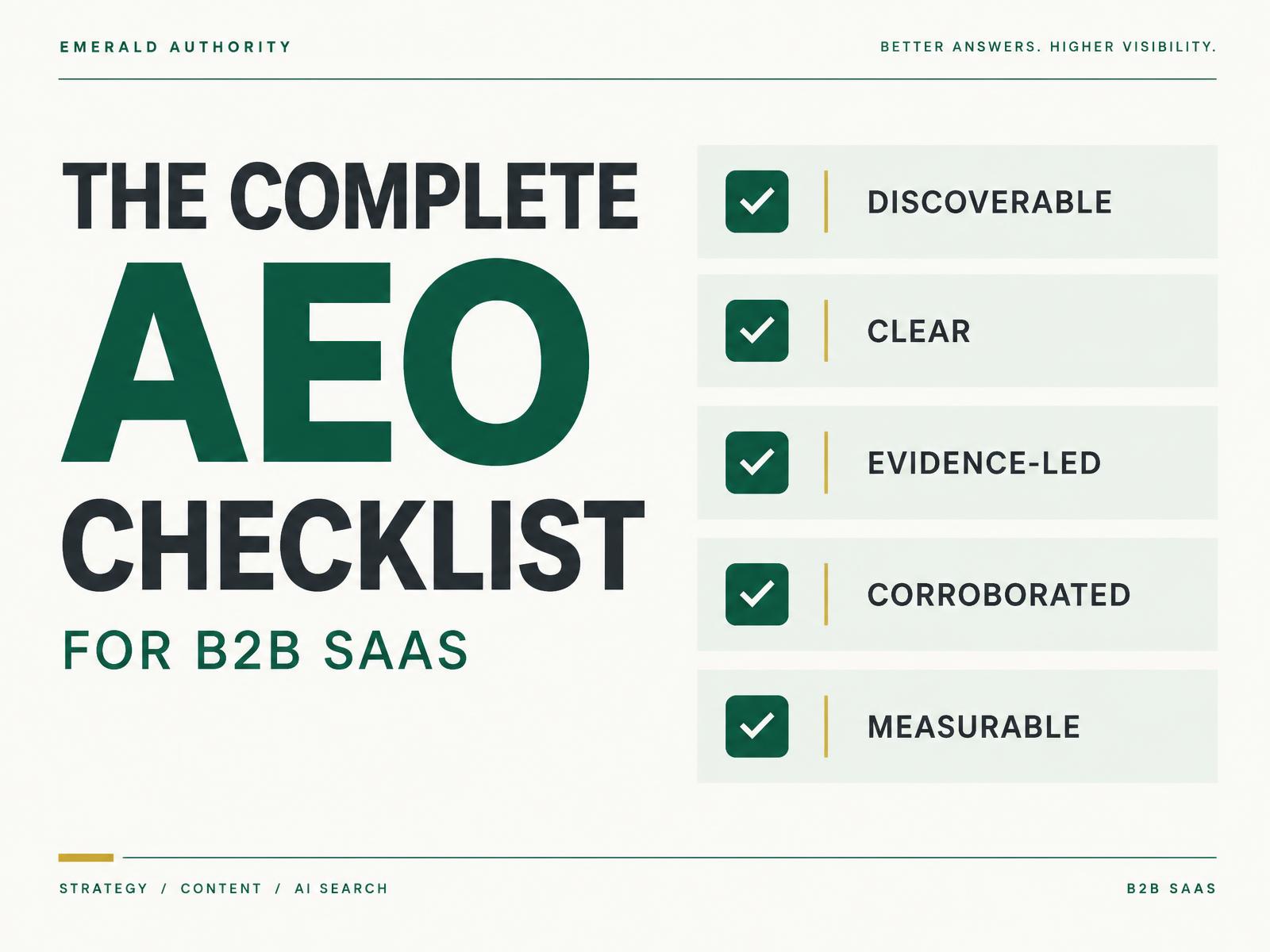
Answer engine optimization is the work of making your company easy for AI search systems to find, understand and cite. For a B2B SaaS brand, that means more than adding schema or rewriting headings. Your pages must be accessible, your category position must be clear, and your claims must have evidence beyond your own website.
Use this checklist on category, comparison, use-case and product pages. A page does not need every item, but your wider content system does.
Why Your Competitor Appears in ChatGPT and You Don't
Usually, the competitor has cleared more retrieval and trust checks. Its page may be crawlable while yours is blocked. Its positioning may be repeated consistently across its website, review profiles and customer stories. Or it may answer the buyer's exact comparison question with evidence that is easier to verify.
OpenAI says any public website can appear in ChatGPT Search, but OAI-SearchBot must be allowed for content to appear in summaries and citations. OpenAI treats that separately from GPTBot, which controls potential training use 1.
Visibility is not guaranteed after fixing access. It simply means you are eligible to compete.
The complete AEO checklist
1. Make every important page discoverable
- Return a clean 200 status and remove accidental
noindextags. - Allow Googlebot, Bingbot, OAI-SearchBot and PerplexityBot unless you deliberately want to opt out.
- Include the page in your XML sitemap and link to it from another relevant page.
- Keep the core answer visible without a login, pop-up or client-side interaction.
Google says AI Overviews and AI Mode use its existing search index and ranking systems. There is no separate technical shortcut for inclusion 2.
2. State the entity and answer clearly
- Use one consistent company, product and category name across the site.
- In the opening paragraph, say who the product serves, what problem it solves and how it is different.
- Give each page one primary buyer question.
- Make each heading descriptive, then answer it in the first one or two sentences.
Clarity is not keyword repetition. It is reducing the effort required to connect your brand with a specific problem and audience.
3. Add evidence worth citing
- Replace “best-in-class” claims with named outcomes, dates and methods.
- Add original benchmarks, anonymised product data, customer results or implementation detail.
- Cite primary sources for external facts.
- State limitations and trade-offs instead of hiding them.
An assistant can paraphrase generic advice from hundreds of pages. Original evidence gives it a reason to select yours.
4. Cover the whole buying question
- Answer fit, pricing logic, integrations, implementation, security, alternatives and proof.
- Use comparison tables where they genuinely simplify a decision.
- Link the main answer to supporting case studies, documentation and relevant product pages.
- Map likely follow-up questions before creating another article.
Google calls this query fan-out: an AI response may retrieve several related searches before composing an answer 3. The practical method is covered in my AI Overview query fan-out playbook.
5. Build independent corroboration
- Keep category descriptions consistent on LinkedIn, partner directories and review platforms.
- Earn honest customer reviews and detailed case studies.
- Contribute useful expertise to publications, podcasts and communities your buyers trust.
- Correct outdated third-party descriptions of your product.
Your website makes the claim. Independent sources help an answer engine decide whether the claim is safe to repeat. This is the central principle in the AI brand-mentions guide.
6. Use structured data as hygiene
- Match Article, Organization or Product markup to content people can see.
- Keep titles, descriptions, author details and dates accurate.
- Do not add unsupported ratings or claims.
- Do not treat schema or
llms.txtas a ranking switch.
Structured data can clarify meaning. It cannot replace a useful answer, original proof or authority.
7. Measure a stable prompt set
- Select 20 prompts across awareness, comparison and purchase intent.
- Test the same prompts monthly across ChatGPT, Claude, Perplexity and Gemini.
- Record brand presence, cited sources, competitors, wording and factual errors.
- Track AI referral traffic and assisted conversions, not citations alone.
OpenAI adds utm_source=chatgpt.com to ChatGPT Search referrals, making that traffic identifiable in analytics 1. Prompt results can vary, so measure a set over time rather than celebrating one screenshot.
A practical priority order
Start with eligibility, then clarity, evidence, corroboration and measurement. Do not publish fifty thin pages before fixing the five pages closest to revenue.
The broader AEO and GEO visibility stack explains how these layers work together. This checklist turns that strategy into a repeatable publishing standard.
AEO is not about writing for robots. It is about making a buyer's question easier to answer with information that is specific, current and safe to cite.