

How to Measure AI Visibility: The Metrics Every Marketing Team Should Track
A practical measurement framework for AI discovery: track mentions, recommendations, share of voice, position, citations, message accuracy, prompt coverage and high-intent visibility.
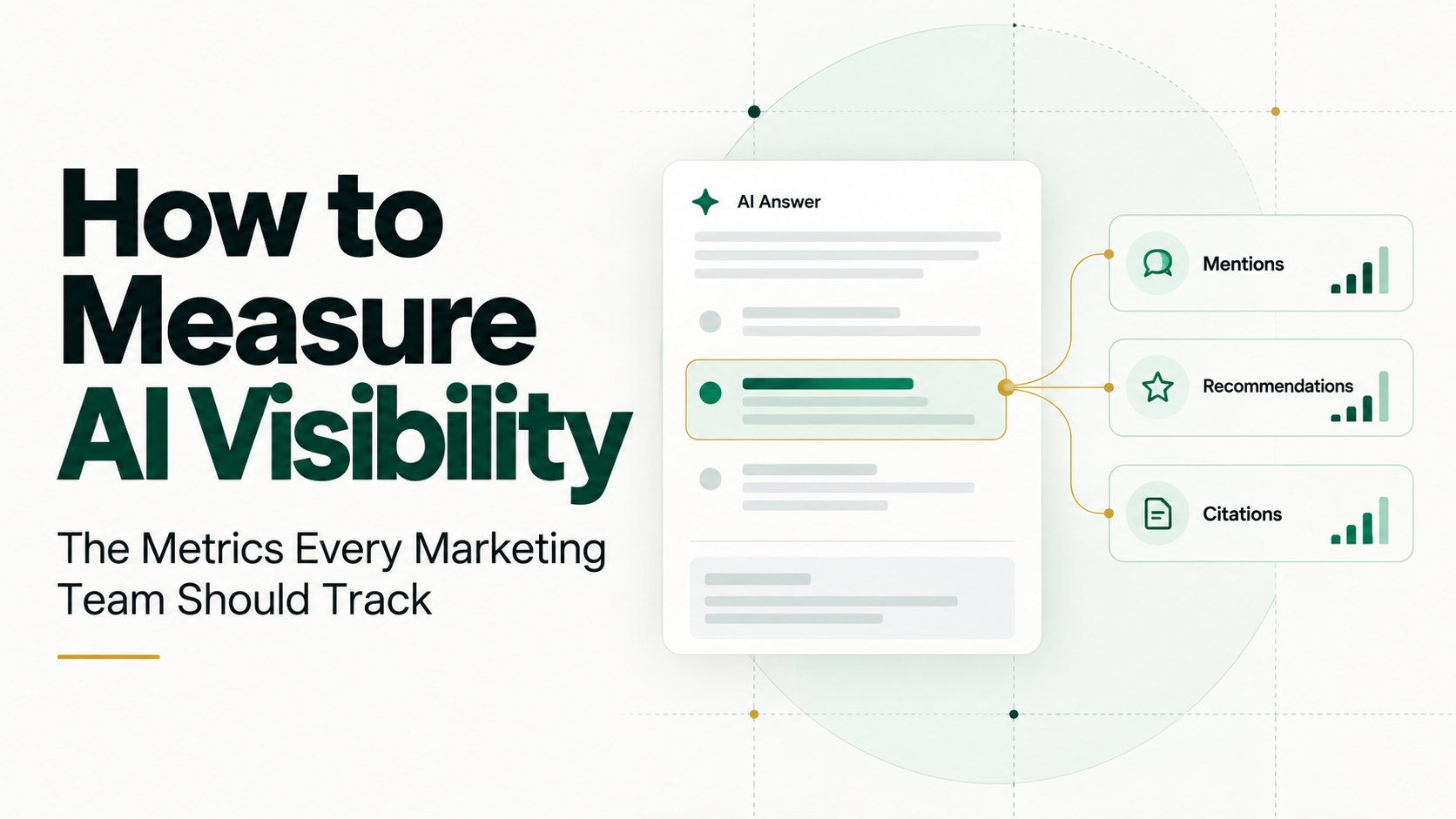
A brand can rank well on Google and still be nearly invisible inside ChatGPT, Gemini, Perplexity, Claude, or other AI-powered discovery experiences.
That is the new measurement problem for marketing teams.
For years, digital visibility was measured through familiar metrics such as keyword rankings, organic traffic, impressions, click-through rates, backlinks, and conversions.
Those metrics still matter.
But they do not answer a newer question:
When a buyer asks an AI system about your category, does your brand appear in the answer — and if it does, how is it represented?
This is where AI Visibility becomes important.
AI Visibility measures how frequently, prominently, accurately, and persuasively a brand appears across AI-generated answers relevant to its market.
The key distinction is simple:
- SEO helps improve visibility in traditional search results.
- AEO, or Answer Engine Optimization, helps structure and strengthen content so answer engines can understand, extract, and surface it.
- AI Visibility measures the actual outcome: whether AI systems mention, cite, describe, compare, or recommend your brand.
And importantly:
AI Visibility should not be treated as a vanity metric.
The goal is not simply to be mentioned more often. The goal is to understand how AI represents your brand across the buyer journey.
1. Brand Mention Rate
The most basic AI Visibility metric is Mention Rate.
It answers:
Out of all relevant prompts tested, how often does our brand appear?
The formula is straightforward:
Mention Rate = Prompts mentioning your brand ÷ Total relevant prompts
Imagine a cybersecurity company tracks 100 buyer-relevant prompts such as:
- What are the best endpoint security platforms?
- Which cybersecurity tools are suitable for mid-market companies?
- What are alternatives to CrowdStrike?
- Which security platforms work well with Microsoft environments?
If the brand appears in 38 responses, its Mention Rate is 38%.
This gives teams a baseline for overall AI discoverability.
But mention rate alone can be misleading.
A brand may appear frequently in educational prompts and remain absent when buyers ask high-intent questions.
That is why the next metrics matter.
2. Recommendation Rate
There is a major difference between being mentioned and being recommended.
Compare these two responses:
“Other platforms include Company X.”
and:
“For mid-market companies looking for quick deployment, Company X is worth considering.”
Both contain a mention.
Only one creates meaningful buyer consideration.
This is why teams should track:
Recommendation Rate = Responses actively recommending your brand ÷ Total relevant responses
Recommendation Rate is particularly useful for Product Marketing and GTM teams because it measures whether the brand is moving from awareness into consideration.
3. AI Share of Voice
Marketing teams also need to know how their visibility compares with competitors.
Suppose, across a set of relevant AI responses:
- Competitor A appears 65 times
- Competitor B appears 48 times
- Competitor C appears 32 times
- Your brand appears 26 times
That reveals something traditional SEO rankings may not.
Search engines tell you who ranks for a keyword.
AI Share of Voice helps show which brands AI systems consistently associate with a category or problem.
This becomes especially useful for competitive intelligence and positioning.
4. Average AI Position
Many AI systems respond to comparison or recommendation queries with ordered lists.
For example:
Best CRM platforms for startups
- HubSpot
- Pipedrive
- Zoho
- Freshsales
- Salesforce
Simply appearing in the answer does not tell the complete story.
Teams should therefore track Average AI Position across prompts where brands are ranked or ordered.
If your brand repeatedly appears fourth or fifth while competitors consistently appear first or second, the issue may be deeper than content volume.
It could indicate weaker category association, fewer authoritative signals, or less differentiated positioning.
5. Citation Rate
Citation Rate measures how often your owned content appears as supporting evidence in AI-generated answers.
Citation Rate = Responses citing your domain ÷ Total responses tested
This is particularly relevant for AEO.
Content such as:
- Original research
- Industry benchmarks
- Product documentation
- Comparison pages
- Proprietary data
- Expert analysis
- Customer case studies
can improve the chances of becoming a useful source for answer engines.
However, citation should not be confused with visibility.
AI systems may mention a brand without citing its website, and citation behavior differs considerably across platforms.
A better way to think about the metric is:
Citation Rate indicates how often your owned content is being surfaced as supporting evidence inside AI-generated answers.
6. Message Accuracy
One of the most overlooked AI Visibility metrics is Message Accuracy.
Being visible is not useful if the AI system describes your company incorrectly.
Marketing teams should regularly audit whether AI responses accurately represent:
- Your product category
- Core capabilities
- Target customers
- Pricing model
- Integrations
- Differentiators
- Geographic availability
- Brand positioning
Imagine an AI assistant repeatedly describes your SaaS product as “primarily built for SMBs,” while your company has spent two years moving upmarket.
Your Mention Rate may look healthy.
Your positioning is still broken.
That makes Message Accuracy one of the most important metrics for Product Marketing teams.
7. Prompt Coverage
AI Visibility should not be measured using ten generic prompts.
Prompts should map to the buyer journey.
For example, a customer engagement platform could track:
Category discovery
“What are the best customer engagement platforms?”
Problem discovery
“How can ecommerce companies reduce customer churn?”
Comparison
“Braze vs WebEngage vs CleverTap”
Alternatives
“Best alternatives to Braze”
Industry-specific evaluation
“Best customer engagement software for fintech companies”
Purchase intent
“Which customer engagement platform should a mid-market fintech company choose?”
Prompt Coverage shows where in the buyer journey the brand is visible — and where it disappears.
8. Weighted AI Visibility
Not every prompt has equal business value.
A mention for:
“What is marketing automation?”
should not be treated the same as:
“Which marketing automation platform is best for a 500-person B2B SaaS company?”
That is why mature teams should eventually track a Weighted AI Visibility Score.
For example:
- Informational prompts: weight 1
- Category evaluation prompts: weight 2
- Comparison prompts: weight 2
- High-purchase-intent prompts: weight 3
The objective is not mathematical perfection.
It is to avoid celebrating visibility that has little commercial relevance.
A Practical Example
Consider a fictional marketing automation company called AcmeFlow.
Its marketing team tracks 200 relevant prompts every month.
The dashboard shows:
- Mention Rate: 42%
- Recommendation Rate: 21%
- AI Share of Voice: 18%
- Average Position: 3.7
- Citation Rate: 12%
- High-intent Prompt Visibility: 14%
At first glance, 42% visibility looks respectable.
But there is a bigger problem.
AcmeFlow appears frequently in educational prompts, yet rarely appears when buyers ask:
- Which marketing automation platform is best for mid-market SaaS?
- Which tool is easiest to implement?
- Which platform is best for ecommerce automation?
Meanwhile, a competitor appears in only 31% of all prompts but in 38% of high-intent prompts.
The diagnosis is clear.
AcmeFlow does not have a general awareness problem.
It has a consideration-stage AI Visibility problem.
The team then analyzes AI responses and discovers competitors are more strongly associated with phrases such as:
- “enterprise-grade”
- “easy to implement”
- “best for ecommerce”
- “strong integrations”
That insight can directly influence Product Marketing.
The company can strengthen its:
- Positioning pages
- Comparison content
- Product documentation
- Customer proof
- Industry landing pages
- Original research
- Use-case content
SEO helps those assets become discoverable.
AEO helps answer engines understand and extract them.
AI Visibility metrics show whether those efforts actually change how AI systems represent the brand.
AI Visibility Is Not the Same as AI Traffic
This distinction is critical.
Traditional SEO measurement often ends with a click.
AI discovery frequently does not.
A buyer might discover your brand inside an AI-generated answer, search for it later, visit your website directly, mention it during vendor evaluation, or add it to a shortlist without ever generating a measurable AI referral click.
That means marketing teams should not judge AEO or AI Visibility initiatives only through referral traffic from ChatGPT, Perplexity, or other AI tools.
The influence may happen earlier in the buying journey.
The AI Visibility Dashboard Marketing Teams Need
A practical monthly AI Visibility dashboard should answer eight questions:
Are we mentioned?
Mention Rate
Are we recommended?
Recommendation Rate
How visible are we versus competitors?
AI Share of Voice
Where do we appear?
Average Position
Is our content being used as evidence?
Citation Rate
Are AI systems describing us correctly?
Message Accuracy
Where are we visible across the buyer journey?
Prompt Coverage
Are we visible where commercial intent is highest?
Weighted AI Visibility
Final Thought
The next generation of search visibility will not only be about whether customers can find your brand.
It will be about whether AI systems understand your brand well enough to mention it, describe it accurately, differentiate it from competitors, and recommend it when a buyer is making a decision.
That is the real value of measuring AI Visibility.
And for modern marketing teams, it is quickly becoming as important as measuring search visibility itself.