

AEO & GEO in 2026: How B2B SaaS Brands Get Cited by AI Search
Search has split in two: links on one side, AI-written answers on the other. Here is what the 2026 data shows about AI citations, the four-layer AI visibility stack, and a pragmatic 30-day start for B2B SaaS teams.
Search did not disappear this year. It split in two.
Alongside the familiar list of links, an AI system now writes the answer and decides which brands appear inside it. For B2B SaaS, that is the moment the shortlist gets built, long before anyone fills in a demo form.
Two acronyms describe the work of showing up there. AEO (Answer Engine Optimization) is about being the answer: content structured so an AI system can extract, understand and quote it. GEO (Generative Engine Optimization) is about being the brand that gets named at all, whether or not the citation links back to you. Classic SEO still does the job it always did, which is making the page eligible to be found in the first place.
What actually changed
Three shifts matter more than the rest.
Clicks are getting rarer. Research compiled across more than twenty primary studies puts zero-click searches at around 68% 3. The answer is consumed on the results page. Visibility and traffic have quietly become separate metrics.
Page-one rankings are no longer the entry ticket. Roughly two-thirds of AI Overview citations come from pages that never reached page one 3. That is genuinely good news if you are a challenger brand. A precise, well-structured page can be cited without out-ranking an incumbent.
Brand mentions now outweigh backlinks. Unlinked mentions of a brand correlate with AI visibility at roughly 0.664, ahead of traditional link signals 6, and one analysis puts mentions at about three times more predictive than backlinks 3. Where your category talks, and whether your name comes up there, is now an SEO variable.
Demand for the discipline is real, not theoretical. Semrush puts US monthly searches for "answer engine optimization" at around 4,400, with related terms such as "AEO tools" and "AEO services" adding several thousand more.
The AI visibility stack
The practical work sits in four layers. Skipping a lower one makes the ones above it decorative.
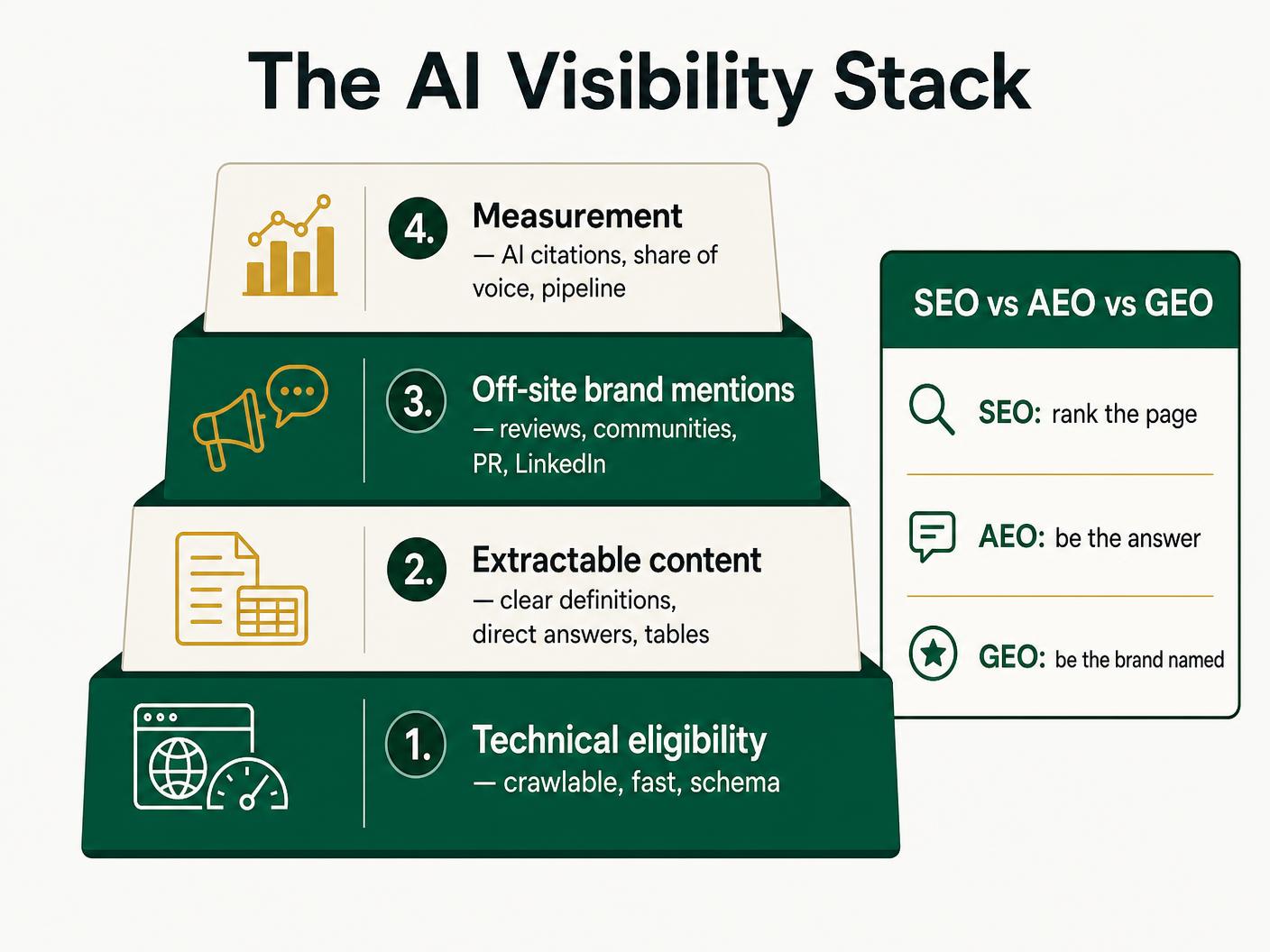
1. Technical eligibility. Crawlable, fast, server-rendered pages. Clean internal links. Schema markup so machines can classify what a page is. None of this wins a citation on its own, but its absence quietly disqualifies you.
2. Extractable content. This is where most B2B teams have the largest gap. Language models reward pages that answer directly. Lead with a one-sentence definition. Put the answer above the elaboration. Use descriptive headers phrased the way buyers ask. Add comparison tables, named numbers, and dated sources. Anything hedged across four paragraphs will be skipped in favour of a competitor who simply said it.
3. Off-site brand presence. Review sites, community threads, podcasts, analyst mentions, founder posts on LinkedIn. Models draw on the broader corpus, not just your domain. If your category discusses a problem daily and your name never appears in that conversation, no on-page change will fix it.
4. Measurement. Rankings and sessions no longer tell the whole story. Track how often you are cited across AI assistants, your share of voice on the ten to twenty prompts a real buyer would type, and which accounts arrive already familiar with you.
A pragmatic 30-day start
You do not need a platform to begin. You need a list.
- Write your prompt set. Twenty questions your ICP would genuinely ask an AI assistant. Category definitions, comparisons, "best tool for X", pricing and integration questions.
- Run them and record the answers. Note which brands are named, which sources are cited, and what the answer gets wrong about you.
- Rewrite three existing pages, do not start three new ones. Add a direct opening answer, a comparison table, and specifics only you can provide: your data, your customers' numbers, your operating detail.
- Fix one category page properly. Positioning, definition, use cases, and an honest comparison section.
- Pick two off-site surfaces where your buyers already gather, and show up consistently for the quarter.
Then re-run the same prompts monthly. Movement in that answer set is the closest thing to a ranking report AI search currently offers.
Where teams get this wrong
The most common mistake is treating AEO as a content-volume problem. Publishing thirty thin posts written to match what already ranks gives an AI system nothing new to quote. Citations reward specificity and originality, which is exactly what a summariser cannot synthesise from existing pages.
The second mistake is chasing citation counts for their own sake. A mention in an answer to a question no buyer asks is a vanity metric. Ten citations across the prompts that precede a purchase decision are worth more than a hundred elsewhere.
The goal was never to be everywhere in AI search. It is to be the named, trusted option at the moment your buyer asks the question that matters.
The bottom line
AEO and GEO are not replacements for SEO. They are the same craft, judged by a stricter reader: quality, clarity, authority and technical hygiene, now assessed by a system that will paraphrase you rather than link to you.
Be unmistakably clear about what you do. Publish things only you can say. Earn mentions where your category actually talks. Then measure whether buyers arrive already knowing your name.
That is the whole discipline. The acronyms are new. The standard is not.