

How to Rank in Google AI Overviews: A Query Fan-Out Playbook for B2B SaaS
Google can turn one buyer question into searches about fit, pricing, proof, risk and alternatives. Use the F-A-N framework to build clear, connected and evidence-rich pages that earn AI Overview citations.
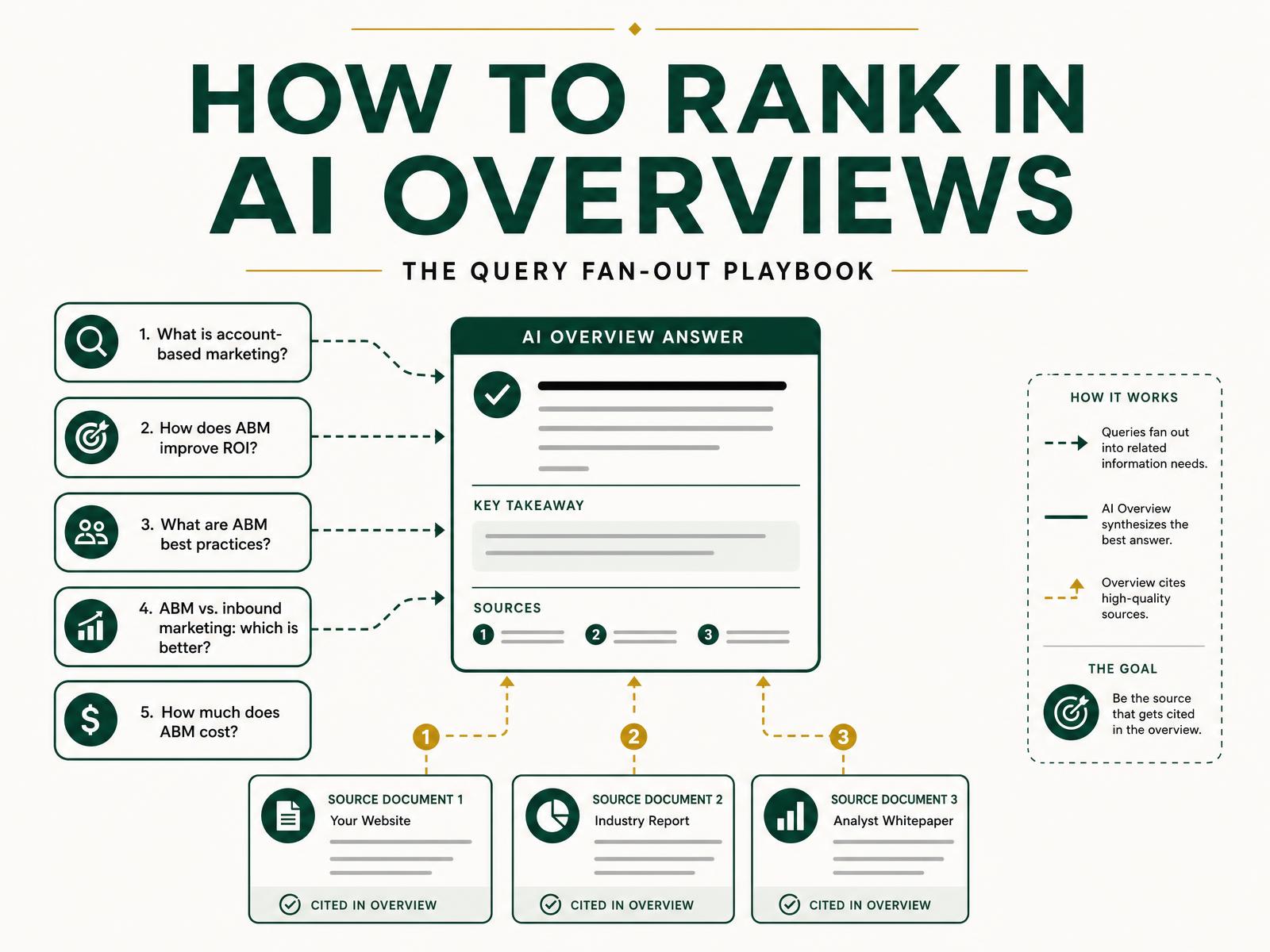
To rank in Google AI Overviews, do not optimize one page for one keyword. Build a page, or a small connected set of pages, that answers the related questions Google may generate around the original query. This is query fan-out: one buyer question becomes several searches about cost, fit, alternatives, evidence, risks and implementation.
For B2B SaaS teams, that changes content planning. The winning page is not simply the longest. It is the source that gives Google clear, specific and verifiable answers across the buyer's decision.
Why query fan-out matters
Google says AI Overviews and AI Mode can issue multiple related searches across subtopics and data sources before producing an answer 1. Its newer optimization guidance describes the same process: Search retrieves fresh pages through its core ranking systems, then uses those sources to ground a response 2.
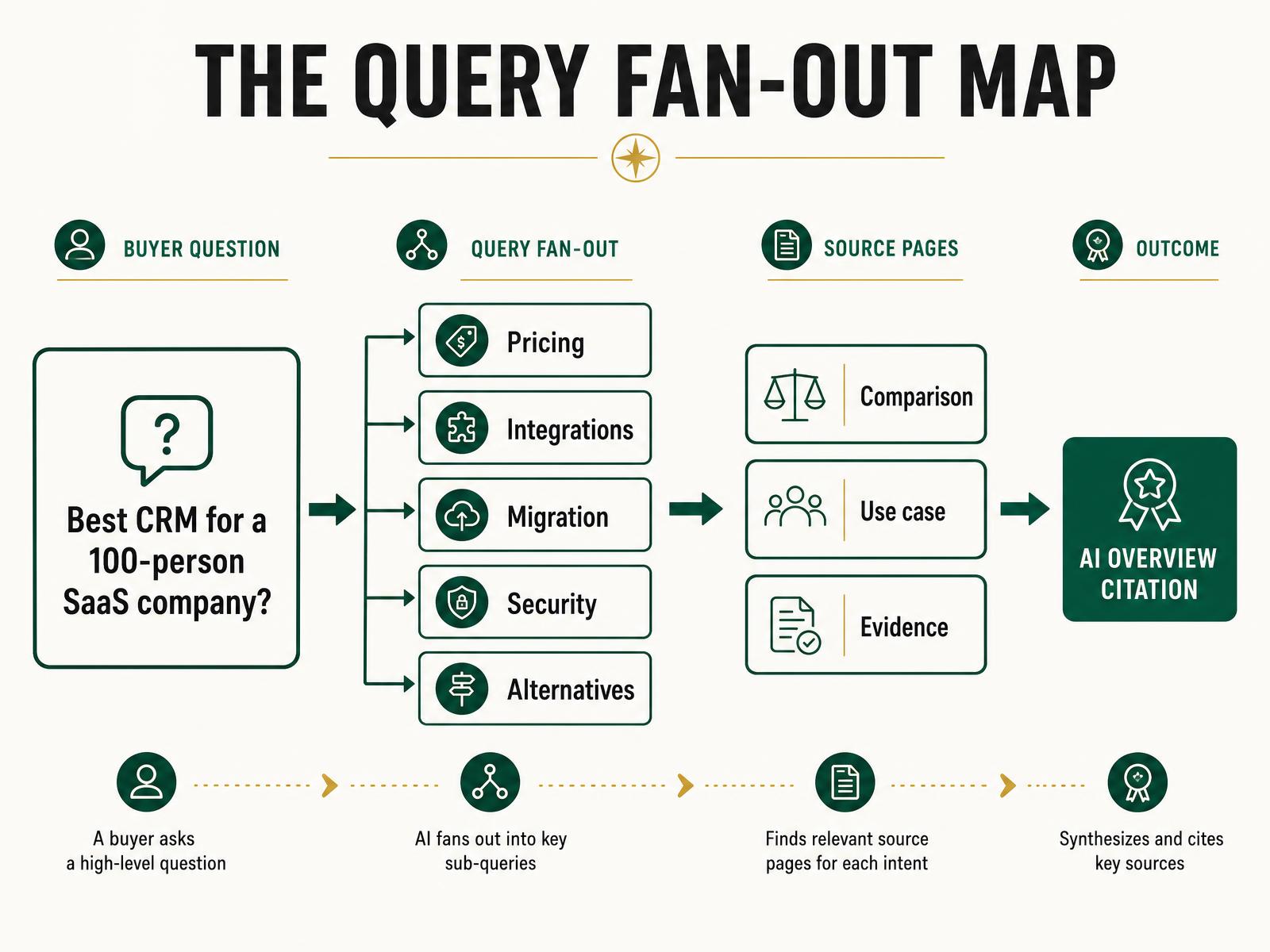
Imagine a buyer asks: “What is the best CRM for a 100-person SaaS company?”
The visible question is only the start. Google may also investigate:
- CRM pricing for 100 users
- integrations with the buyer's existing stack
- migration time and implementation risk
- security and compliance requirements
- alternatives for a specific use case
If your page answers only “best CRM”, it may be relevant to the original phrase but absent from the evidence Google gathers to complete the answer.
The F-A-N framework
Use this three-part framework before creating or refreshing a page.
F: Fan out the buyer's real question
Start with one high-intent prompt, not a broad keyword. Then write the questions a careful buyer would ask next.
Cover five branches: fit, economics, proof, risk and alternatives. For “best customer support platform for fintech”, that means company size and workflow fit, total cost, customer evidence, compliance, and comparisons.
This is not permission to stuff every variation into one article. It is a way to understand the complete decision.
A: Assign each intent to the right page
Decide whether each branch belongs on the main page or needs a supporting page.
A comparison page can answer fit and alternatives. A pricing page should explain cost drivers. An integration page should show what connects and how. A case study should supply evidence. Link them with descriptive anchor text so people and crawlers can follow the same path.
Google explicitly says there are no special technical requirements for AI features beyond sound SEO fundamentals 1. Clear site architecture still matters because retrieval begins with pages Google can discover, index and understand.
N: Nail the extractable answer
Each section should resolve one question in its first one or two sentences. Then add the proof.
Research across thousands of cited and non-cited pages found positive associations between AI citations and clarity, expertise signals, Q&A formatting, section structure and structured-data elements 3. A separate Semrush analysis of five million cited URLs found that cited pages commonly had strong technical foundations, while noting that correlation is not causation 4.
In practice, make every answer carry at least one thing a model can verify:
- a named customer result
- an original benchmark
- a dated product fact
- a transparent methodology
- a direct comparison with stated trade-offs
The answer earns relevance. The evidence earns trust.
What not to do
Do not create twenty near-identical pages. Query fan-out is a research model, not a doorway-page strategy.
Do not hide the answer beneath an introduction. Put the conclusion first, then explain it.
Do not write for a machine alone. Google's spam policies also apply to generative AI results 5. If a paragraph sounds unnatural to a buyer, it is not good AEO.
Do not mistake schema for substance. Structured data can clarify a page, but it cannot create experience, evidence or a useful point of view.
A practical two-hour workflow
- Choose one commercial question from sales calls, customer interviews or Search Console.
- Write five follow-up questions across fit, economics, proof, risk and alternatives.
- Map each answer to an existing page before commissioning anything new.
- Rewrite the weakest sections with a direct answer followed by evidence.
- Add contextual links between the main page and supporting proof.
- Test the original prompt monthly and record which sources appear.
This builds on the broader AEO and GEO visibility stack and turns the Content and AI SEO engine into a page-level operating method.
The bottom line
AI Overviews do not evaluate a keyword in isolation. They assemble an answer from a network of related questions.
Your advantage is not publishing more words. It is understanding the buyer's next question before Google asks it, placing the right answer on the right page, and supporting every important claim with evidence worth citing.
One buyer question. Five branches. A connected body of proof.