

Signal-Based GTM: How B2B SaaS Teams Replace Lists With Triggers
Outbound built on a static list works a calendar, not a market. Here is how signal-based GTM works in practice: which behavioural, contextual and relationship signals actually predict revenue, the four things that must change in your operating model, and a 30-day start that needs no new software.
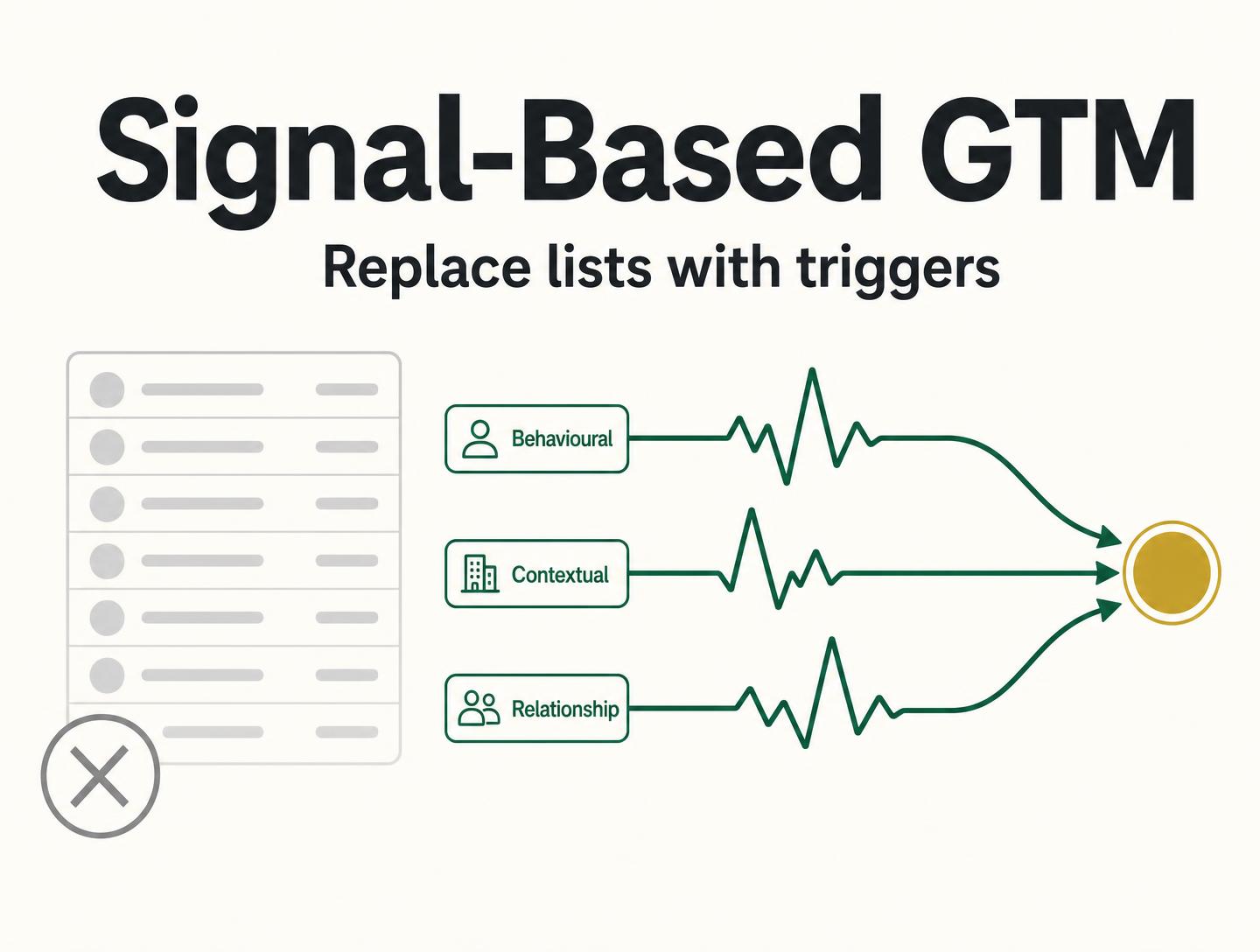
Most outbound still runs on a list. Someone exports accounts that look like the ICP, splits them between reps, and everyone works the same names in the same week, whether or not anything is happening at those companies. The activity looks healthy. The pipeline rarely follows.
Signal-based GTM inverts the input. The list stops being the trigger; an observed event becomes the trigger. An account enters the queue the moment it does something that suggests movement, and the outreach speaks to that specific thing 2.
It sounds like a tooling change. It is really a timing change, and timing is where most B2B revenue is won or lost.
Why this is the conversation in 2026
Two forces met at once.
The first is buyer behaviour. Buyers research quietly, form a shortlist, and reach out late. By the time a form is filled, the evaluation is often already underway, sometimes with a competitor who happened to arrive the week budget was approved.
The second is the inbound backlog. In a 2026 survey of more than 500 marketing leaders, the recurring complaint was not a shortage of leads but what happens after they arrive: slow response times and high-intent prospects going cold in the middle of the funnel 1.
Both problems have the same root. Teams are working a calendar instead of working events.
Worth noting on demand: Semrush puts US monthly searches for "buying signals" at roughly 480, with "signal based selling" near 90 and low estimated difficulty. Small numbers, but they are the vocabulary practitioners are actively adopting, and that is usually the early phase of a category.
The signals that actually matter
Not every signal is a signal. Some are just noise wearing a dashboard.
Practitioner accounts converge on a useful hierarchy. Isolated website visits correlate weakly with revenue. Content downloads predict conversations more than closed deals. The reliable patterns come from context and combination: a hiring spike plus category research, a new executive in a buying role, a competitor renewal window, a funding round followed by tooling changes 5 3.
Treat these as three groups:
- Behavioural — pricing page visits, documentation reads, repeat sessions from one domain, review-site research.
- Contextual — funding, hiring, leadership changes, product launches, tech-stack shifts.
- Relationship — a former champion joining a target account, an advisor on a new board, an existing user changing companies.
The last group is the most under-used and the highest converting, because it carries trust that no intent platform can manufacture.
One rule holds up across every account I have seen do this well: a single signal is a guess, three signals inside a fortnight is a reason to call.
What changes in the operating model
This is where teams underestimate the work. Buying a signal tool and pointing it at an existing cadence changes nothing except the volume of ignored alerts.
Four things have to change together.
Definitions. Write down which events count, what they mean, and how fresh they must be to matter. If two people cannot independently score the same account the same way, you have a feed, not a system.
Routing. Every signal needs a named owner and a maximum response time. A trigger with no route is a notification.
The play, not the pitch. Different signals deserve different motions. A new VP in a buying role warrants an executive introduction. A pricing page visit from an existing user warrants a product-led nudge. A competitor mention warrants a comparison, honestly written.
Governance. Once agents and automations act on signals, someone must be able to explain why any given message was sent. Audit trails are not bureaucracy here; they are how you keep automation from quietly embarrassing you at scale 2.
The competitive advantage was never the data. It is the speed and taste with which a team responds to it.
A 30-day start that does not need new software
You can prove this with a spreadsheet before you approve a budget.
- Pick five signals you can already observe: pricing page visits, new relevant hires, leadership changes, competitor mentions, and product usage crossing a threshold.
- Define the threshold. Three signals in fourteen days, one of which must be contextual.
- Write five plays, one per signal, each a short human message that references what actually happened.
- Set a response clock. Same business day for high-intent, 48 hours otherwise.
- Measure two numbers only: reply rate on signal-triggered outreach versus your list baseline, and meetings held per hundred accounts touched.
If the signal cohort does not beat the baseline within a month, your definitions are wrong, not the approach.
Where this goes wrong
Three failure patterns repeat.
Alert fatigue. Ten thousand signals with no thresholds trains the team to ignore all of them. Fewer, stricter triggers always outperform.
Creepiness. "I saw you visited our pricing page" is not personalisation, it is surveillance with a greeting. Reference the public, business-relevant event, not the browsing history.
Automation without judgement. Signals can find the moment. They cannot decide whether your product genuinely helps this company. That call stays human, and it is the part buyers remember.
The bottom line
Signal-based GTM is not a new stack. It is the discipline of acting when something happens instead of when the quarter says so.
Start with five signals, one threshold, five human plays and a clock. Measure against your current baseline. Add tooling only once the motion works manually.
Buyers do not reward the team with the largest list. They reward the team that shows up at the right moment, having clearly understood why now.