

B2B SaaS Product Launch Checklist: The R-E-A-D-Y Framework
A useful launch checklist does more than collect tasks. Use the R-E-A-D-Y framework to right-size the launch, build evidence, align teams, distribute the story, and measure adoption and revenue.
A B2B SaaS product launch checklist should do more than collect tasks. It should help a cross-functional team make five decisions: how much the launch deserves, what evidence supports the story, who must be ready, how the message will travel, and which customer behaviour will prove the launch worked.
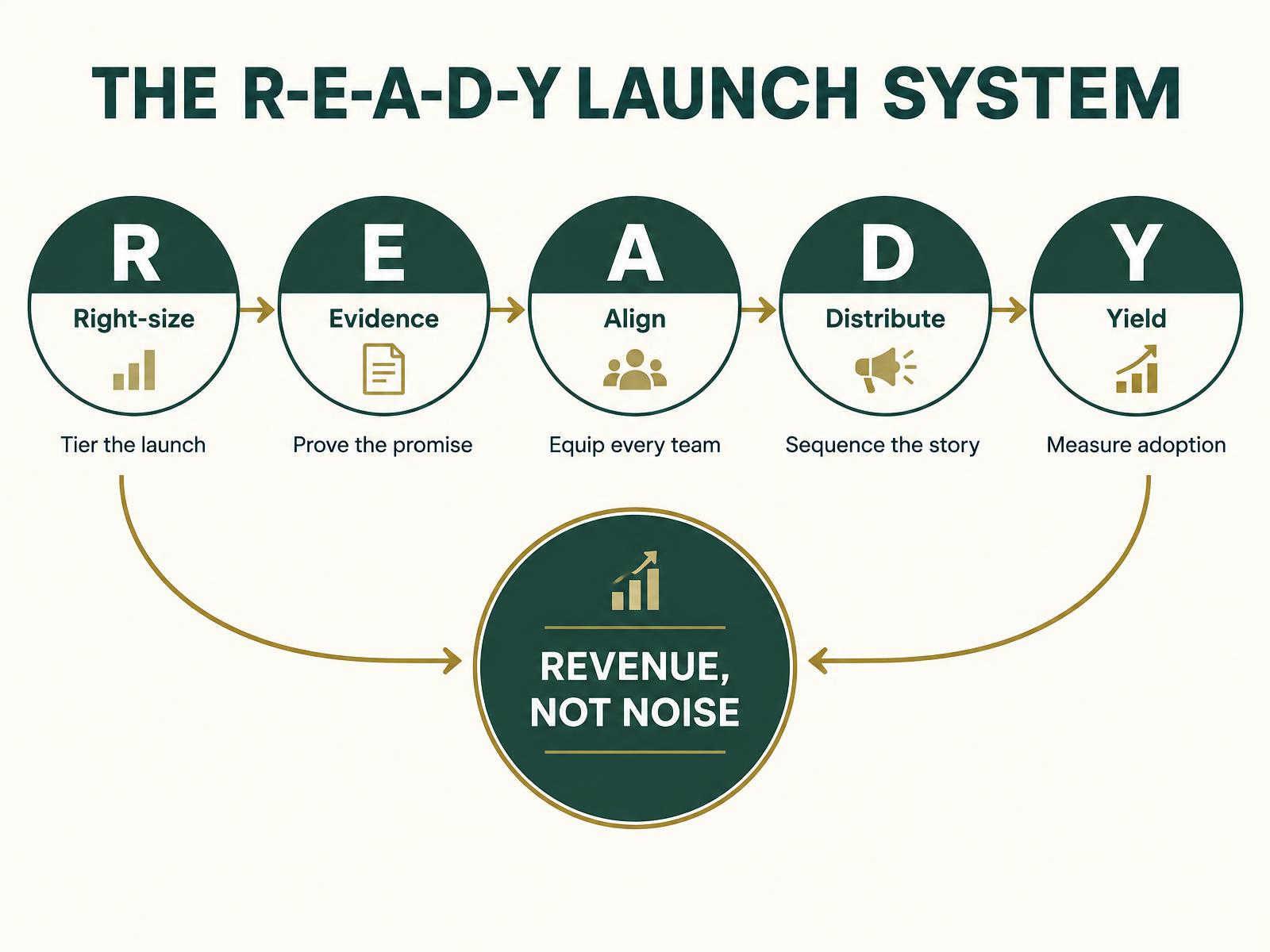
That is the R-E-A-D-Y framework: Right-size, Evidence, Align, Distribute, Yield. Use it for a new product, a major feature, or a repositioning launch without turning every release into a company-wide fire drill.
R: Right-size the launch
Not every release deserves the same budget, runway, or noise.
- Tier 1: A new product, category, or market. Build the full GTM motion.
- Tier 2: A meaningful feature or use case. Focus on the affected segment.
- Tier 3: An improvement or fix. Use release notes, in-product messaging, and targeted customer communication.
Tiering protects attention. If every update becomes a major launch, customers stop listening and teams burn out. Product Marketing Alliance also recommends assigning tasks, tracking progress, communicating across departments, and reviewing the plan continuously rather than treating the checklist as a static document 1.
Checklist: Confirm the tier, launch owner, audience, budget, target date, dependencies, and a written definition of “ready.”
E: Build evidence before the story
Messaging becomes believable when the proof exists before launch day.
Interview five to ten people in the target segment. Record the problem in their language, the workaround they use today, the trigger that creates urgency, and the cost of doing nothing. Then test the product with design partners or beta customers.
You need three kinds of evidence:
- Problem evidence: The pain is real, frequent, and expensive.
- Product evidence: The product reliably delivers the promised outcome.
- Commercial evidence: A buyer will pay, switch, or expand for that outcome.
Atlassian's checklist likewise places market research, audience definition, positioning, goals, testing, and feedback before launch execution 2.
Checklist: Approve the ICP, problem statement, positioning, pricing, proof points, customer quote, demo path, and claim substantiation.
A: Align every customer-facing team
A launch is not ready when Marketing has finished its assets. It is ready when Sales can explain the value, Customer Success can guide adoption, Support can resolve likely issues, and Product can answer what is available to whom.
Give teams one source of truth containing:
- the one-sentence positioning statement
- three value pillars with supporting proof
- eligibility, packaging, and availability
- a demo narrative and discovery questions
- objection handling and competitive context
- support documentation and escalation owners
- the launch-day decision maker and rollback plan
Run role-plays, not presentation-only training. Ask a rep to pitch the change, a CSM to explain it to an existing customer, and Support to handle the hardest expected question. Confusion in rehearsal is cheaper than confusion in market.
Checklist: Secure named approval from Product, Sales, Customer Success, Support, Legal, and Analytics.
D: Distribute the story in sequence
Launch day is a moment inside a distribution plan, not the whole plan.
Start with internal teams, then design partners and customers, followed by prospects, partners, communities, and wider market channels. Match each channel to a job:
- Email activates customers and warm demand.
- Sales outreach creates relevant conversations.
- Customer proof reduces perceived risk.
- Search content captures existing intent.
- Social and community create repeated exposure.
- In-product messages move users toward adoption.
HubSpot recommends planning promotion weeks in advance and pairing it with testing, user feedback, and clear measures of success 3.
Checklist: Finalise the landing page, announcement, customer email, in-product message, sales sequence, partner brief, tracking links, and four-week follow-through calendar.
Y: Measure yield, not launch-day noise
Reach can tell you whether the market saw the launch. It cannot tell you whether the launch created value.
Choose one primary outcome and a short chain of leading indicators. For example:
Qualified visits → demo starts → activated accounts → opportunities → revenue
For an existing-customer feature, the chain might be:
Eligible accounts → feature discovery → first use → repeated use → expansion or retention
Review results after 48 hours for technical issues, after two weeks for message and channel performance, and after six weeks for adoption and pipeline. Route each weak signal to its cause. Low traffic is usually distribution. Strong traffic with weak conversion suggests positioning or proof. Strong activation with weak retention points to product value or customer fit.
Checklist: Confirm event tracking, baseline metrics, dashboard owner, review dates, customer-feedback route, and the decision rules for iteration.
The final readiness test
Before you launch, ask five questions:
- Is the investment appropriate for the launch tier?
- Can we prove the promise we are making?
- Can every customer-facing team tell the same story?
- Does distribution continue after launch day?
- Will we know whether customers adopted and valued it?
Five clear answers mean you are ready. A hundred completed tasks do not.
For the strategy behind this checklist, use the 12-stage GTM operating system. To sharpen the audience before planning the launch, build an evidence-based B2B SaaS ICP.