

B2B Sales Enablement Strategy: Build a System Reps Actually Use
Sales enablement is not a content library. Use the F-L-O-W framework to find deal friction, link guidance to real conversations, operationalise it in seller workflows, and measure outcomes.
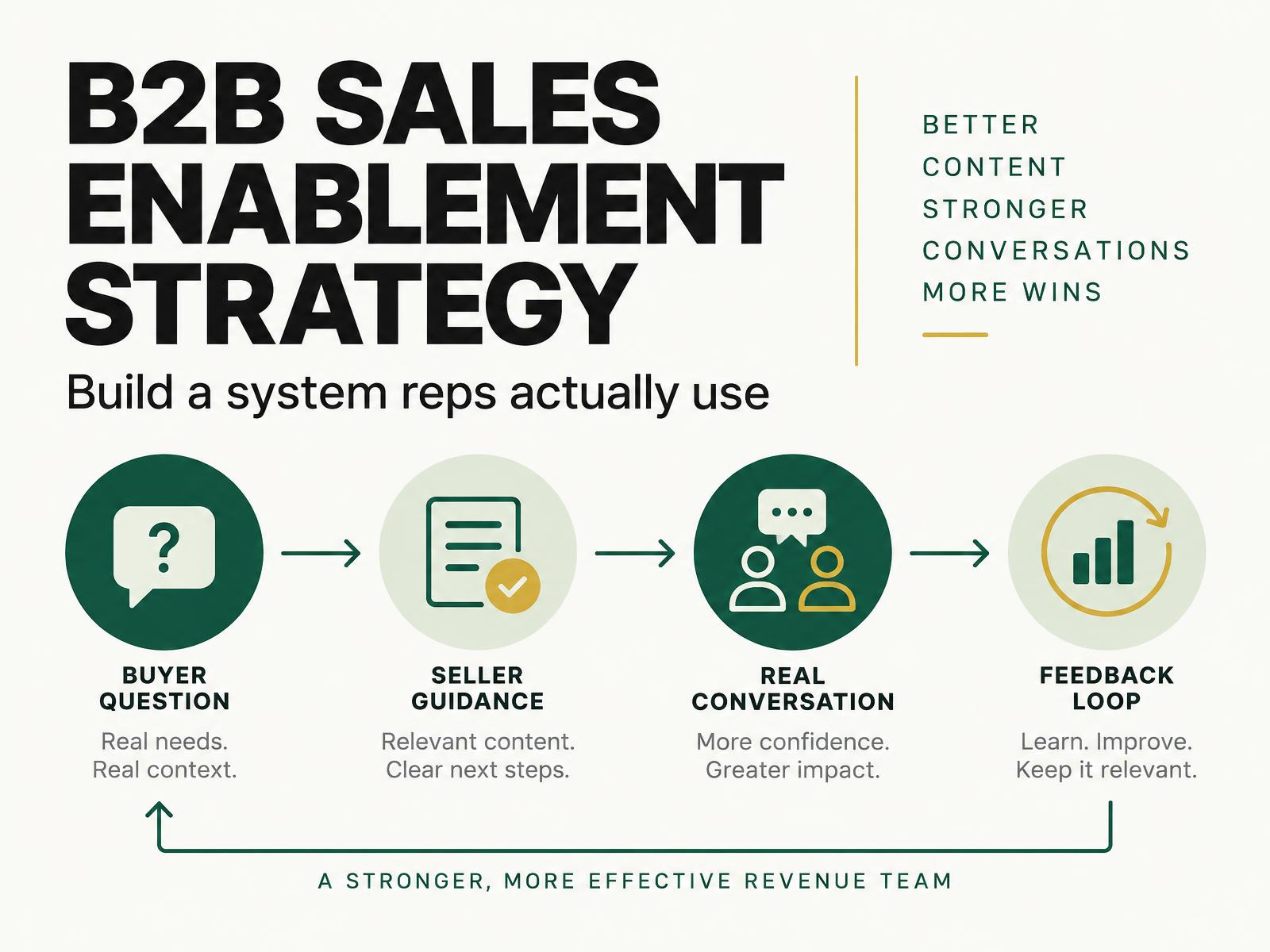
A B2B sales enablement strategy is a system for helping sellers handle real buyer conversations with the right guidance, proof, and next step. It is not a content library, a training calendar, or another tool. Those are inputs. The outcome is consistent execution inside active deals.
That distinction matters because most enablement problems are not creation problems. Teams already have decks, battlecards, case studies, and call recordings. The gap appears when a rep cannot find, trust, or apply them at the moment a buyer asks a difficult question.
Use the F-L-O-W framework to close that gap: Find the friction, Link guidance to the deal, Operationalise it in the workflow, and Watch usage and outcomes.
F: Find the friction
Start with stalled deals, not a list of assets Marketing wants to create.
Review recent call recordings, CRM notes, win-loss interviews, and manager observations. Look for moments where progress breaks: weak discovery, unclear differentiation, missing proof, an unanswered security objection, or no compelling reason to act.
Prioritise a friction point when it is frequent, commercially important, and coachable. “Reps need better messaging” is too vague. “Mid-market prospects question implementation effort after the demo, and reps answer inconsistently” is useful.
This also keeps enablement connected to the buyer. Gartner reports that many B2B buyers prefer a rep-free experience, yet buyers using self-service can experience greater purchase regret 1. The seller's value is not repeating information a buyer can find alone. It is helping the buyer interpret trade-offs and make a confident decision.
L: Link guidance to the deal
Build the smallest useful intervention for the specific moment.
For the implementation objection, that might be:
- two discovery questions that reveal complexity early
- a one-page implementation path by customer type
- a proof point from a comparable customer
- an honest explanation of the main dependency
- a clear next step with named owners
The asset is less important than the behaviour it enables. A battlecard should change how a rep handles an alternative. A case study should reduce perceived risk. A calculator should help the buying committee build an internal case.
Tie every piece of guidance to the audience, deal stage, trigger, expected seller action, and customer outcome. This is where a clear ideal customer profile prevents generic enablement.
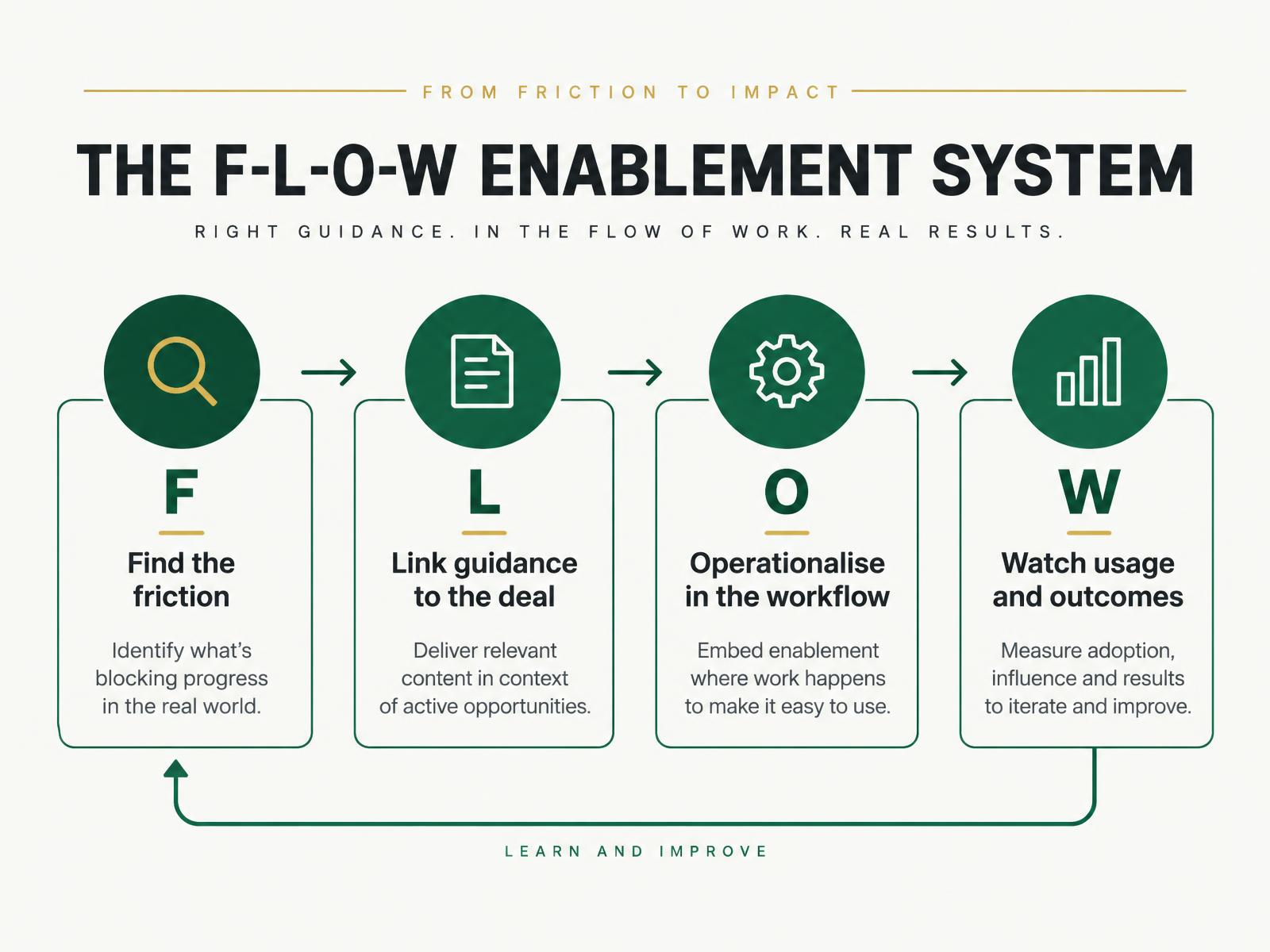
O: Operationalise it in the workflow
If enablement lives in a place reps must remember to visit, adoption will depend on memory and motivation.
Put guidance where the work happens: inside the CRM opportunity, call-preparation checklist, account brief, proposal process, or manager's deal review. Use clear ownership and expiry dates so sellers know the information is current.
Then practise the behaviour. A short role-play using a real opportunity is more valuable than a 45-minute presentation about a new deck. Managers should reinforce the same approach in deal reviews, because enablement without coaching becomes optional.
Current research supports this execution focus. One 2026 study of sales teams reported a large gap between organisations defining a process and reps consistently following it 2. Another analysis of more than 400 companies found that teams increasingly deliver guidance in the surfaces sellers already use 3.
W: Watch usage and outcomes
Downloads and training attendance show activity. They do not prove a seller changed behaviour or a buyer moved forward.
Measure the chain:
Availability → usage → behaviour → buyer response → commercial outcome
For an objection-handling play, track whether reps used it, whether call reviews show the new behaviour, whether the objection was resolved, and whether affected opportunities advanced. For a discovery guide, monitor question quality, problem clarity, qualification accuracy, and conversion to the next stage.
Review the evidence monthly. Retire unused content, improve guidance that gets used but does not change outcomes, and scale what helps buyers progress. Feed those findings back into the next friction point.
A practical 30-day start
- Choose one segment and one stage of the buying journey.
- Review ten recent opportunities, including wins, losses, and stalled deals.
- Name one repeated friction point in observable language.
- Create one intervention and test it with three sellers.
- Place it inside their existing workflow.
- Ask managers to inspect the behaviour in weekly deal reviews.
- Compare usage, buyer response, and stage movement after 30 days.
Do not begin by rebuilding the entire enablement library. Solve one expensive conversation well, prove that the intervention works, and repeat.
The broader GTM operating system shows where enablement fits across a launch. The R-E-A-D-Y launch framework helps teams prepare a shared narrative, while strong revenue operations makes the guidance measurable.
The best sales enablement strategy is not the one with the most content. It is the one sellers can use, managers can reinforce, buyers can feel, and the business can improve.