

How to Build an Ideal Customer Profile (ICP) for B2B SaaS
Most ICPs cannot disqualify a single account, which is the one job they exist to do. Here is how to build one from won revenue: the four scoring layers, the anti-ICP, and how to wire it into your CRM, target lists and reporting in a quarter.
An Ideal Customer Profile is a description of the type of company that gets the most value from your product in the shortest time, and pays you reliably for it. Not a persona. Not a wish list. A filter.
Most B2B SaaS teams already have something called an ICP. It usually lives on slide 4 of the deck and reads like "mid-market companies in North America with a modern tech stack." That sentence cannot disqualify a single account, which means it is not doing the one job an ICP exists to do.
Persona, segment, ICP: three different things
These get used interchangeably, and the confusion is expensive.
- Segment is a market slice you could sell to. Fintech. Healthcare. Series B SaaS.
- ICP is the account-level definition of which companies inside those slices you should sell to now.
- Persona is the human inside the account: the buyer, the champion, the blocker.
You target an ICP. You message a persona. Getting these backwards is why so much outbound sounds relevant to a job title and irrelevant to the business.
Start from won revenue, not from ambition
The fastest ICP work is retrospective. Pull your closed-won accounts from the last 12 to 18 months and sort them not by deal size but by three signals together: time to value, net revenue retention, and expansion. Then look at your churned and stalled accounts the same way.
You are looking for the shape of the accounts that stayed and grew, and the shape of the accounts that bought once and left. Both are useful. The second list is the one that gets ignored, and it is where the real disqualification criteria live.
If you have fewer than about 20 closed-won accounts, the pattern is not statistically interesting yet. Interview instead. Ten honest conversations with recent buyers will tell you more than a spreadsheet of 12 rows.
The four layers of a usable ICP
A profile becomes operational when it can score an account. Four layers, in this order:
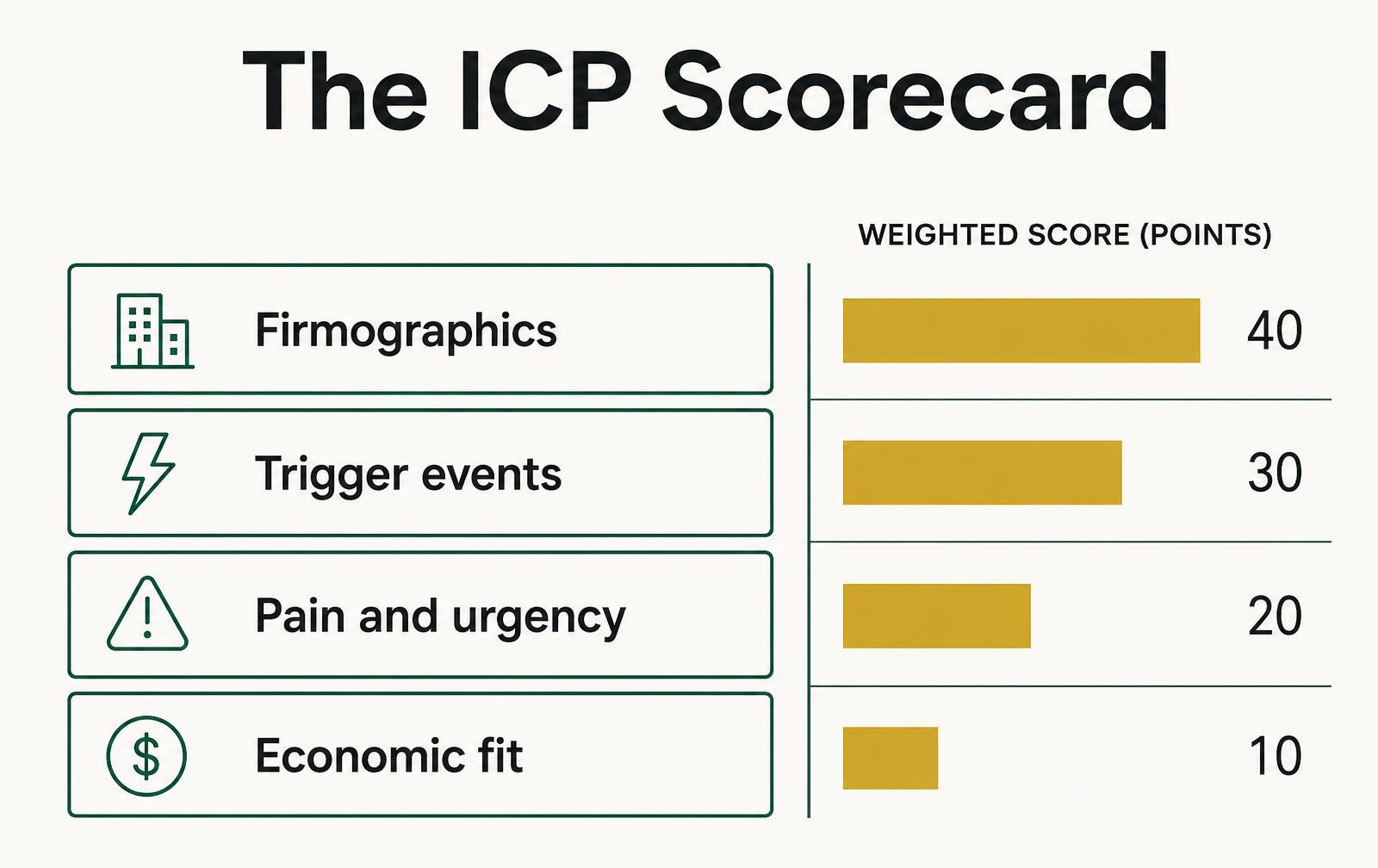
1. Firmographics. Industry, employee count, region, funding stage, technology in use. Easy to source and easy to automate, which is exactly why teams stop here. Firmographics tell you who is reachable, not who is ready.
2. Trigger events. What was happening inside the account in the 90 days before they bought? A new VP in the function you serve, a funding round, a compliance deadline, a competitor migration, a hiring spike in a specific team. Triggers are the difference between a fit account and a fit account with timing.
3. Pain and urgency. The specific, expensive problem your product removes, stated in the words the buyer uses internally. If the pain is real but tolerable, you will lose to inertia rather than to a competitor.
4. Economic fit. Can they afford the outcome, and does the value math work at your price? An account that fits perfectly and cannot fund the purchase is not an ICP account.
Weight them. In most B2B SaaS models, firmographics and triggers carry the majority of predictive weight, with pain and economic fit acting as gates rather than points.
Write the anti-ICP too
The most underrated artifact in go-to-market is the explicit list of who you do not serve. Company size below a threshold. Industries where your integration story breaks. Buyers who need a feature on the roadmap rather than in the product.
An ICP that cannot say no produces pipeline that cannot close. Sales leaders quietly know this; the anti-ICP is what makes it official and defensible in a pipeline review.
If your ICP does not reduce the number of accounts your team is allowed to chase, it is a positioning statement wearing a costume.
Make it operational in one quarter
An ICP that lives in a document decays. Wire it into systems:
- Score it in the CRM. Turn the four layers into fields and a numeric fit score. Route the top band to sellers, the middle band to nurture, the bottom band to self-serve or nowhere.
- Rebuild target lists. Filter outbound sequences by fit score, not by title alone.
- Realign content. Category pages, comparison pages and case studies should speak to the top band explicitly, including the industry and trigger language they actually search.
- Report on it. Add fit band as a dimension on win rate, sales cycle length and NRR. This is how you prove the ICP is right, or find out it is not.
Review it quarterly, rewrite it annually
Your ICP is a hypothesis with a shelf life. Products expand. Pricing changes. New competitors reset what a segment expects. Two questions each quarter are enough: did our best new accounts match the profile, and did the accounts we lost share a pattern the profile missed?
Rewrite the profile once a year with the same closed-won analysis. Most teams find their real ICP has narrowed, not widened, and that narrowing is what unlocked efficiency.
The bottom line
A good ICP does not describe the market you want. It describes the smallest set of accounts where your product wins fastest, and it gives your team permission to ignore everything else.
That permission is the product. Positioning gets sharper because you are talking to fewer, more specific people. Demand generation gets cheaper because targeting improves. Sales cycles shorten because you stopped selling to accounts that were never going to buy.
Start with the accounts that stayed. Write down what they had in common, including the uncomfortable parts. Then build the scorecard, publish the anti-ICP, and put both in the systems your team uses on a Monday morning.