

Too Many AI Tools, Zero Extra Pipeline: How to Audit Your Marketing Stack
Most teams have a subscription problem, not an AI problem. Score every tool on Pipeline, Speed and Cost, then keep, kill or consolidate before renewal.
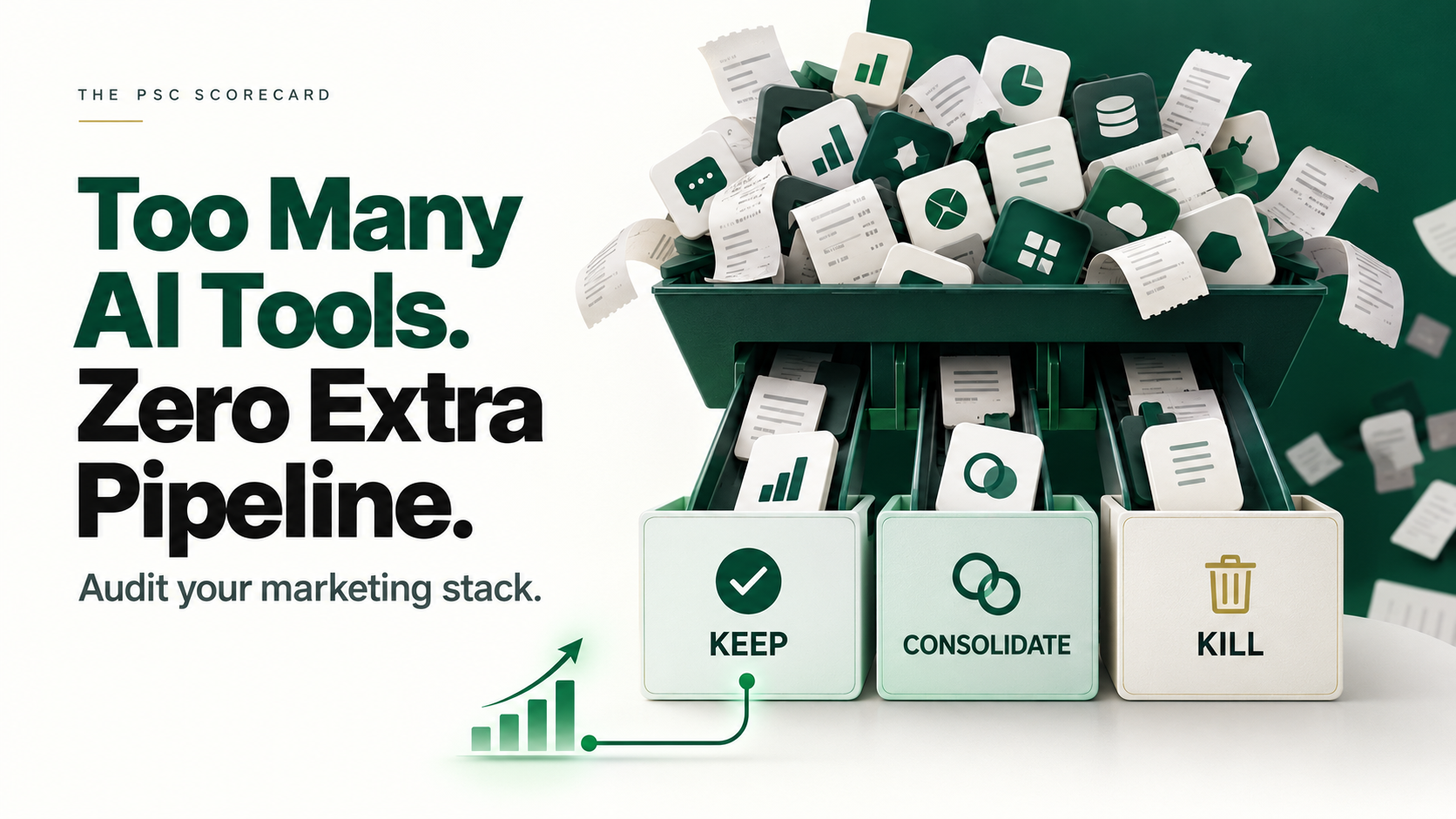
Open last month’s company card statement and count the AI tools on it. Now count the ones that added a single opportunity to your pipeline. If the second number is much smaller than the first, this post is for you.
Short answer: Most marketing teams don’t have an AI problem. They have a subscription problem. To audit your stack, list every tool from your invoices, check real usage, and score each one on a single question: did it move pipeline, speed, or cost? Then keep, kill or consolidate. Done properly, the audit fits inside one quarter and pays for itself at the next renewal.
Key takeaways
- Judge every tool on Pipeline, Speed and Cost, not on features or demos.
- Build your inventory from money (invoices and card statements), not memory.
- No named owner and no success metric means the tool gets cut.
- Reinvest part of the savings in the one program that proves revenue impact.
Why do marketing teams end up with too many AI tools?
Because AI tools are cheap to start, easy to expense, and nobody owns the decision to stop paying. The data shows the pattern clearly:
- Marketers use only 49% of their martech stack’s capabilities, according to Gartner’s 2025 Marketing Technology Survey.
- Overlapping tools were the most cited barrier to utilisation in an earlier Gartner survey, ahead of talent gaps and stack complexity.
- Zylo’s 2026 SaaS Management Index found 36% of SaaS licenses go unused, while AI-native app spend rose 108% in a year and spend through expense claims jumped 267%.
- Torii’s 2026 benchmark concluded that AI is expanding software sprawl and shadow IT, not consolidating it.
The result: a team with 15 AI subscriptions, three tools doing the same job, and no extra pipeline to show for any of it.
The 60-second sprawl test
Answer yes or no:
- Do you pay for more than one AI writing tool?
- Is there a tool nobody on the team has opened this month?
- Are AI tools being paid for on personal or team cards?
- Is there a tool with no clear owner?
- Has any tool renewed automatically without a review?
Two or more yeses: you’re paying an AI tax. Four or more: run the audit this quarter.
What is the PSC scorecard?
The PSC scorecard rates every tool from 0 to 2 on three outcomes a CFO recognises: Pipeline, Speed and Cost. Features, demos and “the team likes it” don’t count.
| Score | Pipeline | Speed | Cost |
|---|---|---|---|
| 2 | Proven lift in meetings, opportunities or revenue (holdout or clean before/after) | Cuts a revenue-critical cycle, such as launch time or speed-to-lead, by 30% or more | Replaced real spend: an agency, freelancer or another tool |
| 1 | Improves an early-funnel step, but the revenue link is unproven | Saves time, but freed hours aren’t redeployed | Cost-neutral |
| 0 | No link to pipeline | No measurable time saved | Net new cost with no offset |
Add the three scores, then apply two gates before deciding.
- Usage gate: fewer than half the paid seats active in the last 30 days.
- Owner gate: no named person accountable for the tool’s result.
| Total score | Decision |
|---|---|
| 5 to 6, passes both gates | Keep. Consider expanding it |
| 3 to 4, or a tool you already own does the same job | Consolidate into the stronger tool |
| 0 to 2, or fails either gate | Kill at the next renewal, or now if billed monthly |
Spot the five zombie tools
Most kill and consolidate decisions fall into one of five patterns:
| Zombie | How to spot it | Usual fate |
|---|---|---|
| The Demo Darling | Bought after a great demo; used for two weeks | Kill |
| The Free-Trial Fossil | Trial became a paid plan nobody remembers approving | Kill |
| The Overlap Twin | Does the same job as another tool you pay for | Consolidate |
| The Hero’s Tool | Only one person uses it, and it’s billed for five seats | Downgrade to one seat |
| The Feature in Disguise | Your CRM, design or workspace suite already does this | Consolidate |
How do you run a marketing AI stack audit?
Run it in five steps over two to three weeks.
- Inventory from money, not memory. Pull invoices, corporate card statements, expense claims and SSO logs. Shadow AI tools almost always show up on someone’s card before they show up in a tool list.
- Check real usage. For each tool, compare paid seats with users active in the last 30 days.
- Map overlaps by job. List the jobs your team does (writing, research, data enrichment, automation, design, meeting notes, analytics) and count the tools per job. Three tools for one job is a consolidation target.
- Score with PSC. Ask each tool’s owner to bring evidence for their scores. No evidence means a 0.
- Decide and act before renewal. Build a renewal calendar, cancel or downgrade 30 days before each date, and record the savings.
Calculate your AI tax in five minutes
AI tax = cost of unused seats + cost of overlapping tools + tools with no owner
- Unused seats: (paid seats − active seats) × price per seat
- Overlap: the full cost of every duplicate tool beyond the best one for each job
- No owner: the full cost of every tool nobody claims
Put that one number on the first slide of your audit. It gets attention faster than any framework.
Copy-paste: the “justify or cancel” message
Hi [Owner], we're reviewing all AI tools before renewals. For [Tool], please reply by [date] with:

1. Active users in the last 30 days
2. One example of pipeline, speed or cost impact, with a number
3. Which other tool could do the same job

If we don't hear back, we'll cancel at renewal on [date]. Thanks!
The deadline does most of the work. Tools with real value get defended quickly. The rest go quietly.
What does a good audit result look like?
Here’s an illustrative example. A 12-person B2B marketing team pays for 18 AI tools, costing ₹28 lakh a year.
| Decision | Tools | Annual saving |
|---|---|---|
| Kill: low usage, no owner, or PSC score of 0 to 2 | 7 | ₹6.5 lakh |
| Consolidate: five overlapping tools merged into two | 5 → 2 | ₹5 lakh |
| Keep: PSC score of 5 to 6 | 6 | — |
| Total | 18 → 8 | ₹11.5 lakh (41%) |
The team then moves half the savings into the one program with proven pipeline impact. That shift is what changes the conversation with finance: marketing stops asking for more budget and starts showing returns on the budget it already has.
These figures are hypothetical. Your own invoices will tell the real story.
What should marketing heads do differently?
- One job, one tool. If two tools do the same job, one of them is a cost, not a capability.
- No owner, no tool. Every subscription needs a person whose name is on its result.
- Write the success metric before you buy. A one-line pilot charter: “This tool will cut content turnaround from 5 days to 2 within 60 days.” If it doesn’t, it goes.
- Check what you already own. HubSpot, Salesforce, Canva, Google Workspace and Microsoft 365 now ship AI features. Test those before buying a point tool — and map the rest against an AI-native GTM stack.
- Pay monthly until it proves itself. Move to annual billing only after a tool earns a PSC score of 5 or more.
- Audit every quarter. Tie the audit to your renewal calendar so it becomes a habit, not a clean-up project.
- Make savings visible. Report what you cut and where you reinvested it. Nothing builds trust with a CFO faster.
For the wider operating model behind these rules, see the marketing leader’s playbook for the AI era.
FAQ
How often should you audit your marketing AI tools? Every quarter, timed 30 days before your biggest renewals.
What if a tool saves time but doesn’t affect pipeline? It can still score on Speed or Cost. If the hours it saves aren’t redeployed into revenue work, it scores 1 at most and becomes a consolidation candidate.
Who should own the audit? Marketing ops or the head of marketing, with finance in the room. Finance brings the invoices; marketing brings the evidence.
PS: The most underused AI feature in most marketing stacks is the cancel button.
PPS: Run the audit before your next AI purchase, not after. It’s much easier to say no to tool number 19 when you can see what tools 1 to 18 actually delivered.