

The AI-Native GTM Stack: Tools, Agents and the 4D Framework
A practical AI GTM guide for marketers: named tools by layer, the agents worth deploying, and the 4D framework to run go-to-market in the AI era.
The short answer
An AI-native GTM stack uses AI agents to handle research, enrichment, first drafts, follow-ups and speed-to-lead calls, so humans can focus on positioning, strategy and relationships.
The rule: automate what is repetitive and low-risk. Keep human what is high-trust and high-stakes.
Why most "AI GTM" setups underperform
Most teams bought tools first and designed workflows later. The result is a stack of eight subscriptions, three half-built automations and one person who understands how it all connects.
The fix is not more tools. It is a simple operating model. Here it is.
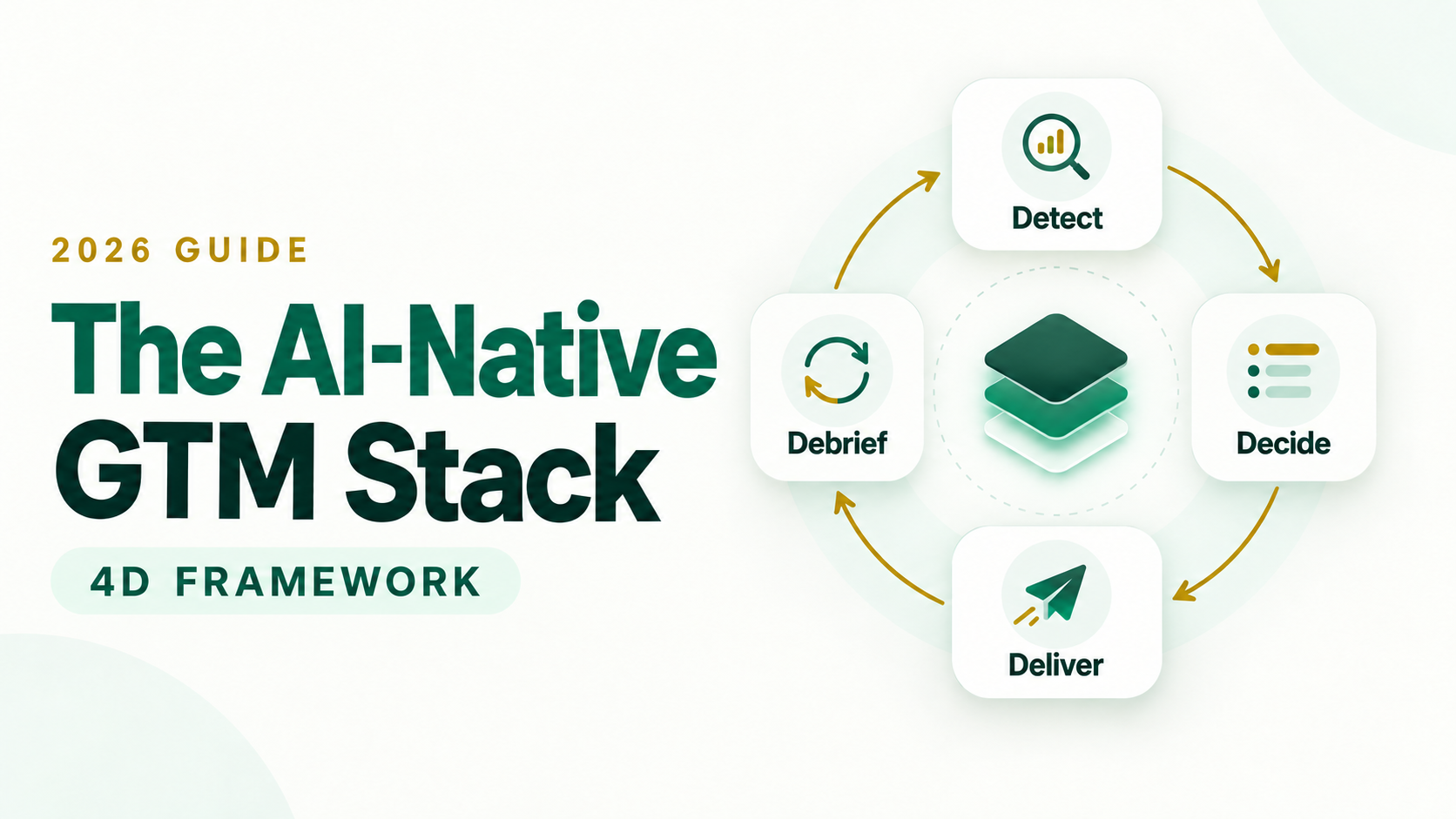
The 4D Framework: how GTM runs in the AI era
Every GTM motion, whether outbound, inbound, lifecycle or events, follows the same loop. AI-native teams design each stage deliberately.
1. Detect: find the signal
What is happening in your market right now? A funding round, a competitor price change, a target account hiring for your persona, a prospect revisiting your pricing page.
- Agent job: Monitor and flag.
- Tools: Clay, Apollo, ZoomInfo, Common Room, Warmly, 6sense
- Human job: Decide which signals actually matter.
2. Decide: choose who, what and when
Which accounts deserve attention? What angle? Which channel?
- Agent job: Score, segment, draft a recommendation.
- Tools: HubSpot or Salesforce (with AI scoring), Clay for enrichment logic, Claude or ChatGPT for account briefs
- Human job: Own the positioning and the final call on priority accounts.
3. Deliver: execute at speed
Send the message, make the call, publish the content, book the meeting.
- Agent job: Draft, personalize, send, call, follow up.
- Tools: Instantly, Smartlead or Lemlist for outbound; ElevenLabs, Vapi or Retell for voice agents; Zapier, n8n or Make to connect everything
- Human job: Approve anything public-facing or high-stakes.
4. Debrief: learn and feed it back
What worked? What did buyers actually say? What should change next week?
- Agent job: Summarize calls, tag objections, report results.
- Tools: Gong, Fireflies or Otter for call intelligence; HockeyStack or Dreamdata for attribution; Looker Studio for dashboards
- Human job: Turn patterns into positioning and messaging changes.
The magic is the loop. Debrief feeds Detect. Your objections become your messaging, your messaging improves your outreach, and your outreach generates better signals.
The Autonomy Ladder: how much to hand to agents
Do not jump straight to full automation. Rate each workflow on this ladder:
- Level 1, Assisted: AI drafts, human does everything else.
- Level 2, Approved: Agent does the work, human approves before it goes out.
- Level 3, Monitored: Agent runs on its own, human reviews samples and exceptions.
- Level 4, Autonomous: Agent runs end to end within strict guardrails.
Where to start: Put most workflows at Level 2. Move to Level 3 only after weeks of clean results. Keep pricing, enterprise deals and brand-critical content at Level 1 or 2 permanently.
The stack by layer
| Layer | What it does | Tool examples |
|---|---|---|
| Data | Single source of truth | HubSpot, Salesforce, Segment, Clay |
| Intelligence | Signals and insight | Common Room, 6sense, Gong, Perplexity |
| Orchestration | Triggers and handoffs | n8n, Zapier, Make |
| Execution | Agents that act | Instantly, Smartlead, ElevenLabs, Vapi, Retell, Claude, ChatGPT |
| Measurement | Proof and feedback | HockeyStack, Dreamdata, Looker Studio |
| Visibility (new) | Show up in AI answers | Ahrefs, Semrush, Profound, Otterly |
That last row matters. Buyers now ask ChatGPT, Perplexity and Google AI Overviews for vendor shortlists. If your content is not structured to be cited, you are invisible where decisions begin.
Tools change fast, so check current features and pricing before committing.
6 agents to deploy first
- Research agent: Builds an account brief before a rep opens the record.
- Enrichment and routing agent: Cleans, scores and assigns inbound leads.
- Outreach agent: Drafts messages grounded in real signals.
- Voice agents: Call and qualify new leads within minutes.
- Follow-up agent: Summarizes calls, updates the CRM, drafts next steps.
- Content agent: Turns one insight into a blog, post, email and sales snippet.
What stays human
Positioning, pricing, enterprise negotiation, customer stories, and the decision of which market to enter. Agents are excellent at doing. They are poor at deciding what is worth doing. That gap is your job.
Your 30-day plan
- Week 1: Pick one workflow your team complains about. Map every step.
- Week 2: Clean the CRM fields it depends on.
- Week 3: Build a Level 2 version: one trigger, one agent, one approval.
- Week 4: Compare response time, meetings booked and hours saved against your baseline. Keep, fix or kill.
FAQ
What is an AI-native GTM stack?
A go-to-market system where AI agents execute across data, research, outreach and follow-up, while humans own strategy and relationships.
What is the 4D framework?
Detect, Decide, Deliver, Debrief: a repeating loop for running GTM with agents handling execution and humans owning judgment.
Which tools should I start with?
A CRM (HubSpot or Salesforce), Clay for enrichment, a workflow tool (n8n or Zapier), and one LLM. Add voice agents and call intelligence once the basics work.
Will AI replace marketers?
It replaces tasks, not judgment.
The takeaway
Do not ask, "Which AI tools should we buy?" Ask, "Where in the Detect, Decide, Deliver, Debrief loop are we slowest?" Fix that one stage first.
PS: The best AI GTM teams I see are not the ones with the biggest stack. They are the ones who can explain, in one sentence, what each agent is allowed to do and who checks its work.