

The Next Era Is Not AI Assisted, It Is AI Done
From drafts to finished outcomes: how AI agents change six careers, a worked cost example, a safe delegation ladder and a one-page brief to use today.
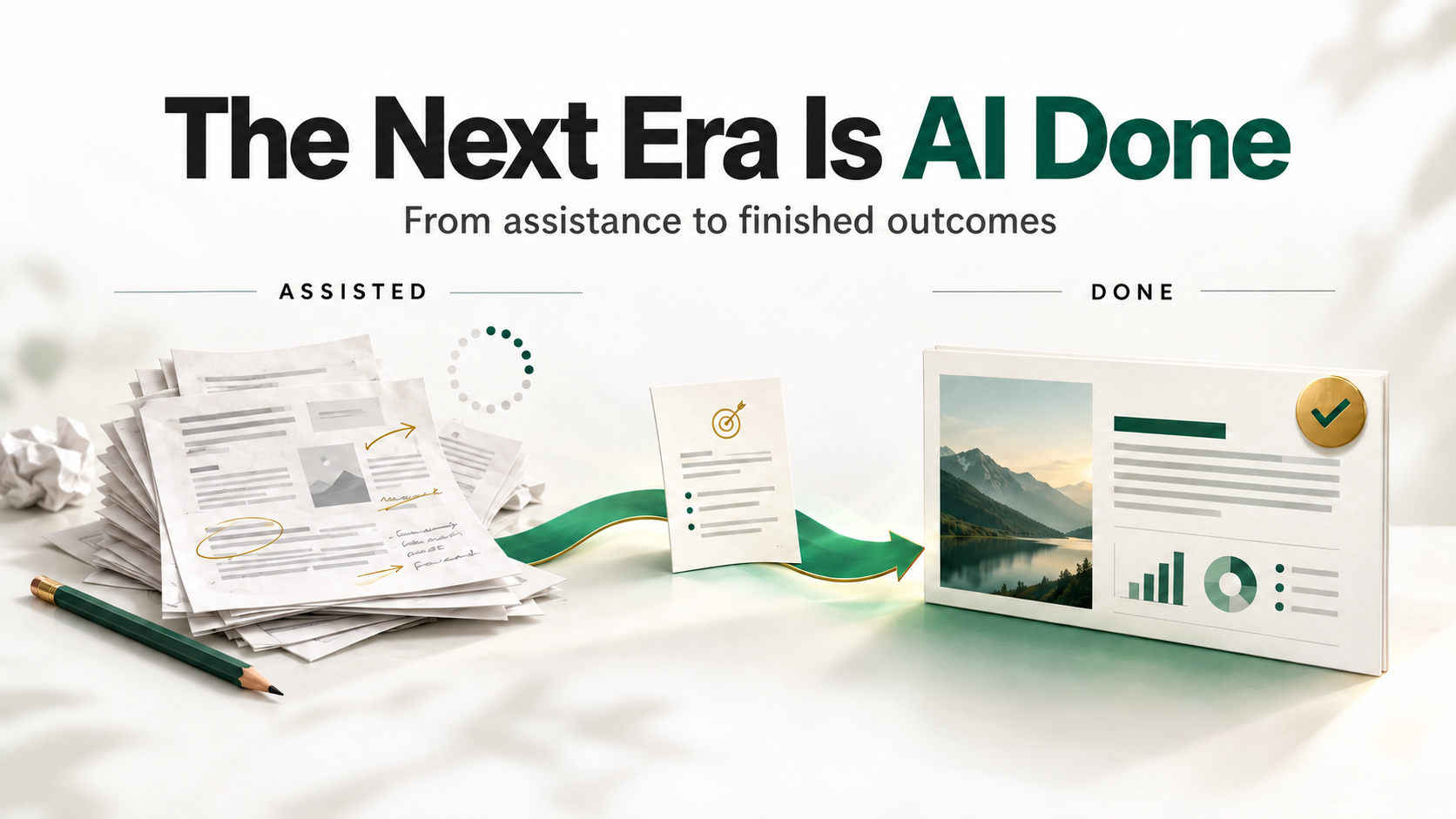
For three years we used AI like a smart intern: it suggested, we edited, we shipped. That era is ending. The next one is AI done, where you hand over an outcome and an agent returns the finished work. Most people are still optimising for the first era.
You will leave with a view of how this plays out in six careers, a worked example, a ladder for delegating safely and a one-page brief to use today.
Assisted and done are different jobs
Assisted AI makes you faster at a task you still own. Done AI owns the task. The difference is who holds the work between the request and the result.
| AI assisted | AI done | |
|---|---|---|
| You give it | A prompt | A goal and a boundary |
| It returns | A draft | A finished outcome |
| Your role | Editor, every time | Reviewer, by exception |
| Time saved | Minutes per task | Whole workflows |
| Typical tools | ChatGPT, Claude, Copilot in a chat window | Agents wired into your CRM, ads, email and support stack |
| Bottleneck | Your attention | Your clarity on what good looks like |
The last row is the one that matters. When AI only assists, the limit is how many drafts you can review. When AI finishes the job, the limit is how well you defined it.
What "done" looks like across careers
The pattern is the same in every field: the agent takes the repeatable middle, and the human keeps the judgment.
| Career | Assisted | Done | Human still owns |
|---|---|---|---|
| Marketing | AI drafts a blog | A workflow briefs, drafts, fact-checks and schedules the post | Positioning, final approval |
| Sales | AI writes a cold email | An agent researches the account, follows up and books the meeting | Discovery calls, negotiation |
| Customer support | AI suggests a reply | An agent resolves the ticket end to end | Angry or high-value customers |
| Finance | AI explains a variance | An agent reconciles invoices and drafts the month-end summary | Sign-off, judgment calls |
| HR and recruiting | AI rewrites a job post | An agent screens resumes and schedules interviews | Hiring decisions, offers |
| Software engineering | AI completes a line of code | An agent takes a ticket, writes the fix, runs tests and opens a pull request | Architecture, code review |
One task, three setups: a worked example
Take a support team with 1,000 routine tickets a month. Illustrative assumptions: 8 minutes of human time per ticket, ₹400 an hour, ₹5,000 a month for an AI drafting tool, ₹10,000 a month for an agent platform, and an agent that fully resolves 70% of tickets.
| Setup | Human hours a month | Cost per ticket |
|---|---|---|
| Manual | 133 | ₹53 |
| AI assisted (drafts cut handling to 5 min) | 83 | ₹38 |
| AI done (agent resolves 70%, humans take 30%) | 40 | ₹26 |
The saving per ticket is modest. The bigger prize is the 93 hours you get back versus manual. Spend them on the 30% of tickets that need a person and on customers about to leave. That is where done turns into revenue, not just savings.
The money moves from seats to outcomes
Assisted AI is sold per seat. Done AI is priced per outcome: a resolved ticket, a qualified meeting, a published asset. That makes measurement simpler, since you compare cost per outcome before and after, and it makes scale less linear, because an agent's cost per unit barely rises with volume.
A test for any workflow: cost per outcome = (people hours × hourly cost + tool cost) ÷ outcomes per month. If an agent can match the outcome at a fraction of that, it is a candidate for done.
The delegation ladder: how to move a task from assisted to done
Don't hand an agent your whole job. Climb one rung at a time, per task.
- Assist. AI drafts, you do everything else. Track the edit rate: how much of the draft you change.
- Co-pilot. AI does the full task, you approve every output. Log what you reject and why.
- Supervised. AI ships on its own for low-risk cases. You review a sample, say 1 in 10, and every flagged exception.
- Done. AI owns the task. You review a weekly scorecard: volume, quality, cost per outcome, errors.
Move up a rung only when the last one is stable for two to four weeks. Move down the moment quality drops.
Write the brief once. This one page is the new skill, and it is where product marketers have an edge. Copy it:
Goal: [the outcome, with a number]
Good looks like: [3 great examples, 1 bad one]
Data it may use: [systems and documents]
Actions it may take: [send, update, refund up to X]
Stop and ask when: [the exact triggers]
Report: [what I want to see every week]
Where humans stay in the loop
Done does not mean unsupervised. Keep a person on money and legal calls, brand-sensitive moments, regulated data and anything the agent has not seen, and make "I'm unsure, escalating" an acceptable answer. Log every action the agent takes, and test its stop button.
The bottom line
In the assisted era, the winners prompted best. In the done era, the winners define outcomes best: what good looks like, what the agent may touch, and when it must stop.
Do this week:
- List five tasks you repeat every week.
- Score each on volume, rule-based-ness and cost of a mistake.
- Pick the best one and write its one-page brief.
- Run it at rung 2 of the ladder for two weeks and track the edit rate.
- Calculate cost per outcome before and after.
PS: if your job is a list of tasks, expect agents to take some of them. If your job is owning an outcome, you just got a team.