

Proving AI’s Revenue Impact: A Measurement Framework Your CFO Will Accept
CFOs don’t fund hours saved. A four-rung Proof Ladder, one ROI formula, a scale-fix-stop rule and a ready-to-send email to win finance’s trust in AI.
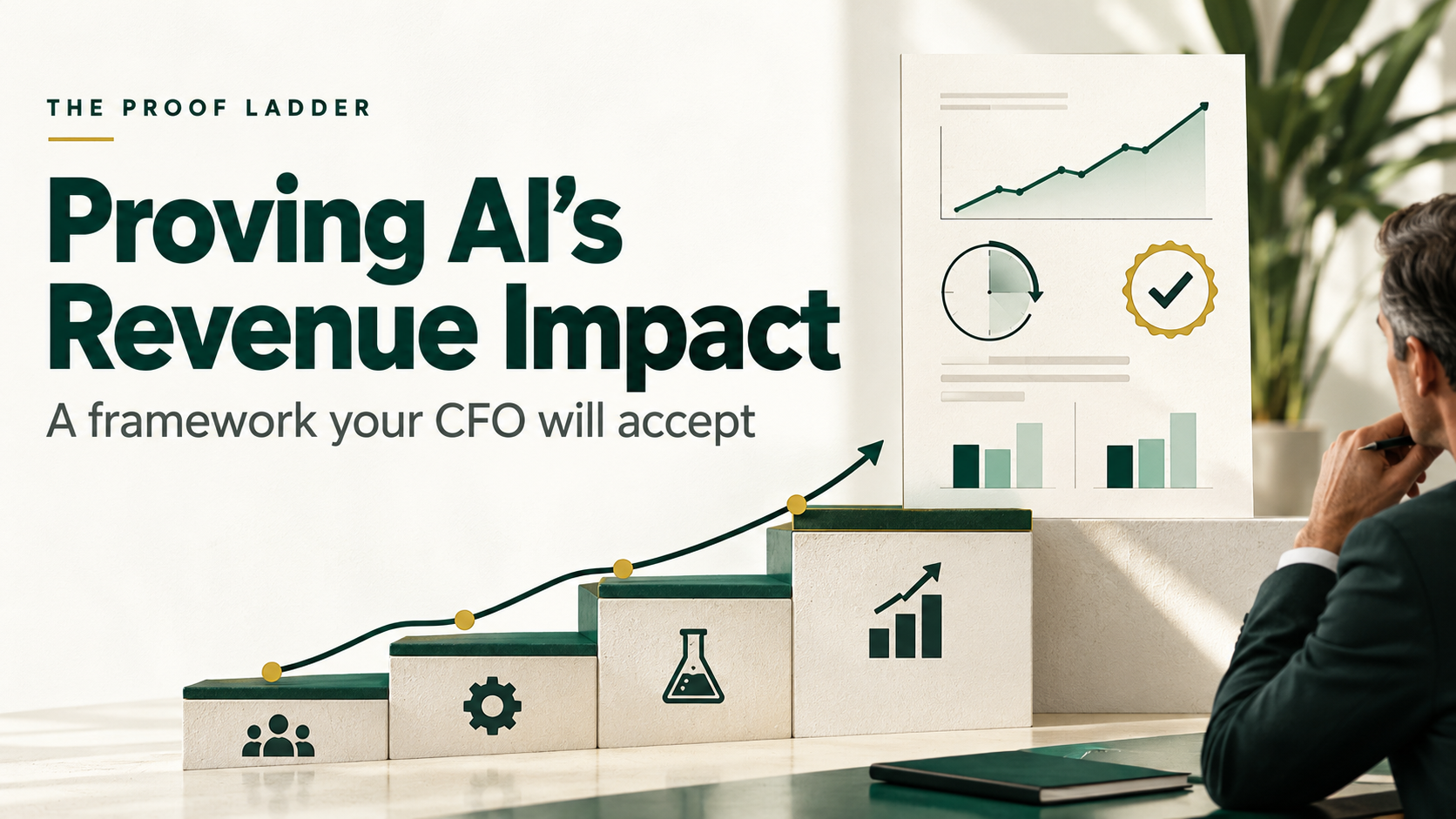
Short answer: CFOs don’t fund “hours saved” or a vendor dashboard. They fund costs that leave the P&L, revenue lift proven against a holdout group, and a clear payback period. Below you’ll find a four-rung framework, one formula, a scale-or-stop decision rule, and an email you can send to finance today.
Why your AI wins aren’t landing with finance
CFO skepticism isn’t new. In Gartner’s 2024 Marketing Analytics and Technology Survey, 40% of senior marketers named the CFO as the person most skeptical of marketing’s value. AI has raised the bar further: Coupa’s 2026 Strategic CFO Report, based on a survey of 600 finance leaders, found that 76% say difficulty quantifying AI ROI is holding back further AI investment. On the marketing side, nearly two-thirds of leaders in the CMO Insights Report 2026 say ROI pressure has risen sharply.
Three things kill most AI-in-marketing decks:
- Hours saved aren’t money. Unless agency spend, freelance budget or a planned hire actually changes, finance sees zero.
- Attribution double-counts. The AI email tool, the intent platform and the SDR all claim the same deal. Attribution spreads credit; it doesn’t prove cause.
- There’s no baseline. “Pipeline up 30%” means nothing without what would have happened anyway.
The Proof Ladder
Every AI claim sits on one of four rungs. The higher the rung, the more a CFO trusts it.
| Rung | What you prove | Metric | CFO confidence |
|---|---|---|---|
| 1. Activity | AI is being used | Outputs, adoption | None. Keep it internal |
| 2. Efficiency | Work got cheaper or faster | Cost per asset, speed-to-lead | Medium, only in rupees |
| 3. Lift | AI caused more conversions | Conversion rate vs. holdout | High |
| 4. Economics | It pays back | Incremental gross profit, ROI, payback | Highest |
The rule: never show rung 1 to finance. Lead with rung 4 and use rung 3 as the evidence.
Rung 2: Turn efficiency into money
Count only savings that hit a budget line: a smaller agency retainer, freelance spend avoided, a hire you didn’t need, outsourced calling you cancelled. Speed counts only when it’s tied to conversion. If voice agents call inbound leads within two minutes, show meeting rate by response-time bucket, not just the response time.
Rung 3: Prove lift with a holdout
- Pick one AI program: AI-personalised outbound, voice agent lead qualification, or AI-scored nurture.
- Hold out 10 to 20% of eligible accounts at random. Randomise at account level, because one account gets touched by email, SDRs and ads.
- Freeze everything else. Directive Consulting flags mid-test changes to budgets, targeting or creative as a common reason results become unusable.
- Run for a full sales cycle. Hyros notes that a 60-day B2B cycle needs a 60-day test. Cometly adds that tracking only form fills measures early-funnel lift, not revenue, so measure opportunities and closed-won.
- Calculate lift: (treated conversion rate − holdout rate) ÷ holdout rate.
No data science team needed: HubSpot or Salesforce can handle random assignment, and GrowthBook or PostHog can manage experiment flags.
Rung 4: The one formula
AI Marketing ROI = (Incremental gross profit + Hard costs removed − Total cost of ownership) ÷ Total cost of ownership
- Use gross profit, not revenue. Incremental closed-won revenue × gross margin. CFOs think in margin.
- Use full cost of ownership. Licences, usage and token costs, integration hours, and the human time spent reviewing AI output. Most decks forget the last two.
Payback (months) = Total cost of ownership ÷ Monthly incremental gross profit
A worked example (illustrative numbers)
A mid-market SaaS company runs voice agent qualification on inbound leads for one quarter, with a 15% holdout.
- Treated: 1,700 leads convert to opportunity at 6.0%. Holdout: 300 leads convert at 4.5%.
- Lift: 33%. Incremental opportunities: 1,700 × 1.5% ≈ 25.
- At a 20% win rate and ₹6 lakh ACV: 5 deals, ₹30 lakh revenue, ₹22.5 lakh gross profit at 75% margin.
- Hard costs removed: ₹3 lakh in outsourced calling.
- Total cost of ownership: ₹8 lakh (₹5L licence and usage, ₹2L setup, ₹1L review time).
- ROI: (22.5 + 3 − 8) ÷ 8 = 219%. Payback: under one month of incremental gross profit.
These figures are hypothetical. Swap in your own.
The decision rule: scale, fix or stop
A number only earns budget when everyone knows in advance what it triggers. Agree these thresholds with finance before the test, adjusted to your margins and cash position:
| Result | Decision |
|---|---|
| Positive holdout lift, ROI above 100%, payback under 6 months | Scale: raise budget or expand to the next segment |
| Positive lift, payback of 6 to 12 months | Fix: cut cost of ownership or narrow targeting, then retest for one cycle |
| No measurable lift, or payback above 12 months | Stop: cancel and redeploy the budget |
These are suggested starting points, not industry benchmarks.
Send this to your CFO before you launch
Hi [Name], before we scale [AI program], I'd like us to agree on how we'll judge it.

- Metric: incremental closed-won gross profit vs. a [15]% random holdout
- Window: [90] days, one full sales cycle
- Cost: full cost of ownership, including licences, usage, setup and review time
- Scale if: ROI above [100]% and payback under [6] months
- Stop if: no measurable lift by [date]

If this works for you, I'll share the scorecard on [date].
This one email turns a budget defence into a shared experiment. When finance helps set the rules up front, they rarely dispute the result.
The one-page CFO scorecard
| AI program | Incremental pipeline | Incremental gross profit | Hard costs removed | Total cost | ROI | Payback | Evidence |
|---|---|---|---|---|---|---|---|
| Voice agent qualification | Holdout | ||||||
| AI outbound personalisation | Pre/post | ||||||
| AI content production | Estimate |
The Evidence column does the heavy lifting. Labelling each number as holdout, pre/post or estimate shows finance you know the difference — and that buys more trust than a bigger number.
Your 30-day start
- Week 1: List every AI program. Cut any without a revenue hypothesis.
- Week 2: Send the email above. Build the baseline and cost of ownership with finance.
- Week 3: Launch a holdout on your largest program.
- Week 4: Share the scorecard with rung 2 numbers while the test runs.
FAQ
What if my volume is too low for a holdout? Compare against a matched earlier period, or hold out one region. Label the result medium confidence on the scorecard.
PS: The fastest way to win over a CFO isn’t a bigger number. It’s a smaller number with an honest confidence label next to it.
Sources
- Gartner via EMARKETER: CFOs are the most skeptical of marketing’s value
- Coupa: The Strategic CFO Report 2026 and press release
- CMO Alliance: CMO Insights Report 2026
- Directive Consulting: Incrementality testing guide
- Hyros: Incrementality testing
- Cometly: Understanding incrementality testing for B2B SaaS