

How I’d Build a 2027 Marketing Plan When Half the Work Is Done by AI
Six steps and five frameworks — the AAO split, the Seat Test, the Rupee Audit, a 70/20/10 budget and four quarterly beats — plus a one-page plan to copy.
TL;DR
- Budgets are flat at 7.8% of revenue. Every AI rupee has to come from somewhere.
- Plan the work before the headcount: sort tasks with the AAO split, then run every seat through the Seat Test.
- An agent’s real cost is its licence plus the human review time. Most plans forget the second part.
- Prune with the Rupee Audit, pour the savings into proof and people, and run the year on a quarterly rhythm.
- Copy the one-page template at the end.
Picture the November planning meeting. The CFO leans back and asks one question:
“If AI does half the work now, why does marketing need the same budget?”
Most marketers answer with a slide full of tool logos. Wrong answer. The right one is a plan that shows exactly which half, who checks it, and where the freed-up money goes. (If you need the measurement side of that conversation, start with the framework your CFO will accept.)
Here’s how I’d build that plan: six steps, five frameworks, one page.
Why last year’s template breaks
- The money isn’t growing. Gartner’s 2026 CMO Spend Survey puts budgets at 7.8% of revenue, flat for three years (Gartner).
- The buyer sends a bot first. Forrester’s 2027 predictions say agentic buying will touch 75% of B2B purchases, and two-thirds of providers will lose deals because buyers can’t verify their claims (Forrester).
- The obvious move is a trap. Forrester also predicts CMOs will cut up to 25% of roles expecting AI gains that don’t arrive, then pay to rehire or bring agencies back (Forrester).
Quick check: score your current plan
Give yourself 2 points for every yes.
- Can you list which tasks AI agents already own?
- Does every agent have a named human reviewer?
- Do you know the pipeline each channel created last year?
- Could a buyer’s AI verify your top three claims?
- Does every experiment have a kill date?
- 8–10: you’re ahead.
- 4–6: you’re normal, which in 2027 means behind.
- 0–2: keep reading.
Step 1: Audit the work, not the org chart
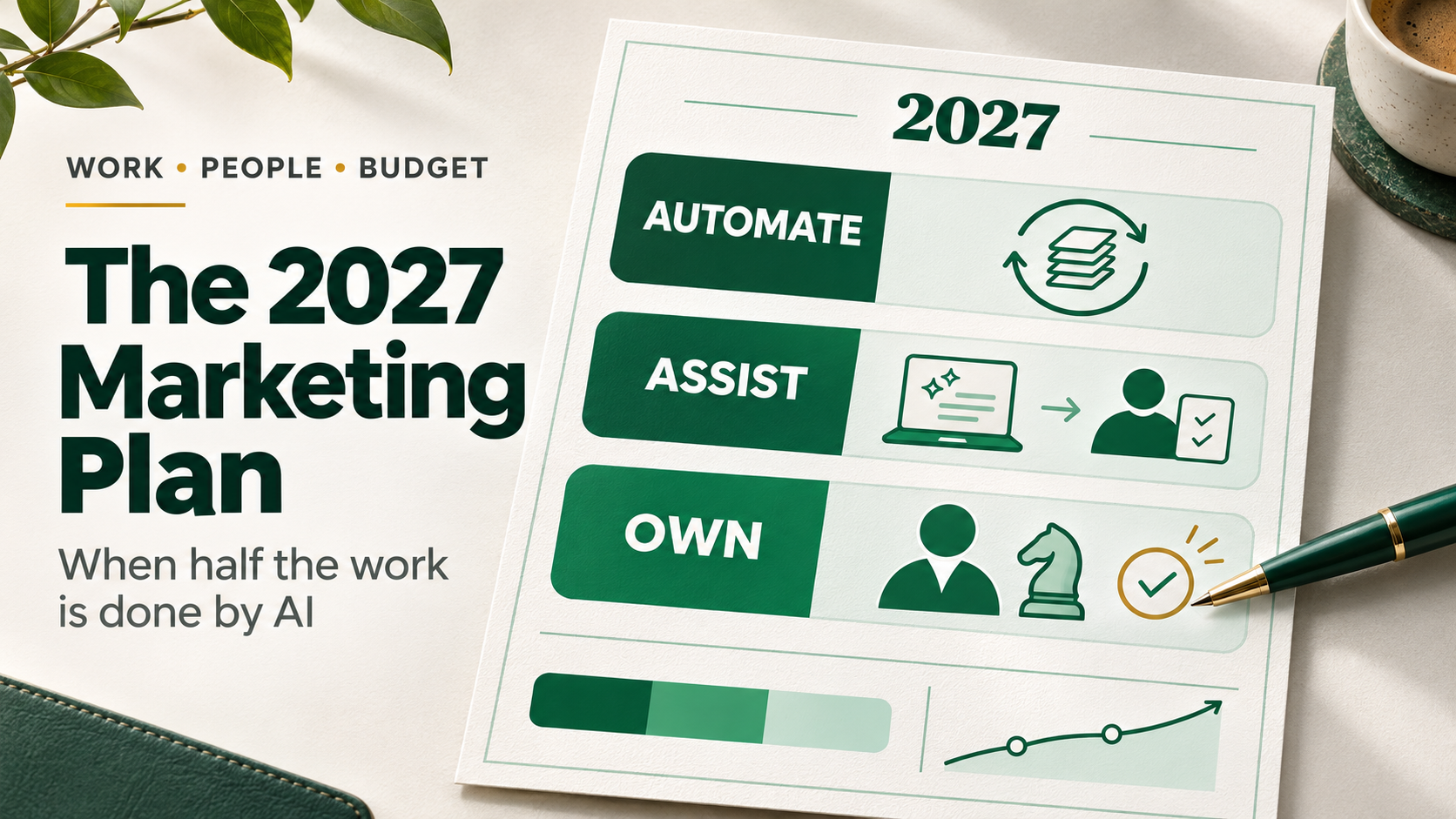
List every recurring task. Sort each with the AAO split:
| Bucket | Who does it | Examples |
|---|---|---|
| Automate | Agent owns it; human spot-checks weekly | Reporting, list hygiene, meeting notes, ad variants |
| Assist | AI drafts; a human decides | Blogs, emails, battlecards, briefs |
| Own | Human only | Positioning, pricing, customer interviews, partner deals |
Stuck on a task? Use the two-minute rule. If a human can check the output in two minutes and a mistake is cheap, Automate. If checking takes longer, or mistakes reach customers, Assist. If the task is the decision, Own.
In most mid-market teams I’ve seen, about half the hours land in Automate or Assist. The Own bucket is small, but that’s where revenue gets decided.
Step 2: Headcount vs. agents
Run every seat through the Seat Test:
- Is it paid for volume, judgment or relationships? Agents absorb volume.
- Who reviews the agent, and for how many hours a week? “Nobody” means not ready.
- What breaks if this seat is empty for 90 days? If nothing, you have your answer.
Then do the maths honestly. The Starr Conspiracy suggests modelling an agent as licence plus review time, and notes most teams underestimate review overhead by half in year one (The Starr Conspiracy).
Illustrative example:
| Content executive | Agent stack | |
|---|---|---|
| Annual cost | Rs 6 lakh | Rs 1.5 lakh in licences |
| Review time | — | 4 hrs/week at Rs 1,500/hr ≈ Rs 2.9 lakh |
| Real total | Rs 6 lakh | ≈ Rs 4.4 lakh |
You save about 27%, not 100%. Different board slide.
Every agent that survives the test gets an agent job description, just like a hire (MarTech):
| Field | Example: weekly pipeline report agent |
|---|---|
| Job | Pull pipeline by channel every Monday, flag drops above 15% |
| Inputs | CRM, ad platforms, web analytics |
| Reviewer | Marketing ops lead, 30 minutes a week |
| Success metric | Report ready by 10am; zero wrong numbers in a month |
| Kill condition | Two wrong numbers in a quarter |
One warning: Contentful and Atlantic Re:think found 25% of marketing teams have reduced or paused entry-level hiring because of AI (Contentful / Atlantic Re:think). Hire one fewer junior, not zero. No juniors today means no seniors in 2030.
Step 3: Where to cut — the Rupee Audit
Ask one question of every budget line: what pipeline did this create? (For a line-by-line version on your tools, see how to audit your AI marketing stack.)
- Named pipeline: keep it.
- “It influenced deals”: cut 30% and make it prove itself by Q2.
- “Not sure”: cut it.
Lines that usually fail:
- Volume content written for clicks. Similarweb shows 68% of Google searches now end without a click (Similarweb).
- Overlapping tools. Platform agents like HubSpot Breeze and Salesforce Agentforce do what three point tools used to (MarTech). The CMO Survey shows martech already at a five-year low of 19.4% of budgets (Webtonic).
- Execution-only agency retainers. Forrester expects agencies to split between orchestration and execution (Forrester). Pay for thinking; let agents do the typing.
Step 4: Where to double down
- Proof machines can verify. Use the claim ladder: adjective (“best-in-class”) → number (“cuts handle time 30%”) → named customer → third-party verified. Move your top five claims up two rungs by March.
- Humans in the deal. Forrester expects buyers to double their human interactions to validate AI recommendations (Forrester). Fund customer advocacy, solution-engineer time and founder-led content.
- AI visibility. Track citations in ChatGPT, Gemini and Perplexity, not just rankings.
- Data and ops. Gartner found 70% of CMOs say their processes can’t yet scale AI (Gartner). Companies with optimised AI programmes get 8.9% of revenue, against the 7.8% average (Marketing Dive via Yahoo Finance). Clean data earns the bigger budget.
Step 5: Split the budget 70/20/10
- Run (70%): channels with proven pipeline.
- Prove (20%): proof assets, advocacy, AI visibility.
- Bet (10%): one or two agent experiments, each with a kill date.
Illustrative example: on Rs 2 crore, that’s Rs 1.4 crore Run, Rs 40 lakh Prove, Rs 20 lakh Bet. Fund Prove and Bet from what you pruned, not new money.
Step 6: Run the year in four beats
| Quarter | Beat | Exit test |
|---|---|---|
| Q1 | Audit and prune | AAO split done; Rupee Audit cuts made |
| Q2 | Pilot two agents | Each beats its job-description metric |
| Q3 | Scale what worked | Hours saved moved to Own work |
| Q4 | Review and plan 2028 | Pipeline per rupee up on 2026 |
Five mistakes that sink an AI-era plan
- Cutting people before the agent has proved itself.
- Counting licences and ignoring review time.
- Buying tools before cleaning data.
- Measuring output (posts, emails) instead of pipeline.
- Hiring zero juniors.
The one-page 2027 plan (copy this)
| Section | What to fill in |
|---|---|
| Revenue target | The company number marketing answers to |
| Pipeline needed | Target ÷ win rate |
| Readiness score | Your score out of 10 from the quick check |
| Work audit | Hours in Automate / Assist / Own |
| Humans | Roles, and what each one Owns |
| Agents | One job description per agent |
| Prune | Rupee Audit cuts, and the rupees saved |
| Pour | Where the savings go |
| Budget split | Run / Prove / Bet amounts |
| Quarterly beats | Exit test for each quarter |
| Scorecard | Pipeline, win rate, AI citations, CAC payback |
The real shift
A 2027 plan isn’t really a budget. It’s a decision about which judgment stays human. So when the CFO asks why marketing needs the money, the answer isn’t “AI”. It’s “here’s the half we automated, here’s who checks it, and here’s what we bought with the savings.”
Marketers who can fill in this page will run teams. Anyone whose whole job sits in the Automate column should start moving now. That’s the next post in this series: what this plan means for the people inside it.
PS: If your plan has an “AI” line item but no named human reviewing each agent, you haven’t planned for AI. You’ve planned to be surprised by it.
PPS: Every rupee figure here is illustrative. Swap in your own before it goes anywhere near your CFO.
Sources
- Gartner: Marketing Symposium/Xpo 2026 Day 1 highlights (7.8% of revenue)
- Gartner: 2026 CMO Spend Survey, AI readiness
- Marketing Dive via Yahoo Finance: AI remains a top priority for CMOs, but spending lags
- Forrester: 2027 B2B go-to-market predictions (Oct 21, 2026)
- Forrester: Predictions 2027 hub (agencies: orchestration vs execution)
- The Starr Conspiracy: Are AI coworkers ready for your 2027 org chart?
- MarTech: How to build a marketing team with AI coworkers
- Contentful / Atlantic Re:think: The Agentic Web
- Similarweb: Zero-click marketing
- Webtonic: 2026 marketing spending statistics (CMO Survey martech share)