

The Founder’s LinkedIn Is Now Your Best SEO
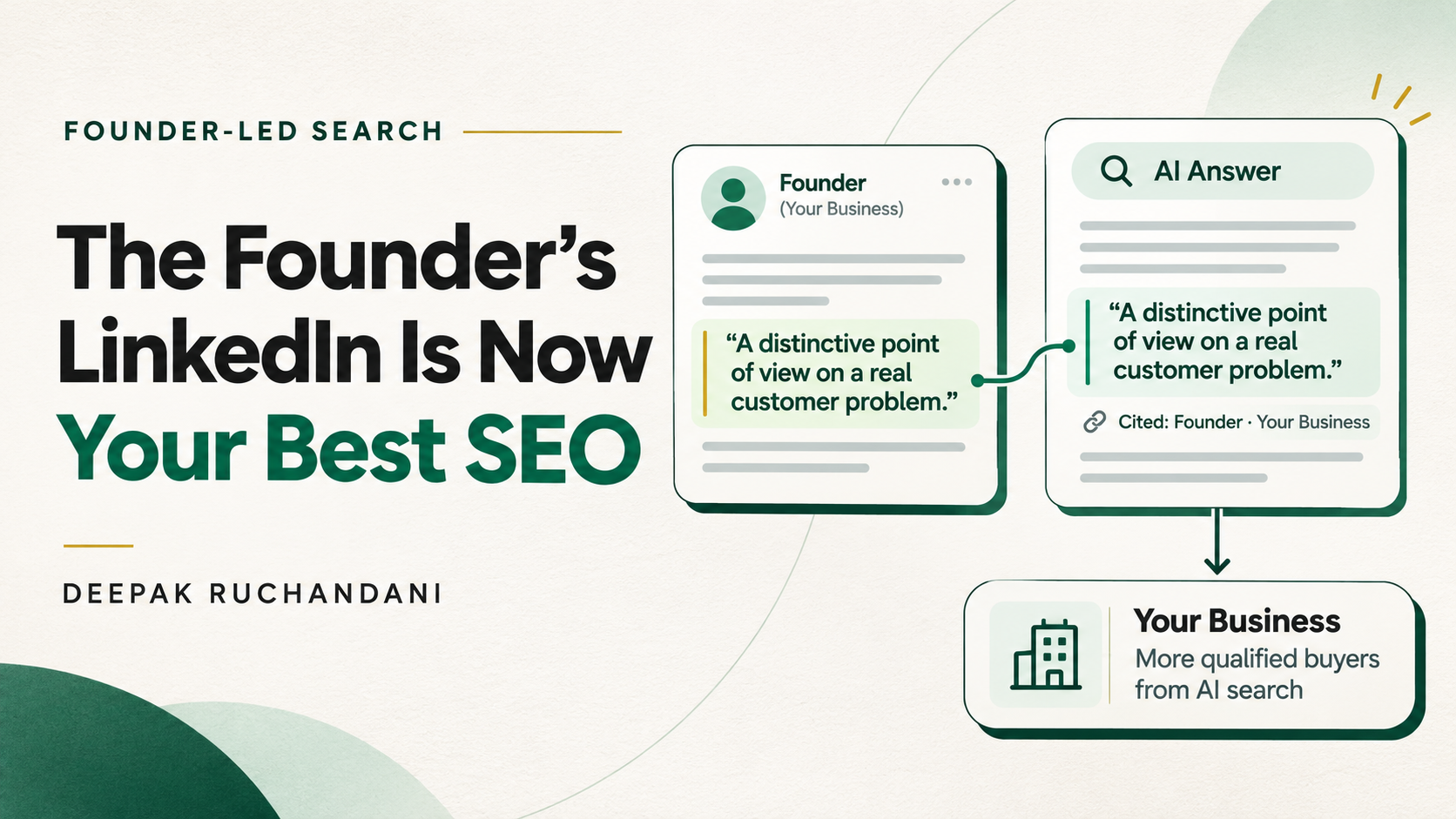
LinkedIn is the second most-cited domain in AI answers, and creators earn most of it. Six founder archetypes, 23 founders to study, the CITE test and a 3-1-1 cadence.
TL;DR
- LinkedIn is now the second most-cited domain in AI answers, and individual creators earn most of those citations, not company pages.
- On YouTube, AI cites long, clear explainers, even ones with under 1,000 views. Popularity barely matters; clarity does.
- One founder built a $5M ARR company with five people and 100% of traffic from LinkedIn. The founder’s voice is no longer “brand work”. It is search infrastructure.
- Pick your lane with the six founder archetypes, learn from 23 founders across India and the world, and run every post through the CITE test.
- Publish with the Platform Split and the 3-1-1 cadence, then check yourself against the five-question AI-ready test.
Ask ChatGPT a question about your category. Look at the sources it cites.
Odds are your company blog isn’t there. A founder’s LinkedIn post might be. Possibly your competitor’s founder.
That’s the shift. For a decade, SEO meant your website. In 2026, AI answers increasingly pull from people and platforms. The founder who shows up there is doing your SEO, whether your marketing team planned it or not.
The data: AI trusts people more than pages
- Semrush analysed 325,000 prompts across ChatGPT Search, Google AI Mode and Perplexity. LinkedIn was the #2 most-cited domain, appearing in 11% of AI answers, ahead of Wikipedia, YouTube and every major news publisher.
- The part founders should notice: on ChatGPT and AI Mode, 59% of LinkedIn citations go to individual creators, not company pages (Semrush).
- Profound found LinkedIn is now the #1 most-cited domain for professional queries across major AI platforms.
- On YouTube, OtterlyAI’s study of 100M+ citations found views, likes and subscribers have near-zero correlation with being cited. WebFX’s summary adds that 94% of cited videos are long-form, and 40.83% had fewer than 1,000 views.
Read that last line again. You don’t need to be famous. You need to be clear, specific and findable.
That’s what Marketing Week calls engineering fame: how quickly you come to mind inside the group that matters. In an AI world, “the group that matters” now includes the machines.
The proof: a company built on one LinkedIn profile
If you still think this is theory, meet Adam Robinson.
He spent two years posting honestly on LinkedIn about his founder struggles. Then he launched RB2B. According to SaaStock, it went from $0 to $5M ARR in about 12 months, with five people, and 100% of its traffic came from LinkedIn.
His own description of the model: he’s in the “edutainment business with a SaaS at the end of the funnel” (The SaaS Podcast).
The audience came first. The product came second. The pipeline came almost for free.
The Citation Flywheel
Here’s how founder content turns into pipeline:
Post → Cited → Searched → Trusted → Bought
- You post a specific, useful idea.
- An AI engine cites it when a buyer asks a question.
- The buyer searches your name.
- They find a body of consistent thinking, and trust it.
- They book the call already half-sold.
Company pages rarely start this loop. People do.
Who’s already doing it: the six founder archetypes
You don’t need anyone else’s personality. You need a lane. Almost every strong founder brand fits one of six archetypes:
| Archetype | What they post | Who does it |
|---|---|---|
| The Teacher | Explains the category so buyers get smarter | Nithin Kamath, Ankur Warikoo, Justin Welsh |
| The Builder in Public | Numbers, decisions and mistakes as they happen | Adam Robinson, Deepinder Goyal |
| The Researcher | Original data nobody else has | Rand Fishkin |
| The Category Namer | Coins the term everyone else ends up using | Dharmesh Shah, Kunal Shah |
| The Host | Interviews others and borrows their audiences | Nikhil Kamath, Steven Bartlett |
| The Missionary | Ties the company to a cause bigger than the product | Girish Mathrubootham, Melanie Perkins |
The rule: pick one primary archetype and one secondary. Try to be all six and you’ll be nobody’s default answer.
11 founders from India to study
| # | Founder | Company | What they’re known for | Steal this |
|---|---|---|---|---|
| 1 | Nithin Kamath | Zerodha | Posts on financial literacy for retail investors; Favikon ranks him among the top 10 LinkedIn influencers in India | Teach the category, don’t sell the product |
| 2 | Nikhil Kamath | Zerodha | Tailors each platform: LinkedIn for depth, Instagram for personal moments, X for commentary (Favikon) | One voice, different formats |
| 3 | Deepinder Goyal | Zomato, Temple | His most-engaged posts share hiring decisions, operational challenges and genuine uncertainty (StartupFeed) | Show the decision, not the victory lap |
| 4 | Kunal Shah | CRED | Named ideas like “Delta 4”; featured on LinkedIn’s Top Voices for India | A named idea travels further than a post |
| 5 | Girish Mathrubootham | Freshworks, Together Fund | A public story of world-class software from India for the world, told on LinkedIn (DT Next) | A mission bigger than the product |
| 6 | Ankur Warikoo | Nearbuy, WebVeda | 2M+ LinkedIn followers; LinkedIn Top Voice 2018, 2019 and 2020 (100X.VC) | Consistency compounds |
| 7 | Ritesh Agarwal | OYO | Ranked 25th in Favikon’s Top 200 Indian LinkedIn creators | Big-company founders can still post like people |
| 8 | Anubhav Dubey | Chai Sutta Bar | LinkedIn Top Voice, ranked 5th in the same Top 200 | A chai brand can earn boardroom attention |
| 9 | Ghazal Alagh | Mamaearth | Among the under-35 entrepreneurs with the biggest social following (Business Insider India) | A founder story becomes consumer trust |
| 10 | Ananya Narang | Entourage | Builds branding and fundraising tools for founders; in the top 1% of LinkedIn creators in India (Favikon) | Your audience can be your first customers |
| 11 | Jatin Saini | House of Creators | Runs a personal-branding agency for founders and VCs; top 2% of LinkedIn India (Favikon) | Practise what you sell, in public |
12 founders from around the world
| # | Founder | Company | What they’re known for | Steal this |
|---|---|---|---|---|
| 1 | Dharmesh Shah | HubSpot | Public thinking that helped make “inbound” a category; HubSpot is at $2.6B ARR (SaaStr) | Name the category, own the answers |
| 2 | Rand Fishkin | Moz, SparkToro | Original research; SparkToro’s zero-click data is quoted across the industry | Original data gets cited forever |
| 3 | Jason Lemkin | SaaStr | Built SaaStr by publishing relentlessly specific advice | Specific beats inspirational |
| 4 | Adam Robinson | RB2B, Retention.com | $0 to $5M ARR in about 12 months, all from LinkedIn (SaaStock) | Audience before product |
| 5 | Justin Welsh | The Saturday Solopreneur | A one-person business to $10M in revenue; known for short-paragraph narrative posts (Prometai) | A repeatable format beats a viral post |
| 6 | Lara Acosta | Kleo | Went from side-project posting to Forbes 30 Under 30 and LinkedIn Top Voice (Kleo) | Authentic beats performative |
| 7 | Steven Bartlett | Flight Group | Turned a podcast into a holding company | Host the conversation your buyers want |
| 8 | Alex Hormozi | Acquisition.com | A business-scaling expert, investor and author (AuthoredUp) | Package expertise into frameworks |
| 9 | Codie Sanchez | Contrarian Thinking | Posts case studies from real acquisitions of unglamorous businesses (ViralBrain) | Own a contrarian niche |
| 10 | Dave Gerhardt | Exit Five | Helped shape founder-led marketing at Drift, then built a B2B marketing community (The LinkedIn Famous Podcast) | Turn followers into a community |
| 11 | Guillaume Moubeche | lemlist | Bold, unconventional posts; lemlist at $10M a year in revenue | Personality is a moat |
| 12 | Melanie Perkins | Canva | Built Canva’s brand through personal storytelling | Tell the origin story often |
Notice the pattern. None of them post like a company page. All of them post like a person with a point of view.
Framework 1: the CITE test
Before you post, check four things:
- C — Claim. One clear point, stated in the first two lines. AI can’t cite a vibe.
- I — Insight from experience. Something only you could know: a decision, a mistake, a number from your own work. About 95% of cited LinkedIn posts are original (UC Strategies).
- T — Takeaway. A framework, checklist or template the reader can use today.
- E — Evergreen phrasing. Write it so it answers a question someone will still ask in a year.
Fail two of four? Rewrite.
Five post formats AI loves to cite
Not sure what to write? Start with these. Each one gives an AI engine something clean to quote.
- The “how we did X” breakdown. Real numbers, real steps. Adam Robinson’s revenue updates are the template.
- The named framework. Three to five steps with a label. Kunal Shah’s Delta 4 is the template.
- The contrarian take, with evidence. “Everyone says X. Our data says Y.” Rand Fishkin’s research posts are the template.
- The comparison. “X vs. Y: when to use which.” Comparative content earns 32.5% of AI citations in one analysis.
- The one-question answer. State the question, answer it in the first line, then explain. It’s the format AI engines lift most easily.
Framework 2: the Platform Split
Different AI engines read different platforms. Per the studies above:
| Platform | Strongest in | What to publish |
|---|---|---|
| LinkedIn (personal profile) | ChatGPT, Google AI Mode | Opinionated posts and articles with frameworks |
| LinkedIn (company page) | Perplexity | Structured, product- and category-focused updates |
| YouTube (long-form) | Perplexity, Google AI Overviews, which drive about three-quarters of YouTube’s AI citations | Tutorials and explainers with chapters |
| Your website | Everywhere, as the canonical source | The full version, with FAQs and schema |
Framework 3: the 3-1-1 cadence
Every week:
- Three LinkedIn posts that pass the CITE test.
- One long-form piece: a YouTube explainer, a podcast clip with a transcript, or a LinkedIn article.
- One website blog that collects that week’s best idea into the canonical version.
One idea, five surfaces. That’s how a founder becomes the default answer.
Framework 4: own a phrase
Kunal Shah has Delta 4. HubSpot has inbound. Pick the one idea you want AI to associate with your name, give it a memorable label, and repeat it until it’s yours. AI engines learn from repetition across sources. So do buyers.
What to measure
Stop measuring likes. Track:
- AI mentions: ask ChatGPT, Perplexity and Gemini your top 10 category questions monthly. Are you named?
- Branded search: are more people searching your name and company?
- Sourced inbound: how many leads say “I saw your post”?
- Founder-influenced pipeline: deals where the buyer engaged with founder content before the first call.
If you want the full scorecard for AI visibility, I’ve broken it down in the AI visibility metrics that matter.
Quick check: would AI cite you?
Answer honestly.
- Could a stranger sum up what you stand for, in one sentence, from your last 10 posts?
- Have you named at least one framework of your own?
- Do at least half your posts include a number, decision or mistake from your own work?
- Does your best idea exist in long form too: an article, a video or a blog?
- Have you asked ChatGPT about your category this month and checked who it names?
4–5 yes: you’re building a citable brand. 2–3: you’re posting, not compounding. 0–1: start with one CITE-tested post this week.
The real shift
Your company blog is still useful. But it’s no longer the front door. The front door is a person, and AI is the one holding it open.
If the founder won’t show up, someone else’s founder will. And they’ll get cited in the answer your buyer reads.
PS: If you’re a founder who “doesn’t have time for LinkedIn”, you don’t have a time problem. You have a distribution problem you’re paying for in ad spend.
PPS: Start small. One CITE-tested post this week. Ask ChatGPT about your category in 30 days and see who it names.
Sources
- Semrush: LinkedIn AI visibility study (89K URLs, 325K prompts)
- Profound: LinkedIn is the most-cited domain for professional queries in AI search
- UC Strategies: What a study of 89,000 LinkedIn posts reveals
- OtterlyAI: YouTube Citation Study 2026 and GEO experiment
- WebFX: YouTube AI citations
- Eclincher: YouTube and AI search, which videos get cited
- Marketing Week: How to engineer fame in an AI era
- SparkToro: In 2026, less than one third of Google searches still send a click
- LexiConn: The CEO as B2B influencer, a playbook for Indian SMEs
- Favikon: Who is Nikhil Kamath
- StartupFeed: 10 Indian founders reshaping global business in 2026
- DT Next: Girish Mathrubootham to step down as Freshworks chairman
- SaaStr: Who is Dharmesh Shah
- Everything PR: Founder-led GTM, the LinkedIn playbook for B2B
Founder examples and case studies
- SaaStock: The $5M LinkedIn playbook, how Adam Robinson cracked founder-led marketing
- The SaaS Podcast: Adam Robinson, $1M ARR three times
- Favikon: Top 10 LinkedIn influencers in India
- India Education Diary: Favikon Top 200 Indian LinkedIn creators
- Marketing Mind: India’s most inspiring LinkedIn influencers
- 100X.VC: Ankur Warikoo
- Sentinel Assam: LinkedIn’s Top 25 Voices for India
- Business Insider India: Under-35 entrepreneurs with the highest social media following
- Favikon: Who is Ananya Narang
- Favikon: Jatin Saini
- Favikon: Top influencers on LinkedIn
- ViralBrain: Top LinkedIn creators to follow in 2026
- Kleo: LinkedIn influencers
- Prometai: 4 LinkedIn entrepreneurs who turned attention into equity
- AuthoredUp: Top business influencers on LinkedIn
- The LinkedIn Famous Podcast: Dave Gerhardt on why founders must post
- Tweet Hunter: Personal brand guide
- Radiant Elephant: Why YouTube is the most-cited domain in AI Overviews