

The 2027 Marketer's Field Guide: Roles, Activities, Tools and AI Workflows Across Every Marketing Function
The SPECS operating loop, the core skills and tool kit every marketer needs, and activities, tools and AI workflows for 18 marketing functions, plus expectations by career level and a 90-day plan.
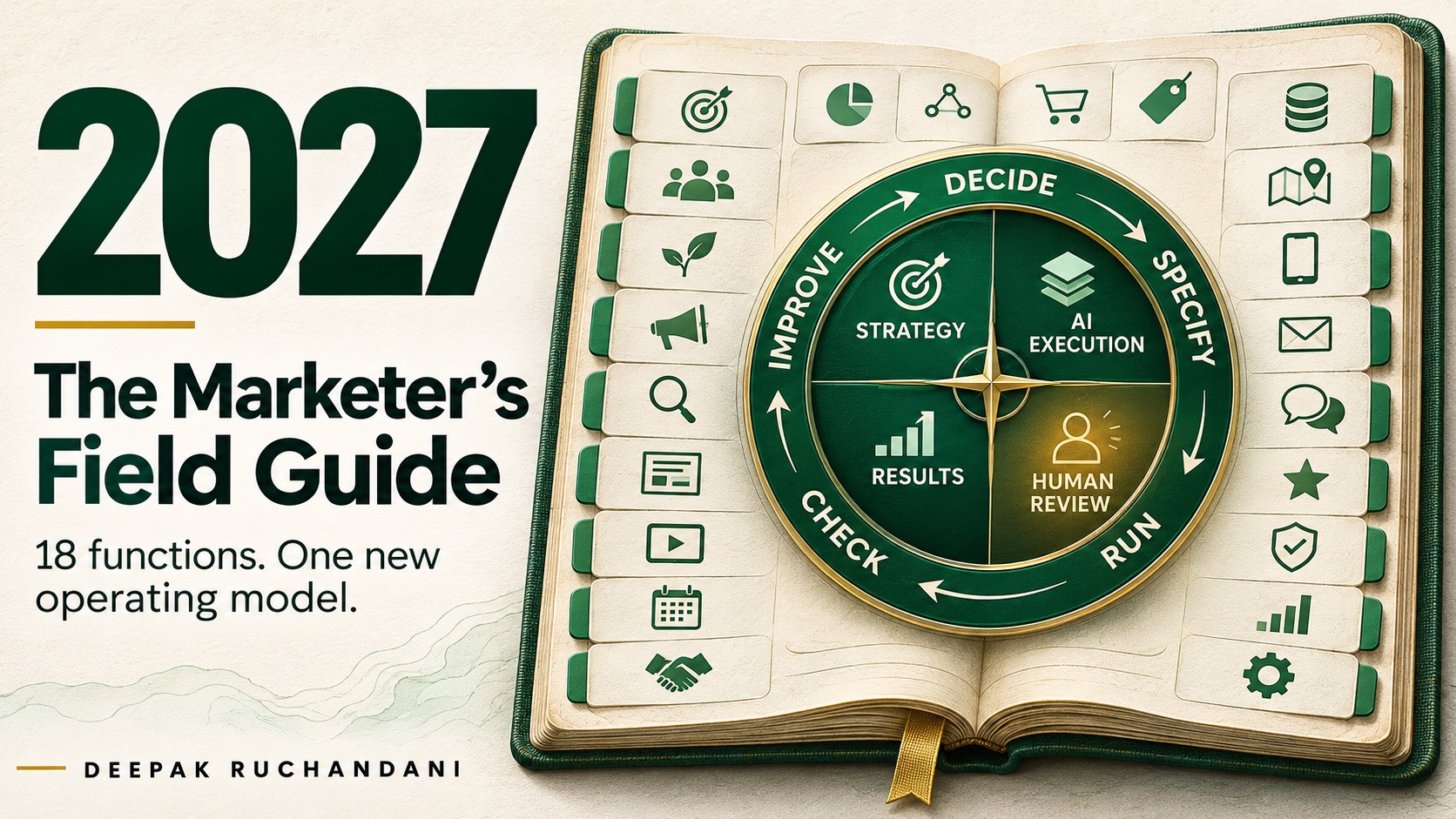
TL;DR: In 2027, every marketer, whatever their function, does five things. They set the strategy and the brief, build and run AI workflows, check what comes out, feed the systems clean data, and own the business result. Doing tasks by hand still happens, but it's no longer the job. This guide covers the activities, tools, workflows and AI workflows for 18 marketing functions, plus what each career level is expected to deliver.
How to use this guide: read the operating model and core skills first. Then go straight to your function. Every function section has the same five parts: what the job is now, core activities, tools to know, the classic workflow, and AI workflows you can set up this quarter.
What changed? Why is marketing work in 2027 different?
Marketing work in 2027 changes because machines now do most of the doing, and marketers are judged on what they direct and check. CMOs in a Gartner survey published in May 2026 expected AI-driven automation of marketing work to more than double, from 16% in 2026 to 36% by 2028 (Profound, citing Gartner). HubSpot's 2026 State of Marketing data says 80% of marketers already use AI for content creation and 92% use automation for analysis and reporting (HubSpot).
Six shifts drive the change:
- Buyers ask AI first. Discovery now starts in ChatGPT, Gemini, Perplexity, Claude and Google AI Overviews. Being cited matters as much as ranking.
- Ad platforms run themselves. Google AI Max now takes a natural-language brief and guardrails instead of keyword lists, a move Digiday described as campaign management shifting "upstream" (Digiday, Apr 30, 2026). Meta Advantage+ is heading the same way.
- Content is no longer scarce. Anyone can produce 100 posts a day. What stands out now is original data, real experience and a clear point of view.
- Agents act, not just answer. AI agents research, draft, update CRM records, launch sequences and pull reports across connected tools.
- Measurement moves away from clicks. Zero-click answers, dark social and automated campaigns break last-click attribution. Media mix modelling (MMM) and incrementality testing come back.
- Trust becomes a feature. Deepfakes, AI-written spam and privacy laws such as India's DPDP Act make transparency and consent part of the marketer's job.
What is the new operating model for a marketer in 2027?
The 2027 marketer runs a repeating loop: decide, specify, run, check, improve. I call it the SPECS loop. It applies to a performance marketer briefing AI Max, a content lead running a drafting agent, and a PMM building a launch kit alike.
- S: Strategy. Pick the goal, audience, offer and the one message that matters. AI can inform this. It can't own it.
- P: Prompt and context. Turn the strategy into briefs, prompts, brand rules, examples and data an AI can act on. This is "context engineering": the better the inputs, the better the output.
- E: Execute with agents. Let AI tools and agents do the volume work: drafts, variants, research, builds, launches, reports.
- C: Check. Review for accuracy, brand fit, legal risk, bias and taste. Nothing goes out without a named human owner.
- S: Scale or stop. Measure the result, keep what works, turn it into a reusable workflow, and kill what doesn't.
Which tasks go to humans, which to AI, and which to drop?
A quick test for any task: does it need judgement, relationships or accountability? Keep it human. Is it repeatable, high-volume and checkable? Hand it to AI. Does it produce nothing anyone uses? Drop it.
| Task type | Who does it in 2027 | Examples |
|---|---|---|
| Strategy and choices | Human, AI-informed | Positioning, budget split, ICP, pricing, campaign bets |
| Relationships and trust | Human | Customer interviews, analyst and media relations, partner deals, executive alignment |
| Taste and final say | Human | Creative direction, brand voice calls, what to publish |
| Research and synthesis | AI drafts, human checks | Competitor scans, call and review mining, market sizing |
| Volume production | AI produces, human edits | Ad variants, social cuts, email versions, localisation, product copy |
| Ops and reporting | AI runs, human audits | List hygiene, UTM checks, weekly reports, CRM updates, QA |
| Low-value rituals | Drop | Vanity-metric decks, status reports nobody reads, manual data copy-paste |
What core skills does every marketer need in 2027?
Every marketer in 2027 needs three layers of skill: lasting fundamentals, AI working skills, and judgement. Missing any one of them makes you either replaceable or risky.
Layer 1: Fundamentals that AI makes more valuable
- Customer understanding: knowing the buyer's problem, words, objections and buying process from real conversations
- Positioning and messaging: choosing what to stand for and what to leave out
- Storytelling and writing: clear thinking on the page; AI drafts, you decide what's true and sharp
- Commercial literacy: CAC, LTV, payback, pipeline, contribution margin, unit economics
- Channel knowledge: how each channel works, so you can tell when the automation is wrong
- Experiment design: hypotheses, control groups, sample sizes, reading results honestly
Layer 2: AI working skills
- Prompting and context engineering: writing briefs, giving examples, attaching data and setting constraints so AI output is usable on the first or second pass
- Workflow design: breaking a job into steps and deciding which steps are AI, human or automated
- No-code automation: building flows in tools like Zapier, Make or n8n that connect your CRM, forms, sheets, email and AI models
- Agent supervision: setting permissions, approvals and checks for agents that take actions
- Data basics: clean spreadsheets, simple SQL or plain-language queries, reading a dashboard critically
- Light building ("vibe coding"): using AI coding tools to make calculators, landing pages, scripts and internal tools without waiting for engineering
- Evaluation: spotting hallucinations, checking sources, scoring output against a rubric
Layer 3: Judgement
- Taste: knowing good from generic, and having the confidence to reject average AI output
- Ethics and risk sense: consent, disclosure, bias, claims you can't prove
- Prioritisation: AI makes everything possible, so choosing what not to do becomes a core skill
- Influence: getting sales, product, finance and leadership to act on what you know
Which tools should every marketer know in 2027?
Every marketer should be fluent in one general AI assistant, one automation tool, their CRM, and their analytics stack. Everything else depends on the function. Tool names change fast, so learn the category and what it does, then pick tools that fit your stack and budget. The examples below were widely used in 2026. Check them before you buy.
| Category | What it does for you | Example tools |
|---|---|---|
| General AI assistants | Research, drafting, analysis, coding, file work | ChatGPT, Claude, Gemini, Microsoft Copilot |
| AI research and answer engines | Cited research, competitor and market scans | Perplexity, ChatGPT deep research, Gemini Deep Research |
| Workflow automation and agents | Connect apps, trigger AI steps, run agents | Zapier (incl. Zapier Agents), Make, n8n, Clay, Gumloop |
| CRM and marketing automation | Contacts, journeys, scoring, built-in AI agents | HubSpot (Breeze), Salesforce (Agentforce), Zoho, LeadSquared |
| Content and copy | On-brand drafting at scale, brand voice | Jasper, Copy.ai, Writer, general assistants |
| Design and creative | Images, layouts, brand kits, resizing | Canva, Adobe Firefly / Express, Figma, Midjourney |
| Video and audio | Generation, editing, avatars, dubbing, voice | Runway, Google Veo, Descript, HeyGen, Synthesia, ElevenLabs |
| SEO and AI visibility | Rankings, technical SEO, citation tracking in AI answers | Semrush, Ahrefs, Surfer, Profound, Google Search Console |
| Paid media | Automated campaigns, creative testing | Google Ads (AI Max, Performance Max), Meta Advantage+, LinkedIn Ads, Smartly |
| Social and listening | Scheduling, listening, community | Sprout Social, Hootsuite, Brandwatch, Buffer |
| Lifecycle and messaging | Email, WhatsApp, SMS, push, in-app, AI decisioning | Braze, Iterable, Klaviyo, MoEngage, WebEngage, CleverTap |
| Conversation intelligence | Call recording, transcripts, deal insight | Gong, Fireflies, Otter, Zoom AI Companion |
| Voice and chat agents | Inbound and outbound conversations at scale | Exotel, Twilio, Yellow.ai, Haptik, ElevenLabs agents |
| Data and analytics | Web analytics, warehouse, BI, product analytics | GA4, BigQuery, Looker Studio, Mixpanel, Amplitude, Power BI |
| Measurement | MMM and incrementality | Google Meridian, Meta Robyn, geo-lift testing |
| Data foundation | Unify customer data for AI and activation | Segment, RudderStack, mParticle, warehouse-native CDPs |
| Work management and docs | Plans, briefs, knowledge base for agents | Notion, Google Workspace, Asana, monday.com |
| AI building and coding | Landing pages, tools, scripts, prototypes | Claude Code, Cursor, Lovable, Replit, v0 |
The minimum kit for any marketer: one assistant you know deeply, a shared prompt and brand-context library, one automation tool, your CRM, GA4 or equivalent, and a docs tool where briefs and rules live so agents can read them.
Function guides: what each marketing role does in 2027
Each guide below follows the same pattern, so you can compare roles and borrow workflows across them.
1. Product marketing
The job now: owning how the market, sales and AI assistants understand the product. PMMs spend less time producing collateral and more time on insight, positioning and making sure every agent and rep says the same true thing.
Core activities
- Market, competitor and category research, kept up to date continuously instead of once a year
- ICP, persona and buying-committee definition
- Positioning, message house and value proposition by segment
- Product launches: tiering, launch plans, readiness, release notes
- Sales enablement: battlecards, pitch decks, objection handling, demo stories
- Win-loss analysis and voice of customer programmes
- Pricing and packaging input
- Auditing what ChatGPT, Gemini, Perplexity and Claude say about the product and its competitors
- Messaging for AI features: what the AI does, its limits, data use and proof
Tools to know: a general AI assistant, Gong or another call recorder, CRM, Notion or Confluence, Figma or Canva, competitive intelligence tools (Klue, Crayon), survey tools, AI visibility trackers.
Classic workflow (launch): product brief → audience and tier decision → positioning and messaging → asset plan → enablement → launch → 30/60/90-day adoption review.
AI workflows to set up
- Win-loss engine: call transcripts and CRM loss reasons go into a monthly AI synthesis, sorted by theme, competitor and segment. The PMM checks it and turns it into messaging updates.
- Always-on competitive scan: an agent checks competitor sites, pricing pages, release notes, reviews and job posts each week and writes a change summary. Battlecards get updated from it.
- Launch kit generator: a single positioning doc becomes first drafts of the blog, email, sales one-pager, FAQ, social posts and release notes. Humans edit, legal approves.
- AI perception audit: run 30 to 50 buyer-style prompts across AI assistants every month. Log whether you're mentioned, how you're described, and any errors. Fix the sources AI is reading.
- Sales question assistant: an AI assistant answers rep questions from approved content only, and lists the questions it couldn't answer so the gaps get filled.
2. Content marketing
The job now: running an editorial engine where AI does the drafting and humans add what AI can't: experience, original data, opinion and taste. Volume is cheap. Being distinct is the job.
Core activities
- Content strategy built on audience questions, the funnel and topic clusters
- An editorial calendar across blog, newsletter, video, podcast, LinkedIn and community
- Subject-matter expert interviews and capturing first-hand stories
- Original research: surveys, data studies, benchmarks
- Brand voice systems: style guides, examples, banned phrases
- Repurposing one core asset into many formats
- Editing, fact-checking and QA on AI drafts
- Distribution and refreshing existing content
Tools to know: AI assistants, Jasper or Writer for brand voice at scale, Grammarly, Descript, Canva, a CMS (WordPress, Webflow), Semrush or Ahrefs, Notion, plagiarism and AI-detection checkers.
Classic workflow: topic research → brief → draft → SME review → edit → design → publish → distribute → measure → refresh.
AI workflows to set up
- Interview-to-article: record a 30-minute SME call, transcribe it, and have AI draft from the transcript using your brief and voice guide. An editor adds structure, data and a strong opening and close. This keeps real experience at the centre.
- One-to-many repurposing: one pillar article becomes a LinkedIn carousel, five posts, a newsletter, a short video script, an FAQ block and a sales email.
- Content QA agent: checks every draft for unsupported claims, missing sources, banned phrases, reading level and SEO or AEO structure before an editor sees it.
- Refresh radar: a monthly scan flags posts losing traffic or AI citations and drafts an update brief for each.
- Research assistant: collects stats with source links for every draft. Every number gets checked against its original source before publishing.
3. SEO, AEO and GEO (search and AI visibility)
The job now: making sure the brand is found, cited and described correctly wherever people search, whether that's Google, AI Overviews, ChatGPT, Perplexity, Gemini or an AI agent browsing on a buyer's behalf. SEO gets you ranked. AEO (answer engine optimisation) gets your page quoted as the answer. GEO (generative engine optimisation) gets your brand named in AI-written answers.
Core activities
- Keyword research plus prompt research: what buyers ask AI assistants
- Technical SEO: crawlability, speed, schema, clean site structure, AI crawler access decisions
- Answer-first page structure: question headings, short direct answers, tables, FAQs
- Topic clusters and internal linking
- Off-site mentions: digital PR, reviews, Reddit, YouTube, podcasts, LinkedIn
- Tracking AI visibility: citations, share of voice, how the brand is described
- Product feeds and structured data for AI shopping and browsing agents
- Correcting wrong AI answers by fixing the sources they draw on
Tools to know: Google Search Console, GA4, Semrush, Ahrefs, Screaming Frog, Surfer or Clearscope, schema validators, AI visibility trackers (Profound, Semrush AI toolkit, Ahrefs Brand Radar).
Classic workflow: audit → keyword and prompt map → technical fixes → content plan → build and optimise → earn links and mentions → track → refresh.
AI workflows to set up
- Prompt research pipeline: pull questions from sales calls, support tickets, Reddit and People Also Ask. AI groups them into intents and maps each to a page.
- Answer-block optimiser: AI rewrites each section opener into a 40 to 60 word direct answer and suggests tables and FAQ schema. A human checks accuracy.
- AI citation tracker: a weekly run of target prompts across assistants, logging mentions, competitor mentions and source URLs into a sheet.
- Technical audit summariser: crawl exports go to AI, which ranks issues by impact and writes developer tickets.
- Programmatic pages with guardrails: templated location or integration pages built from real data. Every page has unique value, and a quality check runs before indexing.
4. Performance marketing and paid media
The job now: steering automated ad platforms instead of operating them. Platforms like Google AI Max, Performance Max and Meta Advantage+ handle bidding, targeting and placement. The marketer controls the inputs (offer, creative, conversion data, budget, guardrails) and checks the outputs.
Core activities
- Setting objectives, budgets and value rules tied to business outcomes, not platform metrics
- Signal engineering: clean conversion tracking, server-side events, offline conversions, value-based bidding
- Creative strategy and high-volume creative testing
- Writing campaign briefs and guardrails (brand rules, exclusions, disclaimers) for AI-driven campaigns
- Audience and first-party data strategy
- Budget pacing, anomaly checks, brand safety
- Incrementality and lift testing
- Planning for new surfaces: ads in AI answers, retail media, quick-commerce ads, connected TV
Tools to know: Google Ads, Meta Ads Manager, LinkedIn Campaign Manager, YouTube, Amazon Ads, Google Tag Manager, server-side tagging, GA4, creative tools (Canva, Adobe, AI video tools), Smartly or Madgicx, Looker Studio.
Classic workflow: goal and budget → tracking check → audience and offer → creative production → launch → optimise → report → scale or cut.
AI workflows to set up
- Creative testing machine: one creative concept becomes 20 to 50 AI-made variants (hooks, formats, ratios, languages). Launch in structured tests, read the results weekly, and feed the winners into the next round.
- Daily anomaly watch: an agent checks spend, CPA, ROAS and conversion volume against forecast and alerts you with a likely cause.
- Search term and placement audit: AI reviews search terms and placements from automated campaigns, flags waste and brand-safety issues, and suggests exclusions.
- Offline conversion loop: CRM stages (SQL, deal won, revenue) sync back to ad platforms automatically, so bidding optimises for revenue, not form fills.
- Weekly performance narrative: AI writes the "what happened, why and what next" summary from platform data. The marketer checks the reasoning before sending it to leadership.
5. Social media and community
The job now: being the brand's human voice in feeds filling up with AI content. AI handles scheduling, cutting clips, captions and listening. People handle tone, timing, relationships and judgement calls when something goes wrong.
Core activities
- Channel strategy across LinkedIn, Instagram, YouTube, X, WhatsApp Channels and Reddit
- Short-form video planning and production
- Social listening, trend spotting and crisis detection
- Community management: replies, moderation, member programmes
- Employee and founder advocacy programmes
- Creator and partner collaborations
- Measuring reach, engagement, share of voice and assisted demand
Tools to know: Sprout Social, Hootsuite, Buffer, Brandwatch or Talkwalker, Canva, CapCut, Descript, Opus Clip, native platform analytics, Discord, Slack, Circle.
Classic workflow: content pillars → calendar → create → approve → publish → engage → listen → report.
AI workflows to set up
- Long video to clips: a webinar, podcast or event talk goes into a clipping tool. You get 10 to 20 captioned short clips. A human picks the five best and writes the hooks.
- Listening and alert agent: watches mentions, competitor mentions and category keywords, groups them by sentiment, and alerts the team when volume spikes.
- Reply drafting with approval: AI drafts replies to comments and DMs in brand voice. Anything sensitive (complaints, legal, media) goes to a human.
- Employee advocacy kit: each week, AI turns company news into three post angles per employee persona, written so they don't all sound alike.
- Trend-to-post sprint: a daily trend digest comes with a fit score for the brand and a quick concept. A human approves within hours, not days.
6. Brand marketing and creative
The job now: keeping the brand distinctive when everyone has the same AI tools. Generative tools make production cheap and fast. Brand teams own the idea, the consistency and the trust.
Core activities
- Brand strategy, positioning, platform and architecture
- Creative direction, campaign ideas and storytelling
- Brand guidelines written for both humans and AI tools
- Asset libraries and design systems
- Brand tracking: awareness, consideration, distinctiveness, sentiment
- Brand safety, IP, likeness and usage rights for AI-generated work
- Pre-testing creative with attention and prediction tools
Tools to know: Adobe Creative Cloud and Firefly, Figma, Canva with brand kits, Midjourney, Runway, Google Veo, ElevenLabs, brand tracking tools (YouGov, Kantar, Latana), creative pre-testing tools.
Classic workflow: brand brief → insight → idea → concepts → production → adaptation → launch → brand lift measurement.
AI workflows to set up
- Concept-to-storyboard in a day: AI generates mood boards, scripts and animated storyboards for three to five concepts, so stakeholders react to visuals instead of decks.
- AI-ready brand kit: colours, fonts, logos, tone rules, do and don't examples, and approved prompts in one place that every tool and agency uses.
- Adaptation engine: one master asset becomes every size, language and channel format, with automatic brand checks.
- Pre-flight testing: run attention or prediction scoring on variants before spending media, then confirm with small live tests.
- Rights and disclosure log: track which assets used AI, which models, what rights and what disclosure, for each campaign.
7. Lifecycle, CRM, email and WhatsApp marketing
The job now: moving from fixed journeys to real-time decisions. AI picks the message, channel and timing for each customer. The lifecycle marketer designs the rules, the offers and the guardrails.
Core activities
- Segmentation and lifecycle stage design (onboarding, activation, retention, win-back)
- Journey design across email, WhatsApp, SMS, push, in-app and RCS
- Personalisation and next-best-action logic
- Churn, upsell and propensity models
- Deliverability, consent and preference management
- Writing for AI-summarised inboxes: clear subject lines, a key point up top, one ask
- Testing and holdout groups to prove incremental impact
Tools to know: HubSpot, Salesforce Marketing Cloud, Braze, Iterable, Klaviyo, MoEngage, WebEngage, CleverTap, WhatsApp Business Platform through approved providers (Gupshup, Interakt, AiSensy), CDPs.
Classic workflow: segment → trigger → message → test → send → measure → iterate.
AI workflows to set up
- Churn early warning: a model scores usage drops and support signals weekly, and at-risk accounts go into save journeys plus alerts to account managers.
- AI content blocks: subject lines, intros and product picks are generated per segment within locked brand and offer rules, and tested against a control.
- WhatsApp chat agent: answers product questions, recovers abandoned carts, and books demos or appointments, handing over to a human when needed.
- Send-time and channel decisioning: let the platform's AI pick timing and channel. Keep a 10% holdout to prove it actually helps.
- Journey audit agent: monthly review of every live journey for broken links, stale offers, low-performing steps and consent gaps.
8. Demand generation and account-based marketing (B2B)
The job now: owning pipeline in a funnel where AI handles research, outreach and first conversations. Demand gen marketers design the motion, pick the accounts, set the quality bar and work closely with sales.
Core activities
- ICP and target account list building, refreshed with intent and firmographic data
- Buying-committee mapping
- Multi-channel programmes: paid, content, events, webinars, outbound, partners
- Account-level personalisation of ads, pages and emails
- Lead routing, scoring and speed-to-lead
- AI SDR and voice agent deployment for qualification, with human hand-off
- Pipeline forecasting and marketing-sourced and influenced revenue reporting
- Agreeing funnel definitions and service levels with sales
Tools to know: HubSpot or Salesforce, Clay, Apollo, ZoomInfo, 6sense or Demandbase, LinkedIn Sales Navigator and Ads, Outreach or Salesloft, Gong, Chili Piper, webinar platforms, voice agent platforms.
Classic workflow: ICP → account list → programme plan → launch → capture → route → nurture → hand off to sales → pipeline review.
AI workflows to set up
- Account research agent: for each target account, it pulls news, hiring, tech stack, funding and leadership changes, then writes a one-page brief and a personalised opening line.
- Speed-to-lead with voice agents: a form fill triggers a voice agent call within minutes. It qualifies on agreed questions, books a meeting or hands off to a human rep, and logs everything to the CRM.
- 1:1 landing pages: for your top 50 accounts, AI builds tailored pages from a template, using their industry, use case and proof points.
- Intent signal triage: AI combines website visits, intent data and engagement into a weekly "accounts to act on" list with suggested plays.
- Pipeline review prep: AI summarises pipeline movement, stalled deals and campaign influence before the weekly marketing and sales meeting.
9. Marketing operations and martech
The job now: building the plumbing that AI marketing runs on. If CRM data is messy, every agent built on it produces confident nonsense. Marketing ops becomes the team that makes AI safe, connected and cost-controlled.
Core activities
- CRM and data hygiene: deduplication, enrichment, field standards, lifecycle stages
- Martech architecture and integrations, including connecting AI agents to tools via APIs and connectors (MCP is the emerging standard)
- Lead management: scoring, routing, SLAs
- Agent governance: who can do what, approvals, audit logs, data access
- Tracking and tagging: UTMs, events, consent mode
- Tool rationalisation as AI features overlap across products
- Tracking AI costs: seats, credits, tokens
- Process documentation that both people and agents can follow
Tools to know: HubSpot or Salesforce admin, Zapier, Make, n8n, Workato, Segment or RudderStack, Google Tag Manager, consent management platforms (OneTrust, Cookiebot), BigQuery or Snowflake, Clay, data quality tools.
Classic workflow: requirement → process design → build → test → document → train → monitor.
AI workflows to set up
- CRM hygiene agent: a nightly job dedupes records, fills missing firmographics, standardises job titles and flags bad data for review.
- Lead enrichment and routing: each new lead is enriched, scored and routed to the right owner or sequence within minutes, with the reason written on the record.
- UTM and tracking QA: checks every new campaign link and tag against naming rules before launch.
- Ops request triage: AI reads incoming requests, sorts them by type and urgency, drafts a solution for common ones and routes the rest.
- Agent approval gates: any agent action that sends externally, spends money or deletes data waits for human approval in Slack or email.
10. Analytics, measurement and attribution
The job now: proving what actually drives growth when clicks are disappearing and platforms grade their own homework. Analysts move from building reports to answering decisions.
Core activities
- Defining the KPI tree: business outcome → marketing drivers → channel metrics
- Web and product analytics setup and governance
- Media mix modelling (MMM) for budget allocation
- Incrementality testing: geo-lift, holdouts, conversion lift studies
- Multi-touch and self-reported attribution ("How did you hear about us?")
- Measuring AI-era channels: AI visibility, zero-click impact, dark social
- Forecasting and scenario planning
- Measuring the ROI of AI itself: time saved, cost per asset, quality, revenue impact
Tools to know: GA4, BigQuery, Looker Studio, Power BI or Tableau, Mixpanel or Amplitude, Google Meridian or Meta Robyn for open-source MMM, Python or R basics, spreadsheet modelling, AI data analysis in ChatGPT, Claude or Gemini.
Classic workflow: question → data pull → clean → analyse → insight → recommendation → decision → follow-up test.
AI workflows to set up
- Ask-your-data assistant: marketers ask questions in plain language against a governed dataset. Analysts check answers to important questions before anyone acts on them.
- Auto weekly report: data refreshes, AI writes the narrative ("what moved, why, what we'll do"), and the analyst checks the logic.
- Quarterly MMM refresh: AI helps prepare data and run open-source MMM. The output becomes a budget reallocation proposal with a range of possible outcomes.
- Test design helper: AI drafts the hypothesis, sample size, duration and success criteria for every proposed experiment.
- AI ROI scorecard: track hours saved, output volume, quality scores and outcome lift for each AI workflow every month, and cut what doesn't pay off.
11. Conversational marketing and voice agents
The job now: designing the conversations a brand has at scale. Voice agents and chat agents now handle lead qualification, reminders, renewals, collections, onboarding and support-led selling. The marketer owns the persona, the script logic, the hand-off and compliance.
Core activities
- Choosing use cases: inbound qualification, outbound campaigns, reminders, feedback, cart recovery
- Designing the conversation: persona, tone, flows, objection handling, escalation
- Multilingual design for Indian and regional markets
- Consent, disclosure, DND and telecom compliance
- Integrating with CRM, calendars and payment links
- Mining conversation data for objections, intent and message testing
- Monitoring quality: containment, conversion, sentiment, error rates
Tools to know: voice and CPaaS platforms (Exotel, Twilio), conversational AI platforms (Yellow.ai, Haptik, Gupshup), ElevenLabs and other voice providers, WhatsApp Business Platform, CRM integrations, call analytics tools.
Classic workflow: use case → script and flow → build → test with real calls → soft launch → monitor → tune → scale.
AI workflows to set up
- Inbound lead qualification agent: calls new leads within minutes, asks agreed qualifying questions, books meetings and pushes a call summary to the CRM.
- Renewal and reminder campaigns: outbound voice and WhatsApp reminders for renewals, payments or appointments, with an easy route to a human.
- Conversation insight loop: every week, AI groups call transcripts into top objections, questions and competitor mentions, and shares them with PMM and sales.
- Multilingual rollout: the same flow localised into Hindi and regional languages, each version tested by native speakers before launch.
- QA sampling: AI scores every call against a rubric, and humans review a sample plus every flagged call.
12. E-commerce, D2C and agentic commerce
The job now: selling to people and, more and more, to AI agents shopping on their behalf. Product data quality, feeds and reviews become marketing assets as important as ads.
Core activities
- Product catalogue and feed quality: titles, attributes, images, prices, stock
- Marketplace and quick-commerce marketing (Amazon, Flipkart, Blinkit, Zepto, Swiggy Instamart)
- Retail media advertising
- Conversion optimisation: product pages, checkout, offers
- Reviews, ratings and user-generated content
- Personalisation and recommendations
- Pricing and promotion strategy
- Preparing for AI shopping assistants and agent checkouts
Tools to know: Shopify, WooCommerce, Google Merchant Center, Meta Commerce Manager, Amazon Seller Central and Ads, feed tools (Feedonomics, DataFeedWatch), review platforms, Klaviyo, Triple Whale or similar analytics, AI product photography and try-on tools.
Classic workflow: catalogue → listing optimisation → traffic → conversion → retention → reviews → repeat purchase.
AI workflows to set up
- Feed enrichment: AI writes complete, attribute-rich product titles and descriptions from spec sheets, then checks them against marketplace rules.
- AI product imagery: product shots become lifestyle scenes, seasonal versions and marketplace-compliant images, without a full photoshoot.
- Review mining: AI groups reviews into top praises and complaints. These feed listing copy, ads and the product team.
- Agent-readiness check: test how AI shopping assistants describe and rank your products, then fix the gaps in feeds and structured data.
- Promo calendar planner: AI combines sales history, festive calendars (Diwali, Big Billion Days, end of season sales) and margin rules into a draft promo plan.
13. Influencer and creator marketing
The job now: finding creators whose audiences trust them and measuring what they actually drive. AI speeds up discovery, vetting and briefing. Trust between people is still the product.
Core activities
- Creator discovery, vetting and fraud checks (fake followers, audience mismatch)
- Briefing, contracts, usage rights and disclosure rules (ASCI guidelines in India)
- B2B creator programmes on LinkedIn and YouTube
- Turning creator content into paid ads (whitelisting)
- Measuring sales, reach, sentiment and influence on AI visibility
- Deciding if and when to use AI-generated or virtual creators
Tools to know: Modash, Upfluence, Qoruz, Winkl, CreatorIQ, platform creator marketplaces, link and code tracking, contract tools.
AI workflows to set up
- Discovery and vetting: AI shortlists creators by audience fit, engagement quality and brand-safety history. A human checks the final 10.
- Brief builder: turns campaign goals into a creator brief that sets the must-say points and leaves the creator's voice free.
- Content compliance check: reviews creator drafts for disclosure tags, banned claims and brand guidelines before they go live.
- Impact report: combines codes, links, post-campaign search lift and sentiment into a single ROI view.
14. PR, communications and reputation
The job now: earning trust in media and in the sources AI assistants rely on. Earned media now feeds AI answers, so PR has become a visibility channel, not just a reputation function.
Core activities
- Narrative and message development
- Media relations, pitching and spokesperson preparation
- Digital PR for links and mentions in trusted sources
- Monitoring media and AI assistants for brand narrative and accuracy
- Crisis communications, including deepfakes and misinformation
- Executive thought leadership and internal communications
Tools to know: Meltwater, Cision, Muck Rack, Brandwatch, Google Alerts, AI assistants for drafting and research, AI visibility trackers.
AI workflows to set up
- Journalist matching: AI maps recent articles to reporters and drafts personalised pitch angles. A human sends every pitch personally.
- Narrative tracker: a weekly summary of how media, social and AI assistants describe the brand compared with competitors.
- Crisis first-24-hours kit: pre-approved holding statements, a deepfake verification process and AI-assisted monitoring that starts the moment an alert fires.
- Exec voice assistant: builds drafts from an executive's own past talks and posts, then the executive edits to keep the voice real.
15. Events and field marketing
The job now: running in-person and virtual experiences that matter more because so much else is automated. AI handles logistics, targeting and follow-up. Marketers handle the room.
Core activities
- Event strategy and portfolio: owned events, sponsorships, roundtables, webinars
- Account targeting and invitations
- Agenda, speakers and content
- On-site experience and lead capture
- Fast, personalised follow-up
- Event-to-pipeline measurement
Tools to know: Hubilo, Zoom Events, Goldcast, Luma, Eventbrite, badge scanning apps, CRM, AI note-takers.
AI workflows to set up
- Invite list builder: AI scores target accounts by fit and intent, and drafts personal invites from account managers.
- Session-to-content: every session is recorded and transcribed, then turned into recap blogs, clips and quote cards within 48 hours.
- Personalised follow-up: AI drafts follow-ups using the sessions attended, booth conversations and notes captured on-site.
- Event ROI report: attendees are matched to pipeline and deals 30, 60 and 90 days later.
16. Partner, channel and ecosystem marketing
The job now: growing through integrations, marketplaces, resellers and, increasingly, AI tool ecosystems where agents discover and recommend products.
Core activities
- Partner programme design and tiering
- Co-marketing plans, joint campaigns and MDF management
- Marketplace listings (AWS, Google Cloud, Salesforce AppExchange, HubSpot, app and agent marketplaces)
- Partner enablement and certification
- Building integrations or connectors so AI agents can use your product
- Partner-sourced and influenced pipeline tracking
Tools to know: PRM platforms (PartnerStack, Impartner, Crossbeam), marketplace consoles, co-branding tools, CRM.
AI workflows to set up
- Co-marketing kit generator: produces co-branded emails, pages and decks from a single joint value proposition.
- Partner overlap analysis: account mapping data shows where to run joint plays first.
- Partner Q&A assistant: answers partner questions from approved enablement content, around the clock.
17. Customer marketing, advocacy and community
The job now: turning customers into the most believable marketing channel. AI helps find advocates and produce stories quickly. Relationships remain human.
Core activities
- Onboarding and adoption campaigns
- Advocate identification and programmes
- Case studies, testimonials and reviews (G2, Capterra, Google)
- Customer advisory boards and user groups
- Expansion and upsell campaigns with customer success
- Feeding customer insight back to product and PMM
Tools to know: Gainsight, Totango, Influitive, review platforms, survey tools, CRM, call recorders.
AI workflows to set up
- Advocate finder: usage, NPS and sentiment data surface the customers most likely to say yes to a case study or review.
- Case study in hours: an interview recording becomes an AI draft structured as challenge, solution and results. The customer reviews and approves it.
- Review request engine: asks at happy moments (after a milestone or a good support resolution), personalised by use case.
18. Localisation and regional marketing
The job now: reaching customers in their own language and context at scale. In India this means Hindi and regional languages for Tier 2 and Tier 3 cities. Globally it means GCC, Southeast Asia and other markets.
Core activities
- Choosing priority languages and markets
- Transcreation, not just translation: idioms, festivals, cultural cues
- Regional campaigns and creator partnerships
- Vernacular voice, video and WhatsApp journeys
- Native-speaker review and quality control
Tools to know: DeepL, Google Translate and Gemini, Sarvam AI and other Indic language models, ElevenLabs dubbing, HeyGen video translation, localisation management tools.
AI workflows to set up
- Localisation pipeline: the master asset gets AI transcreation into each language, native review, a brand check and then publishing.
- Festival calendar engine: regional festivals and moments by state turn into a draft campaign calendar with creative angles.
- Vernacular voice agent: the same conversation flow runs in several Indian languages, tested with real speakers from each region.
What is expected at each career level in 2027?
At every level, the bar has moved up by one step. Juniors are expected to deliver what used to be mid-level output, because AI handles the entry-level tasks. Leaders are expected to redesign how the team works, not just run it.
| Level | What you own | AI expectations | How you're judged |
|---|---|---|---|
| Junior / executive (0-3 yrs) | Execution of campaigns, content and ops within one function | Uses AI daily for drafts, research and analysis; follows team workflows; checks every output | Quality and speed of output, accuracy, learning pace |
| Mid-level / manager (3-7 yrs) | A channel, programme or segment end to end | Builds and improves AI workflows for their area; writes briefs and prompts others reuse | Results against KPIs, workflows shipped, cost per output |
| Senior / lead (7-12 yrs) | A function or a multi-channel strategy | Designs the human-plus-agent operating model for the team; sets quality and governance rules | Pipeline or revenue contribution, team output, cross-team influence |
| Head / director / VP | Marketing strategy, budget and org | Decides budget split across people, tools, media and AI; leads reskilling; reports AI ROI | Business growth, efficiency, team capability |
| CMO | Growth agenda and brand | Sets the company's AI marketing direction, risk appetite and investment case to the board | Revenue, brand health, market position |
How juniors get experience when AI does the entry-level work
- Take ownership of a small workflow end to end (for example, the weekly report agent) instead of just tasks
- Join customer calls and sales calls early. Customer understanding can't be outsourced to AI
- Keep a public portfolio: workflows built, before and after results, writing samples
- Ask for feedback on judgement calls, not just finished output
How mid-career marketers stay relevant
- Turn your domain experience into reusable briefs, rules and evaluation rubrics. That's what AI needs most
- Ship one AI workflow per quarter in your function and measure it
- Learn just enough data and automation to stop waiting on other teams
- Move towards roles that combine domain knowledge with building: AI marketing engineer, GTM engineer, marketing ops lead
Emerging titles to watch
Head of AI Marketing, AI Marketing Engineer, GTM Engineer, Marketing Engineer, AEO/GEO Specialist, Marketing AI Ops Manager, Conversational Experience Designer, Creative Technologist, Content Systems Lead.
What governance and compliance does every marketer need to handle?
Every marketer in 2027 is partly a risk manager. AI lets one person publish or contact thousands of people in minutes, so one mistake also spreads in minutes. Rules change often, so check the current position with your legal team before acting on any of the points below.
The non-negotiables
- A team AI use policy: which tools are approved, what data can go into them, what needs human sign-off, and how AI use is disclosed
- Privacy and consent: India's Digital Personal Data Protection (DPDP) Act and Rules govern consent, purpose limits and data rights. GDPR applies when marketing to the EU. Get consent right before you build personalisation
- Telecom and messaging rules: TRAI's DND and commercial communication rules for calls and SMS, and WhatsApp Business policies for messaging
- Advertising standards: ASCI guidelines in India cover influencer disclosure and misleading claims. Every claim needs proof
- AI transparency: disclose AI-generated content and AI agents in customer conversations where the law or trust requires it. The EU AI Act adds transparency duties for brands marketing in Europe
- IP and likeness: check rights for AI-generated images, voices and music. Never clone a real person's voice or face without written consent
- Bias and fairness: review targeting and personalisation for unfair exclusion, especially in BFSI, housing, jobs and healthcare
- Accountability: every published asset and every agent action has a named human owner
A simple approval rule: AI can draft anything. AI can publish only low-risk, pre-approved formats. Anything that spends money, makes claims, touches personal data or speaks for the brand in public needs a human to approve it.
What does a week look like for a marketer in 2027?
A 2027 marketer's week has fewer hours spent producing and more spent deciding, checking and talking to customers. Here's a sample rhythm you can adapt to any function.
| Day | Focus | AI does | You do |
|---|---|---|---|
| Monday | Plan | Writes last week's performance summary and flags anomalies | Pick this week's three priorities; brief agents and the team |
| Tuesday | Customers | Transcribes calls and groups themes | Join two customer or sales calls; update messaging notes |
| Wednesday | Build | Drafts assets, variants and pages | Edit, set direction, approve; improve one workflow |
| Thursday | Grow | Runs tests, scans competitors, tracks AI visibility | Read results, decide what to scale or cut, sync with sales |
| Friday | Learn | Collects tool and model updates | Try one new tool or technique; document what worked |
How do you become an AI-ready marketer in 90 days?
You become AI-ready by shipping workflows, not by collecting course certificates. This plan works for any function.
Days 1-30: Foundations
- Pick one AI assistant and use it for real work every day
- List every recurring task you do and tag it human, AI or drop
- Write your brand and role context file: audience, voice, offers, proof points, banned claims
- Build a personal prompt library of 15 to 20 prompts for your most common tasks
- Learn one automation tool well enough to connect a form, a sheet and an AI step
Days 31-60: Ship workflows
- Pick the two most time-consuming recurring tasks and build an AI workflow for each
- Measure hours before and after, plus quality against a simple rubric
- Add human checkpoints and write down what the workflow can't be trusted with
- Share the workflows with your team and collect feedback
Days 61-90: Scale and prove
- Build one workflow that ties to a business metric (pipeline, conversion, retention)
- Run a proper test with a control group
- Write a one-page case study: problem, workflow, result, lessons
- Add it to your portfolio and LinkedIn
- Plan the next quarter's three workflows
Frequently asked questions
Will AI replace marketers in 2027? AI replaces marketing tasks, not marketers who can set strategy, judge output and own results. The roles most at risk are those made up only of repeatable production or manual channel operation. Roles that combine customer insight, judgement and AI workflow skills are growing.
Which marketing function is changing the most? Performance marketing and content are changing fastest. Ad platforms now automate bidding, targeting and creative assembly, and AI can produce content at almost no cost. Both functions are shifting from doing the work to directing inputs and enforcing quality.
What is the single most valuable AI skill for a marketer? Context engineering: giving AI the right brief, examples, data and constraints. It turns generic output into usable work and carries over to every tool and function.
Do marketers need to learn coding? Not traditional coding. But marketers who can use AI coding tools to build a landing page, a calculator or a small automation will move faster than those who wait for engineering. Treat it as a useful extra skill, not a requirement.
How should a marketer measure AI's impact on their work? Track four things for each workflow: hours saved, output volume, quality against a rubric, and the business metric it touches. Keep workflows that improve at least one without hurting the others.
The bottom line
The 2027 marketer isn't a prompt operator. They're a strategist who can build. The fundamentals still decide who wins: knowing the customer, choosing a position and telling the truth well. AI decides how fast and how far those fundamentals travel. Start with one function, one workflow and one measurable result this week.