

The Global Marketing Career Map for Indian Marketers (2026): Where the Jobs Are, What They Pay and Which Visas You Need
Gulf, Southeast Asia, Europe, the UK, North America and remote-from-India roles compared: 2026 visa salary floors, pay signals, which roles travel best, the 4D Market Filter and a 90-day plan.
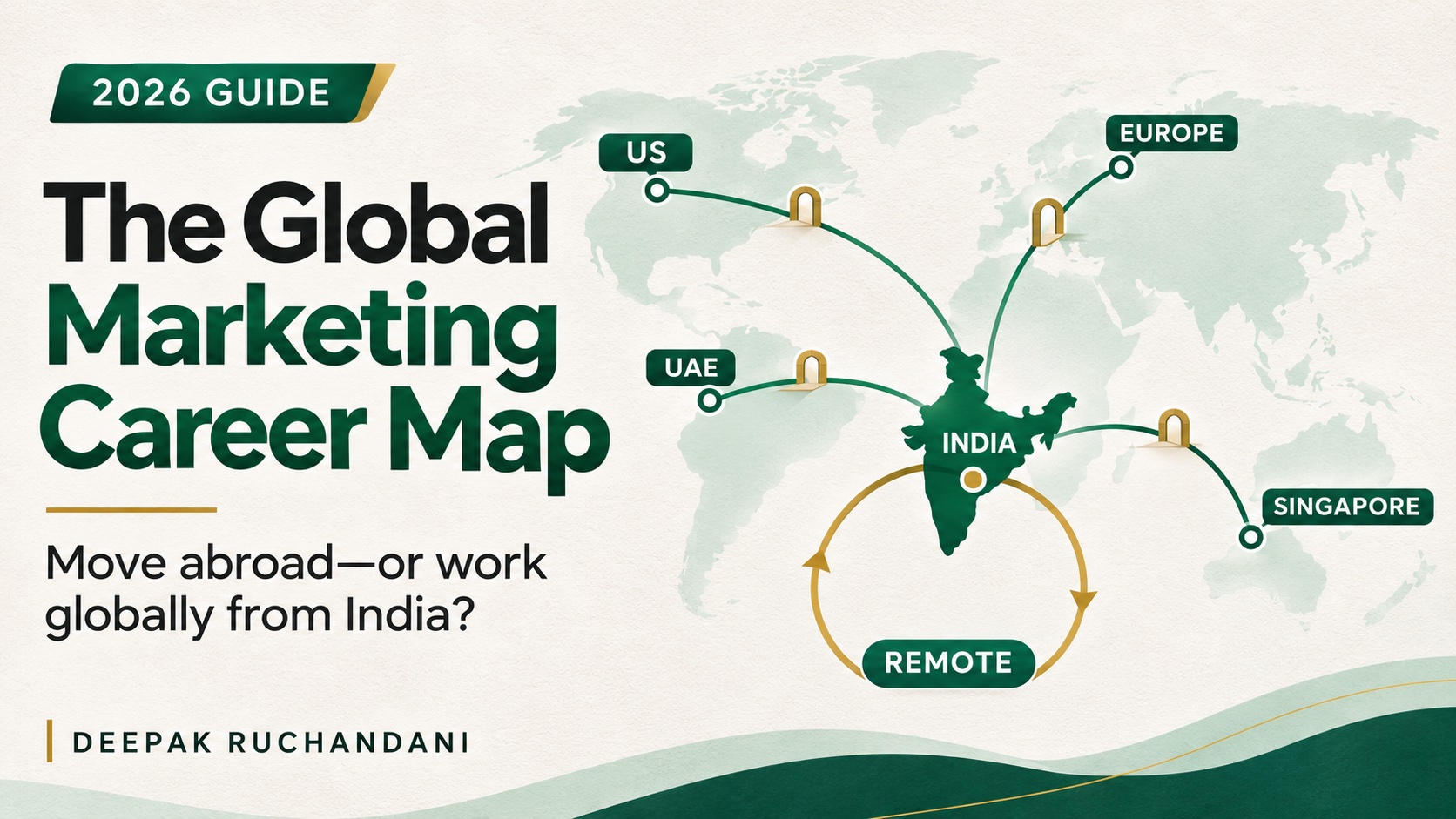
TL;DR: In 2026, Indian marketers have more global options than ever, but each door has its own entry fee. The Gulf (UAE first) is the fastest move, but Saudi Arabia now requires 60% of marketing staff to be Saudi. Singapore pays well but its visa rules screen hard on salary. Europe and the UK have clear, published salary floors. The US is the hardest door to walk through. The highest-ROI option for many is a remote role for a global company, without leaving India. Pick your market by which door your profile already fits, not by which city sounds best.
Why should an Indian marketer look abroad in 2026?
Because the map has changed faster than most career advice has. Four shifts happened in the last 12 months, and each one opens or closes a door.
- The Gulf got more selective. Saudi Arabia began enforcing a 60% Saudization quota for marketing and sales roles on 19 April 2026 (HRSD). It is a quota, not a ban: expats can still be hired, but the bar is higher.
- Singapore raised its salary floor. The Employment Pass minimum salary moves to S$6,000, and new COMPASS salary benchmarks apply to new applications from 1 January 2027 (Singapore Global Network, EY).
- The US lottery now rewards pay, not luck. From February 2026, the H-1B lottery is weighted by wage level, giving higher-paid positions up to four times the chance of selection (HSF Kramer).
- Remote global roles reached India. Companies like ClickHouse are hiring India-based field and product marketers to build pipeline in the region (Remowork). Remote US is the largest single market for product marketing postings (Corvi).
The takeaway: "going global" is no longer one decision. It is four or five different decisions, each with a different price of entry. The rest of this guide prices each one.
The map at a glance: where should you look first?
Ranked from easiest to hardest entry for a mid-to-senior Indian marketer. Salary floors are the visa minimums for 2026. Your real offer has to clear them on base pay alone.
| Market | Main route | 2026 visa salary floor | Entry difficulty | Best fit |
|---|---|---|---|---|
| Remote from India | No visa | None | Low | PMM, demand gen, field marketing |
| UAE | Employer-sponsored work visa | None published (Golden Visa: AED 30,000/month basic) | Low to medium | Growth, brand, regional B2B |
| Malaysia | Employment Pass | RM5,000 to RM20,000+/month basic, by category | Medium | Regional and shared-services marketing |
| Saudi Arabia | Employer-sponsored work visa | None published; 60% Saudization quota | Medium (senior roles) | Senior, specialist, regional leads |
| Ireland | General / Critical Skills Permit | €36,605 / €40,904 per year | Medium | EMEA PMM and demand gen |
| Netherlands | Highly Skilled Migrant | €5,942/month (30+) | Medium | International HQ roles |
| Singapore | Employment Pass + COMPASS | S$6,000+/month, higher with age | Medium to high | APAC PMM and demand gen |
| Germany | EU Blue Card | €50,700/year | Medium to high | SaaS and startup marketing |
| UK | Skilled Worker | £50,100/year (marketing managers) | High | Senior PMM, growth leads |
| Australia | Skills in Demand 482 | A$79,423 core / A$146,576 specialist | High | Senior and specialist roles |
| Canada | Express Entry (points) | No salary floor; score-based | High | Strong-score applicants |
| US | H-1B or intra-company transfer | Wage-weighted lottery | Very high | Via a global employer, two-step |
Each row is sourced in its section below. Difficulty is our judgment based on those rules.
Middle East: is the Gulf still the easiest move for Indian marketers?
Yes for the UAE, with conditions for Saudi Arabia and Qatar. The Gulf has the shortest flights home, a large Indian community, and employer-sponsored work visas that don't use a lottery or a points test. What changed in 2026 is that localisation quotas now shape who gets hired, and where.
Where the Gulf marketing jobs are
JobXDubai counted 1,018 open marketing and communications jobs across the Gulf in October 2026: 467 in Saudi Arabia, 396 in the UAE and 64 in Qatar (JobXDubai). In its marketing-only feed, the most active employers were hotel groups (Hilton, Accor, Marriott, IHG) and the delivery app Keeta. Where employers stated pay, the median was AED 15,000 to 21,000 a month (JobXDubai).
What that tells you: most Gulf marketing demand sits in hospitality, retail, real estate and consumer brands. B2B SaaS and product marketing roles exist, but they are a smaller slice. Tech players like Delivery Hero, Binance and Spotify hire marketers in Dubai, and those roles lean towards growth and product communications (JobRise).
UAE: the default first stop
- Visa: an employer-sponsored work permit and residence visa. No lottery, no points test, no published minimum salary for a standard work visa.
- The upgrade path: the 10-year Golden Visa for skilled professionals needs a basic monthly salary of at least AED 30,000. Allowances like housing and transport no longer count (Abu Dhabi Residents Office, Fragomen). For most marketers, that's a director-level salary.
- Pay signals: PayScale puts the median base for a product marketing manager in the UAE at about AED 160,000 a year (PayScale). For an experienced marketing manager, it's about AED 198,000 (PayScale). Self-reported data swings widely, so treat these as rough reference points, not offers.
- What hiring managers want: commercial leaders who combine strategy, customer focus and digital skills (Michael Page UAE). Recruiters also say AI skills and visibility now matter more, and employers are getting more selective (Gulf News).
Saudi Arabia: the biggest market, the steepest new rule
- The rule: since 19 April 2026, private firms with three or more workers in marketing and sales roles must have at least 60% Saudi nationals in those roles (HRSD). It covers marketing managers, advertising and PR specialists, graphic designers and related jobs (DLA Piper).
- What it really means: this is a quota, not a ban. Many technical, specialist and senior roles remain open to expats (Wego). The 40% of seats left for expats will go to people who bring something a local hire can't yet: regional leadership, B2B SaaS GTM depth, performance marketing at scale, or martech and AI skills.
- Your play: aim for senior, specialist or regional-HQ roles in Riyadh. Avoid generalist executive roles, which are the seats most likely to be localised.
Qatar: smaller, slower, still open
Qatar is moving towards formal private-sector localisation, and employers there must prioritise eligible Qatari nationals (Fragomen). Large employers already tag some marketing roles for Qataris only. Qatar Airways and QNB both list "Qatarization" brand and marketing roles (Qatar Airways Careers). Expat demand is concentrated in hospitality, banking and events.
| Gulf market | Open marketing jobs (Oct 2026) | Main visa route | Watch out for |
|---|---|---|---|
| Saudi Arabia | 467 | Employer-sponsored work visa | 60% Saudization in marketing and sales |
| UAE | 396 | Employer-sponsored work visa; Golden Visa at AED 30,000 basic | Hospitality-heavy demand; few B2B SaaS seats |
| Qatar | 64 | Employer-sponsored work visa | Qatarization priority hiring; small market |
Job counts from JobXDubai.
Southeast Asia: is Singapore worth it, and what's beyond it?
Singapore is the APAC headquarters for global SaaS and tech marketing, and it now screens hard on salary. Malaysia is the value play. Indonesia, Vietnam and the Philippines are markets you usually reach through a regional role, not a direct move.
Singapore: the regional HQ
- Why marketers go: many global B2B companies run Asia-Pacific (APAC) or Asia-Pacific-and-Japan (APJ) marketing from Singapore. That makes it the hub for regional product marketing, field marketing and demand gen roles that cover 6 to 12 countries from one desk.
- Visa: the Employment Pass (EP) has two gates. You must meet the minimum qualifying salary, then pass COMPASS, a points test on salary, qualifications, employer diversity and local hiring (MOM). The minimum qualifying salary rises to S$6,000 a month (S$6,600 in financial services) (Singapore Global Network). It also rises with age, so a senior hire needs a much higher offer.
- The trap most people miss: clearing the minimum salary doesn't mean you'll pass COMPASS (Newland Chase). New sector salary benchmarks apply to new EP applications from 1 January 2027 (EY). Ask your employer to run MOM's self-assessment tool before you resign anywhere.
- The top-tier route: the ONE Pass is a 5-year pass for people earning a fixed monthly salary of at least S$30,000 (MOM). That's CMO territory for most marketers.
- Pay signals: PayScale puts the median base for a product marketing manager in Singapore at about S$100,000 a year, and about S$121,000 for experienced PMMs (PayScale, PayScale). Rent eats a big share of that, so compare take-home after housing, not headline pay.
Malaysia: the value play
Since 1 June 2026, Malaysia's Employment Pass has three salary bands: Category I from RM20,000, Category II from RM10,000 to RM19,999, and Category III from RM5,000 to RM9,999 (MDEC FAQ). Only basic salary counts: allowances, bonuses and pay from abroad don't (MDEC FAQ). Category I passes can now last up to 10 years (EY).
Why it matters for marketers: Kuala Lumpur hosts many shared-services and regional marketing operations, and living costs are far lower than Singapore's. Category II roles may need a succession plan, which means training a local replacement (EY). Ask about this in the interview.
Indonesia, Vietnam and the Philippines: reach them through a regional role
These are big, fast-growing consumer and fintech markets. But direct moves are harder for marketers.
- Indonesia: work permits are employer-sponsored and tied to one employer and one role (Chambers). Authorities have limited some roles, including marketing advisors, to six-month work visas (BAL).
- Vietnam and the Philippines: both run employer-sponsored work permit systems that favour specialist and managerial roles. Check current rules with your employer's immigration counsel before accepting an offer.
- The smarter route: take a Singapore- or Kuala Lumpur-based regional role that covers these markets. You build SEA experience, and the employer handles a visa system built for regional hires.
| Market | Main visa | Salary floor (monthly) | Best for |
|---|---|---|---|
| Singapore | Employment Pass + COMPASS | S$6,000+, higher with age | Regional PMM, APAC demand gen |
| Singapore (top tier) | ONE Pass | S$30,000 fixed | CMO and VP-level leaders |
| Malaysia | Employment Pass Cat I / II / III | RM20,000 / RM10,000 / RM5,000 basic | Regional and shared-services marketing |
| Indonesia | Work permit + KITAS | No single published floor | Specialists on employer sponsorship |
Europe and the UK: which countries actually sponsor marketers?
Europe is the most transparent market: every route has a published salary floor you can check before you apply. The catch is that these floors are set for skilled roles, so a mid-level marketer has to land a mid-to-senior offer to qualify.
United Kingdom
- Visa: the Skilled Worker visa. Your salary must clear the higher of two numbers: the general threshold of £41,700, or the "going rate" for your occupation code (Tarve).
- What that means for marketers: the going rate for marketing and commercial managers (SOC 2432) is £50,100 a year from 8 April 2026, so that's your real floor (Tarve). Marketing managers aren't on the Immigration Salary List, so there's no discount.
- Watch out: only guaranteed base pay counts, not bonuses (AYJ Solicitors).
Germany
- Visa: the EU Blue Card. In 2026 you need a gross salary of at least €50,700 a year. A reduced floor of €45,934.20 applies to shortage occupations, recent graduates and IT specialists (RT Partner). Most marketing roles fall under the standard floor.
- The job-search route: the Opportunity Card (Chancenkarte) lets qualified non-EU workers enter Germany to look for work for up to a year without an offer, if they score at least 6 points (Make it in Germany). You can work up to 20 hours a week while you search (Make it in Germany).
- Reality check: English-only marketing roles cluster in Berlin's startup and SaaS scene. For many other employers, German is a real advantage.
Netherlands
- Visa: the Highly Skilled Migrant permit, sponsored by a recognised employer. The 2026 gross monthly floor is €5,942 if you're 30 or older and €4,357 if you're under 30, excluding holiday pay (IND).
- Why marketers like it: Amsterdam hosts many international HQs where English is the working language, and the process is fast once your employer is a recognised sponsor.
Ireland
- Visa: from 1 March 2026, the General Employment Permit needs a minimum salary of €36,605, and the Critical Skills Employment Permit needs €40,904 (Department of Enterprise).
- Why it matters: Dublin is the EMEA headquarters for many US tech companies, which means EMEA product marketing and demand gen roles. Check whether your role is on the eligible occupation lists, which changed 32 times in May 2026 (Mason Hayes & Curran).
| Country | Route | 2026 salary floor | Search without an offer? |
|---|---|---|---|
| UK | Skilled Worker | £50,100/yr for marketing managers (going rate) | No |
| Germany | EU Blue Card | €50,700/yr standard | Yes, Opportunity Card |
| Netherlands | Highly Skilled Migrant | €5,942/month (30+), €4,357 (under 30) | No |
| Ireland | General / Critical Skills Permit | €36,605 / €40,904 per year | No |
North America and Australia: are the big markets still reachable?
They pay the most and are the hardest to get into. For most Indian marketers in 2026, the US is a two-step move (work for a US company first, then transfer). Canada and Australia are possible but not built for marketers.
United States
- The lottery changed. From February 2026, the H-1B lottery is weighted by wage level, and higher-paid roles get up to four times the chance of selection (HSF Kramer). A senior, well-paid PMM role now has far better odds than a junior one.
- The $100,000 fee is in the courts. A September 2025 proclamation added a $100,000 fee for some H-1B petitions for people outside the US. On 24 July 2026, an appeals court reinstated a ruling against it, and the fee was not being required as of October 2026 (University of Colorado ISSS). This can change again, so check the latest status before planning around it.
- The realistic path for marketers: join a US company's India office or a global company with a US HQ, deliver for 1 to 2 years, then ask about an intra-company transfer. You arrive with a sponsor who already knows your work.
- Why it's still worth thinking about: remote US is the single largest market for product marketing roles, ahead of New York and San Francisco (Corvi). Many of those roles hire across borders, which is the subject of the next section.
Canada
- Route: Express Entry, a points-based permanent residence system. For 2026, Canada added targeted categories for doctors, researchers and senior managers with Canadian work experience, and transport jobs (Government of Canada).
- What it means for marketers: marketing isn't a priority category, and category draws now need at least one year of work experience (Fragomen). You can still apply through the general pool, but you'll compete on your score alone. Strong English or French test scores matter most.
Australia
- Route: the Skills in Demand (subclass 482) visa, sponsored by an employer. From 1 July 2026, the Core Skills stream needs a salary of at least A$79,423, and the Specialist Skills stream needs A$146,576 (Vialto Partners).
- What it means for marketers: the Core Skills stream only covers occupations on the Core Skills Occupation List, so check yours first (Home Affairs). Senior leaders above the specialist threshold have a cleaner path.
| Country | Main route | Key 2026 number | Verdict for marketers |
|---|---|---|---|
| US | H-1B (wage-weighted lottery) or intra-company transfer | Up to 4x odds for higher wage levels | Two-step move via a global employer |
| Canada | Express Entry (points) | 1 year experience for category draws | Possible, but marketing isn't prioritised |
| Australia | Skills in Demand 482 | A$79,423 core / A$146,576 specialist | Check occupation list; easier at senior level |
Remote from India: can you get a global career without moving?
Yes, and for many marketers this is the highest-ROI option on the map. You skip the visa, keep India's cost of living, and still earn above local rates and build global experience.
The numbers
- In a July 2026 snapshot of 2,092 active product marketing jobs worldwide, about 500 (24%) were remote (Corvi).
- Remote US was the single biggest location, with 458 roles. Bengaluru had 75 (Corvi).
- Global companies now post India-based remote roles directly. ClickHouse hired for a regional field marketing role to build awareness and pipeline in India (Remowork). Other postings include remote PMM roles for AI teams and founding marketer roles open only to India-based candidates (Jobgether on Lever).
Three types of remote role
- Regional role for a global company: you market to India or South Asia for a global brand (for example, field marketing for India). This is the easiest to land because your market knowledge is the qualification.
- Global role, India time zone: you own a product line or a channel for all markets and work mostly async, with some overlap with Europe or the US.
- US-hours role: you work on a US team's schedule. It pays the most and costs the most in sleep and family time.
How you get paid
Most global employers hire Indian staff in one of three ways: through their own Indian entity, through an Employer of Record (a third party like Deel or Remote that employs you on their behalf), or as an independent contractor. Each has different implications for tax, provident fund, health insurance and job security. Before you sign, ask which model they use and run the offer past a chartered accountant.
Remote red flags to screen for
- No clear answer on the employment model or who pays your benefits
- "Remote" roles that really expect US-hour availability without paying for it
- Pay quoted in rupees at local-market rates for a global-scope role
- No in-person time at all, which makes promotion harder in a company run from another continent
Product marketing, growth or demand gen: which role travels best?
Each role travels to a different part of the map. Pick the region where your function is in demand rather than forcing your role into a market that doesn't hire it.
| Role | Strongest markets | What global employers screen for | Indian experience that travels well |
|---|---|---|---|
| Product marketing | US (remote and onsite), Singapore APAC HQs, Dublin and Amsterdam EMEA HQs | Positioning, launches, sales enablement, win-loss, written storytelling | B2B SaaS launches, multi-segment positioning (SMB to enterprise), competitive battlecards |
| Growth marketing | Dubai consumer tech, SEA super-apps and fintech, US D2C | Experiment velocity, funnel analytics, lifecycle and CRM, paid efficiency | High-volume, price-sensitive consumer funnels; WhatsApp and app-first journeys |
| Demand generation | US and EMEA B2B SaaS, Singapore regional roles, remote-from-India roles | Pipeline ownership, ABM, attribution, sales and marketing alignment | Pipeline built across many verticals on lean budgets; outbound plus inbound orchestration |
| Field and regional marketing | Singapore, Dubai, remote India roles | Events, partner marketing, local pipeline, working with distant HQs | Running a region for a global brand; local market knowledge |
Three patterns worth knowing:
- Product marketing is most global and least visa-friendly. The deepest PMM markets (US, Singapore, EMEA HQs) are the hardest to enter on a visa. That makes remote PMM roles and two-step moves (join an India office, then transfer) the smart route.
- Growth marketers are a natural fit for the Gulf and SEA. Delivery Hero hires growth marketers in Dubai, and consumer apps there have similar funnels to India's (JobRise). Your experience with price-sensitive, mobile-first users is a direct asset.
- Demand gen has the best remote case. Pipeline is measurable, so employers trust remote demand gen leaders more easily. A clear pipeline number on your CV does the convincing for you.
AI fluency is now table stakes everywhere. UAE recruiters say AI skills and visibility increasingly decide who gets shortlisted (Gulf News). Show the AI workflows you actually run, not just the tools you've tried.
How do you pick your market? The 4D Market Filter
Run every country through four questions, in this order. If a market fails one, move on. Don't spend months applying to a country whose visa your realistic offer can't clear.
- Door: can you legally get in? Compare the visa salary floor with the offer you could realistically get. A UK marketing manager role needs £50,100 base (Tarve). If your market value there is £45,000, the door is shut, however good the job looks.
- Demand: does that market hire your function? Growth marketers find depth in Dubai and SEA. Product marketers find it in US, Singapore and EMEA tech hubs. Check live job boards for your exact title, not "marketing" in general.
- Delta: what's the real gain? Compare take-home pay after tax, rent, schooling and flights home with your India take-home. A tax-free Dubai salary and a taxed London salary with the same headline aren't the same offer.
- Direction: does it compound? Ask what the move leads to: a long-term visa (UAE Golden Visa, Germany's Blue Card), a stronger CV for the next global role, or a dead end you'll have to restart from.
A 90-day plan to go global
- Days 1 to 15: pick two target markets. Run the 4D filter on 4 to 5 countries and keep the top two. Write down the visa salary floor for each.
- Days 16 to 30: rebuild your proof. Turn your CV into outcome statements with numbers: pipeline influenced, launches shipped, CAC cut, win rate lifted. Global recruiters can't read Indian company names as a signal, so make every line self-explanatory.
- Days 31 to 45: get visible in the market. Update your LinkedIn headline and location preferences for your target markets. Post about problems your target market cares about. Join one regional community (APAC PMM groups, Dubai marketing networks).
- Days 46 to 75: run targeted outreach. Make a list of 30 companies: global firms with an India office, regional HQs in your target city, and remote-first companies hiring in India. Contact hiring managers directly, not just job portals.
- Days 76 to 90: check every offer against the filter. Before you accept, confirm the base salary clears the visa floor, the employer will sponsor, and the take-home beats your current package after costs.
What mistakes cost Indian marketers the most?
- Counting allowances towards visa floors. The UAE Golden Visa, Malaysia's Employment Pass, Germany's Blue Card and the UK Skilled Worker visa all look at base salary only (Fragomen, MDEC FAQ). A package that looks big because of housing allowance can still fail.
- Treating the minimum salary as the finish line. In Singapore, meeting the minimum doesn't mean you'll pass COMPASS (Newland Chase). In the UK, the going rate for your occupation often beats the general threshold.
- Comparing headline pay instead of take-home. Rent in Singapore or Dubai, school fees and flights home can erase much of the gap. Always compare monthly savings, not CTC.
- Applying for generalist roles in localised markets. In Saudi Arabia, generalist marketing executive seats are the ones most likely to go to nationals. Target the specialist and senior roles that remain open to expats (Wego).
- Using an India-style CV. Long responsibility lists and company names global recruiters don't recognise get skipped. Lead with outcomes, numbers and the scale of the market you handled.
- Ignoring the remote option. Many marketers chase a relocation when a remote global role would give them more savings, global experience and no visa risk.
- Planning around a rule that's still in the courts. The US $100,000 H-1B fee has gone back and forth through 2026 (University of Colorado ISSS). Check the status the week you decide, not the month you start planning.
FAQ
Which country is easiest for an Indian marketer to move to in 2026? The UAE. It uses employer-sponsored work visas with no lottery, points test or published minimum salary for a standard work visa. Demand is strongest in hospitality, retail and consumer tech (JobXDubai).
Can Indian marketers still get jobs in Saudi Arabia after the 60% Saudization rule? Yes. The rule is a quota, not a ban: 40% of marketing seats in covered firms can still go to expats (Wego). Senior, specialist and regional roles are your best bet.
What salary do I need for a Singapore Employment Pass? The minimum qualifying salary rises to S$6,000 a month, higher in financial services and for older candidates (Singapore Global Network). You must also pass the COMPASS points test (MOM).
What's the minimum salary for a UK visa as a marketing manager? £50,100 a year, the 2026 going rate for marketing and commercial managers. It's higher than the £41,700 general threshold, so it applies instead (Tarve).
Can I work for a US or European company without leaving India? Yes. About a quarter of product marketing postings in a July 2026 snapshot were remote (Corvi), and global companies are posting India-based roles directly. Check whether you'll be hired through an Indian entity, an Employer of Record or as a contractor.
Is Germany realistic without speaking German? For English-first startups and SaaS companies, yes. The Opportunity Card lets you search in Germany for up to a year without an offer if you score at least 6 points (Make it in Germany). Outside that niche, German widens your options a lot.
Sources
Visa rules and salary floors change every year. Every figure here was checked against these sources in November 2026; confirm with the official page before you act.
Middle East
- HRSD: Saudization in marketing and sales professions
- DLA Piper: Saudi Arabia increases Saudisation in marketing and sales roles
- Wego: Saudization jobs 2026
- JobXDubai: Marketing & Communications job market in the Gulf
- JobXDubai: Marketing jobs in the UAE & Gulf
- JobRise: Marketing jobs in the UAE, Oct 2026
- Abu Dhabi Residents Office: Golden Visa for skilled professionals
- Fragomen: UAE Golden Visa changes
- PayScale: Product Marketing Manager salary, UAE
- PayScale: Experienced Marketing Manager salary, UAE
- Michael Page UAE: Sales and marketing salary guide
- Gulf News: Jobs in the UAE, sectors hiring
- Fragomen: Qatar nationalization law
- Qatar Airways Careers: Qatarization marketing role
Southeast Asia
- MOM: COMPASS
- MOM: ONE Pass key facts
- Singapore Global Network: 2026 talent policy changes
- EY: Singapore COMPASS salary benchmarks, Aug 2026
- Newland Chase: COMPASS C1 benchmarks for 2027
- PayScale: Product Marketing Manager salary, Singapore
- PayScale: Experienced Product Marketing Manager salary, Singapore
- MDEC: Revised Employment Pass policy FAQ
- EY: Malaysia EP salary and validity changes
- Chambers: Corporate Immigration 2026, Indonesia
- BAL: Indonesia work visas limited to 6 months for some roles
Europe and UK
- Tarve: SOC 2432 going rate 2026
- AYJ Solicitors: Skilled Worker going rates
- RT Partner: EU Blue Card minimum salary 2026
- Make it in Germany: Opportunity Card
- Make it in Germany: Opportunity Card after one year
- IND: Fees and required amounts for 2026
- Department of Enterprise, Ireland: Employment permit thresholds
- Mason Hayes & Curran: 2026 updates to Ireland's permit regime
North America and Australia
- HSF Kramer: Navigating the new H-1B lottery
- University of Colorado ISSS: $100,000 H-1B fee status
- Government of Canada: 2026 Express Entry categories
- Fragomen: Canada Express Entry updates for 2026
- Vialto Partners: Australia income thresholds from 1 July 2026
- Home Affairs: Skills in Demand visa
Remote and global