

Your Positioning Doc Is Now Infrastructure: How PMMs and GTM Engineers Build the Context Layer Together
What a GTM context layer is, the five-layer context stack, who owns what across PMM, GTM engineering and RevOps, a 30-day build plan, sample files, eight workflows it powers and how to keep it fresh.
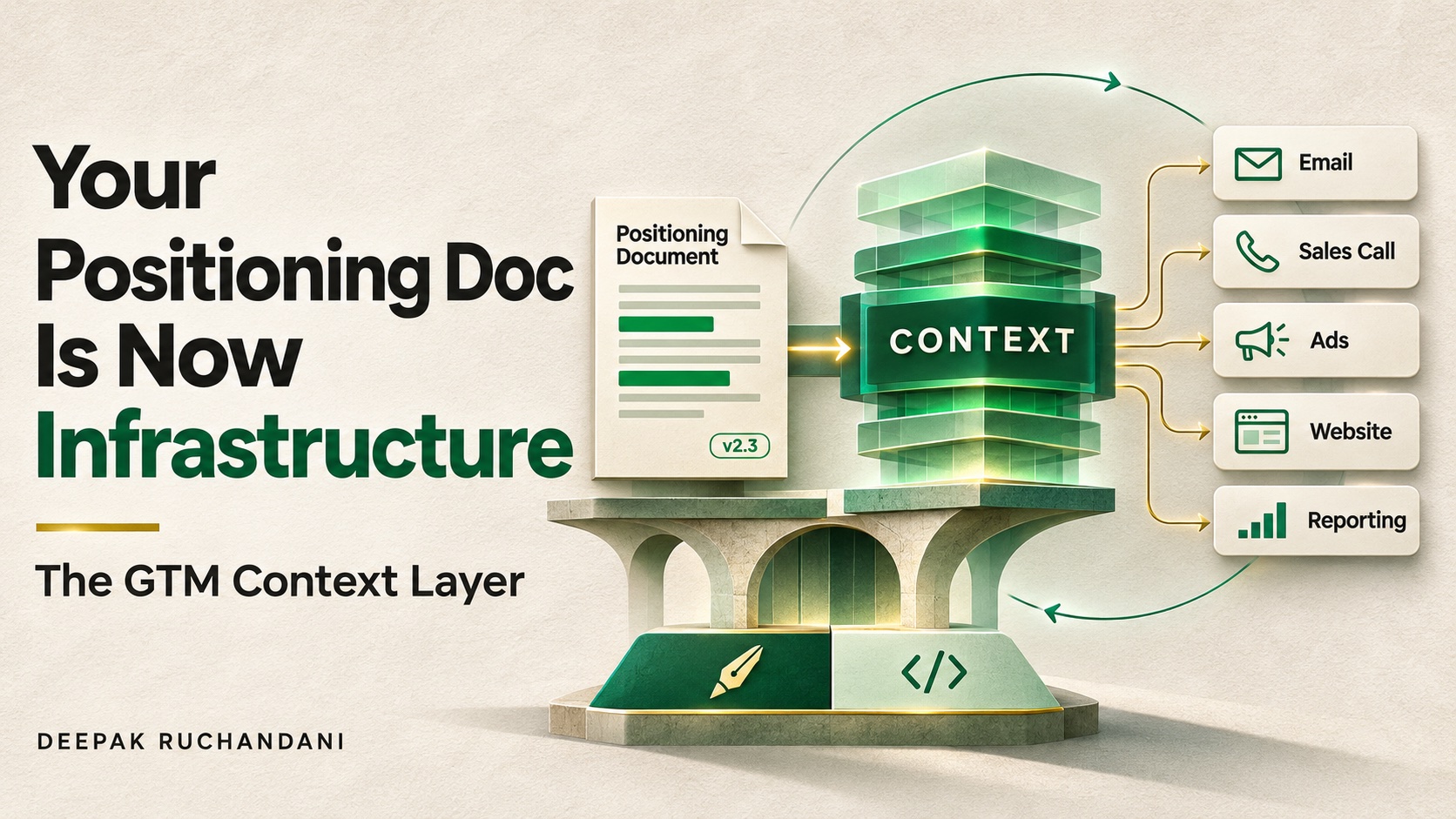
TL;DR: AI agents now write emails, qualify leads, build decks and prep sales calls. They can only do that well if they can read your positioning, ICP, personas, proof points and voice rules in a structured form. That structured, versioned, machine-readable source of go-to-market truth is the GTM context layer. Product marketing owns what goes in it. GTM engineering owns how it is stored, served and measured. Built together, it turns the positioning doc from a slide nobody opens into infrastructure every person and agent runs on.
Who this is for: product marketers, GTM engineers, RevOps and marketing ops leaders, and founders who have bought AI tools and are wondering why the output still sounds generic.
Why does AI-generated GTM content still sound generic?
AI GTM output sounds generic because the agents are starved of strategy, not because the models are weak. A model knows the internet. It doesn't know your ICP, which competitor you lose to, the three proof points sales trusts, or the claim legal banned last quarter. Unless someone feeds that in every time, it falls back on the average of everything it has read.
Most companies hit the same wall:
- The spend is there, the scale is not. Gartner's 2026 CMO Spend Survey, as cited by Klaviyo, found CMOs put an average of 15.3% of marketing budgets into AI initiatives, but only 30% of those organisations say they are ready to scale (Klaviyo).
- Review queues eat the time savings. Off-brand output is hard to describe, so it piles up with human reviewers. Product details drift and unapproved claims slip in (Hightouch).
- Audiences tune out. Hightouch cites an eMarketer survey where consumer preference for AI-generated content fell to 26%, from 60% in 2023 (Hightouch).
- Positioning is scattered. Positioning sits in a Google Doc, competitive intel in a Notion page, and ICP criteria in a spreadsheet. Humans can read them, but AI can't use them reliably (Octave glossary).
Here's what this looks like in practice. A PMM ships a sharp new positioning in March. In June, the SDR team's AI sequences still pitch the old value proposition, the website chatbot quotes last year's pricing tiers, and the paid team's AI-made ads lead with a feature the product team de-prioritised. Nobody did anything wrong. The positioning just never reached the machines.
What is a GTM context layer?
A GTM context layer is the single, structured, versioned source of go-to-market knowledge that every human, workflow and AI agent reads from before acting. Octave, which markets itself as a context-layer platform, defines it as the infrastructure that stores, organises and serves go-to-market knowledge to AI systems and automated workflows (Octave glossary).
The simplest way to understand it is through two kinds of context, a distinction Octave set out in July 2026 (Octave):
| Type 1: facts and events | Type 2: strategy and opinion | |
|---|---|---|
| What it is | What happened in and around the business | How the company interprets what happened and what to do about it |
| Examples | CRM history, product usage, call recordings, support logs, firmographics, news | ICP and anti-ICP, personas and pains, use cases, differentiation, voice, sales plays, proof points, objection handling |
| Who usually owns it | RevOps, data and GTM engineering | Product marketing, with sales and leadership |
| Without the other | Data with no judgement: agents know a company raised a Series C but not why that matters | Strategy with no evidence: agents repeat messaging that never adapts to the account |
Type 1 is data most companies already have. Type 2 is what's missing, and it's exactly what product marketing produces. That's the core argument of this post: positioning stops being a document and becomes a dependency.
What the context layer is not
- Not a prompt library. Prompts are instructions. The context layer is the knowledge those instructions draw on.
- Not a dump of every document. Anthropic's engineering team describes context as a finite resource with diminishing returns: as more tokens are added, a model's ability to recall information from them declines (Anthropic). Curated beats complete.
- Not a vendor's shared model. Snowflake argues that brands should own and govern their context and keep models swappable, rather than handing strategic patterns to platforms whose shared models may also help competitors (Snowflake, Jul 9, 2026).
- Not a one-time project. Positioning, pricing and competitors change. A context layer without owners and refresh cycles becomes a confident source of outdated facts.
Why is the context layer becoming a priority now?
Five shifts in 2025 and 2026 turned the context layer from a nice idea into a hiring and budget priority.
- Context engineering became a named discipline. Anthropic calls context engineering the natural progression of prompt engineering: curating the smallest set of high-signal information a model needs (Anthropic). Scott Brinker and Frans Riemersma's State of Martech 2026 names context engineering as a key competency, describing it as "where company knowledge becomes machine-readable" (Snowflake, citing the report).
- GTM engineering job posts now ask for it. One senior GTM engineering role asks candidates to build workflows that help marketing teams produce campaign assets using centralised information about product positioning, target personas, use cases and channel best practices (job post via Growthtalent). That is a context layer described in a job description.
- A vendor category formed around it. Octave pitches a "GTM context engine". Hightouch publishes on the "brand context layer", an operational, queryable form of brand knowledge (Hightouch). Sitecore ships "brand context" as structured, reusable information for its AI agents (Sitecore docs). When three different kinds of vendor converge on one idea, it is a category.
- Agents can now plug into shared context. Model Context Protocol (MCP) servers, Claude Projects and Skills, and similar features in other assistants let one store of knowledge feed many tools. Klaviyo notes that in Claude, this context lives in Projects or Skills (Klaviyo). Airbyte's VP Marketing describes the Octave MCP inside Claude as his "right hand for strategic work" (Octave).
- Buyers increasingly ask AI first. CMSWire, citing Similarweb's 2026 index, reports that 35% of US consumers use AI tools at the product discovery stage. It argues that brands missing from AI answers usually have an infrastructure problem: knowledge AI can't reliably retrieve or trust (CMSWire). The same structured context that powers your internal agents also makes you easier for external AI to describe correctly.
One early proof point: WorkSpan, a Series D B2B SaaS company, built what Octave calls a headless GTM context layer powering 10+ tools and its whole GTM team. The case study reports a 130% increase in pipeline per marketing dollar and 122% more pipeline per BDR as part of a broader AI transformation (Octave case study). These are vendor-reported numbers, so treat them as directional, not as a benchmark.
What goes into a GTM context layer? The five-layer context stack
A working GTM context layer has five content layers that product marketing writes, one serving layer that GTM engineering builds, and a feedback loop that keeps it honest. I call it the five-layer GTM context stack. It combines the entity-and-relationship structure Octave describes (entity store, relationship graph, retrieval, version control, feedback capture) (Octave glossary) with what Hightouch says makes a brand context layer work: queryable during generation, source systems left in place, open access and compounding feedback (Hightouch).
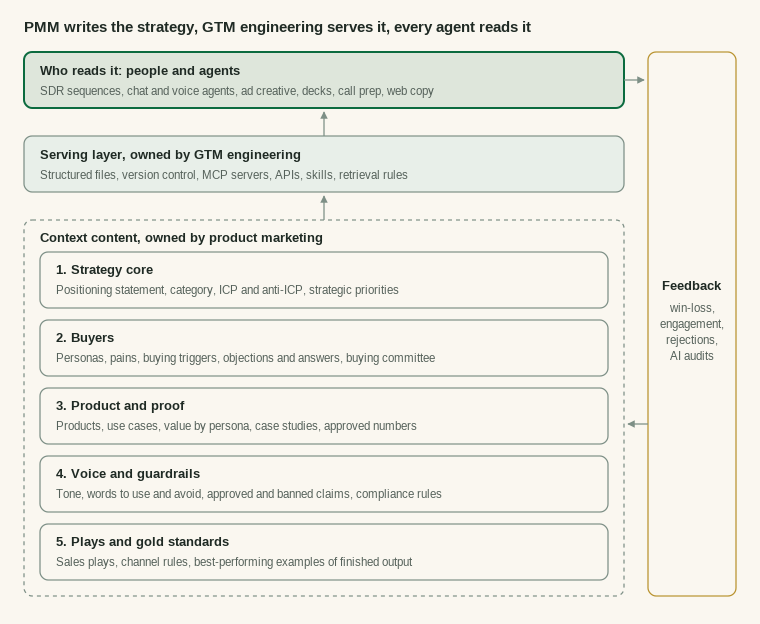
Read it from the bottom up. Strategy is written once in the content layers, served through one serving layer, and read by every person and agent at the top. What happens in the market flows back on the right and updates the content.
What each layer holds
- Strategy core. A positioning statement built on a proven framework such as April Dunford's (competitive alternatives, unique attributes, value, best-fit customers, market category). Add the ICP and, just as important, the anti-ICP: who not to sell to. Octave stresses that strategic context should be opinionated and should define who not to target (Octave).
- Buyers. Personas with their jobs, pains, the language they actually use, buying triggers, the buying committee and objections with approved responses.
- Product and proof. Products and packages, use cases mapped to personas, value statements, case studies, and the approved numbers sales can quote, each with a source and an expiry date.
- Voice and guardrails. Tone, words to use and avoid, approved and banned claims, legal and compliance rules, and regional or regulatory variations (for example, BFSI disclaimers).
- Plays and gold standards. Sales plays (who, when, which message), channel rules (what a good LinkedIn ad or cold email looks like), and three to five excellent finished examples per asset type. Anthropic recommends a small set of diverse, canonical examples over a long list of edge cases (Anthropic).
Serving layer. The same knowledge stored as structured files (Markdown with YAML front matter, or JSON), kept under version control, and exposed through whatever your agents can read: an MCP server, Claude Skills or Projects, a custom GPT's knowledge, an API, or a vendor context platform.
Feedback loop. Win-loss outcomes, engagement and conversion by message, reviewer rejections and monthly audits of what AI assistants say about you all flow back to the PMM, who updates the content.
Who owns what? Product marketing vs GTM engineering vs RevOps
Product marketing owns the meaning, GTM engineering owns the machinery, and RevOps owns the data and the measurement. Things break in the gaps: a PMM who writes a positioning doc no agent can read, or a GTM engineer who hard-codes messaging into 40 Clay columns with no source of truth.
| Responsibility | Product marketing | GTM engineering | RevOps / marketing ops | Sales and leadership |
|---|---|---|---|---|
| Positioning, ICP, anti-ICP | Owns | Consulted on how it is encoded | Supplies win-rate and segment data | Approves |
| Personas, pains, objections | Owns | Consulted | Supplies call and CRM evidence | Contributes field input |
| Proof points and approved numbers | Owns, with an expiry date on each | Builds the expiry alerts | Verifies the data behind them | Legal approves claims |
| Voice and guardrails | Owns with brand and legal | Turns rules into automated checks | Not involved | Legal and compliance approve |
| Schema and file structure | Co-designs | Owns | Consulted | Not involved |
| Storage, version control, access | Consulted | Owns | Consulted on CRM sync | Not involved |
| Serving to agents (MCP, skills, APIs) | Tests output quality | Owns | Connects CRM and data | Not involved |
| Workflows that consume context | Defines what "good" looks like | Builds and maintains | Owns routing, scoring and data | Uses the output |
| Evaluation and feedback | Owns quality rubrics and reviews | Owns evaluation runs and logging | Owns outcome metrics | Gives feedback on the output |
| Change management | Announces positioning changes | Ships the change to all systems in one release | Updates fields and reports | Gets enabled on the new message |
The one rule that makes this work: no agent, sequence or prompt may contain its own copy of positioning. Everything references the context layer. When the PMM changes a value proposition, it changes everywhere in one release. Harmonic Security's team describes exactly this outcome with Octave: positioning is updated once and every campaign reflects it (Octave).
How do you build a GTM context layer in 30 days?
You can build a usable first version in four weeks with one PMM, one GTM engineer or technical marketer, and access to call recordings and CRM data. Start small: one product, one segment, two workflows. Scale after it works.
Week 1: Audit and extract
- List every place positioning lives today: decks, docs, the website, sequences, prompts, chatbot instructions, Clay columns, enablement content
- Pull 20 to 30 recent call transcripts (wins and losses) and the top CRM loss reasons
- Ask an AI assistant to extract personas, pains, objections and buyer language from the transcripts. The PMM checks every line
- Mark conflicts: where two sources say different things about the same thing
Week 2: Write the five layers
- Strategy core: a one-page positioning statement, ICP, anti-ICP and the top three priorities
- Buyers: one file per persona with pains, language, triggers and objection responses
- Product and proof: one file per use case, each proof point with its source, owner and expiry date
- Voice and guardrails: tone, do and don't word lists, approved and banned claims
- Plays and gold standards: two sales plays and three excellent examples each for cold email, LinkedIn ad and landing page hero
Week 3: Structure, store and serve
- Turn each file into Markdown with a YAML header (example below) so humans can read it and machines can parse it
- Store it in one versioned place: a Git repo, a Notion database with change history, or a context platform
- Expose it to the tools your team actually uses: a Claude Project or Skill, a custom GPT, an MCP server, or an API your Clay or n8n workflows call
- Remove embedded positioning from existing prompts and sequences, and point them to the layer
Week 4: Test, measure and launch
- Run the same 20 tasks (emails, ad copy, call briefs) with and without the context layer
- Score both sets blind against a rubric: accuracy, on-message, voice, specificity, usable without edits
- Fix the gaps the test exposes, then launch it for the two pilot workflows
- Set the refresh cadence and name an owner for each file
A sample file structure
gtm-context/
  00-strategy/
    positioning.md
    icp.md
    anti-icp.md
  01-buyers/
    persona-head-of-cx.md
    persona-cfo.md
    objections.md
  02-product-proof/
    use-case-lead-qualification.md
    proof-points.md
    case-studies/
  03-voice-guardrails/
    voice.md
    claims-approved.md
    claims-banned.md
  04-plays-examples/
    play-new-cro-trigger.md
    examples-cold-email.md
    examples-linkedin-ads.md
  CHANGELOG.md
A sample persona file
The YAML header gives agents fields they can filter and route on. The body gives them the nuance.
---
type: persona
id: head-of-cx
segment: mid-market BFSI, 200-2,000 employees
owner: product-marketing
last_reviewed: 2026-11-15
review_every: 90 days
linked_use_cases: [lead-qualification, payment-reminders]
linked_proof: [proof-017, proof-022]
---
## What they're measured on
First-response time, CSAT, cost per contact.

## Pains, in their words
- "Our agents spend half the day on calls that should never need a human."

## Triggers that open a conversation
New CX leader hired, festive-season volume spike, regulator complaint data published.

## Top objections and approved responses
- "Voice agents will annoy our customers." -> Lead with hand-off design and proof-017.

## Never say
Replace your team. Guaranteed savings.
The content in this example is illustrative. Replace it with what your own calls and CRM data show.
What can you build once the context layer exists?
Once the context layer exists, every new AI workflow starts with the strategy already built in. The workflow only needs the task and the account data; the strategy is already there. Here are eight workflows, each showing which layers it reads.
| Workflow | What it does | Layers it reads | Owner |
|---|---|---|---|
| Signal-based outbound | Matches an account signal (new CRO, funding, hiring) to the right play and writes a persona-specific email | Strategy, buyers, plays, voice | GTM engineering |
| Lead qualification | Scores inbound leads against ICP and anti-ICP, and explains why in the CRM | Strategy, buyers | RevOps |
| Voice and chat agents | Answers product questions, handles objections and qualifies, within approved claims | Product and proof, voice, buyers | Conversational or CX team |
| Call prep briefs | One-page brief before every sales call: likely pains, relevant proof, expected objections | Buyers, product and proof, plays | Sales enablement |
| Launch kit generation | Turns a launch brief into blog, email, one-pager, ads and FAQ drafts | All five layers | Product marketing |
| Ad and landing page variants | Creates segment-specific variants of headlines and pages for testing | Strategy, buyers, voice, examples | Performance marketing |
| Battlecard refresh | Updates competitive responses when competitor pricing or messaging changes | Strategy, product and proof | Product marketing |
| AI visibility fixes | Compares what ChatGPT, Gemini and Perplexity say about you against the strategy core and flags gaps to fix on the site and in PR | Strategy, product and proof | SEO or content |
A worked example: one positioning change, ten systems
Say a mid-market SaaS company decides to stop leading with "cost savings" and lead with "speed to resolution" instead, after win-loss shows that's why it wins.
Without a context layer: the PMM updates the deck and messaging doc, sends a Slack note, and hopes. Weeks later, SDR sequences, the chatbot prompt, ad copy and the onboarding emails still say "cost savings", because each lives in a separate tool with its own copy.
With a context layer:
- The PMM edits
positioning.mdandproof-points.md, and logs the change and its reason inCHANGELOG.md. - The GTM engineer's evaluation run checks that sample outputs now lead with speed, then releases the new version.
- Every connected workflow (sequences, voice agents, ad generation, call prep) picks up the change on its next run.
- RevOps tags all activity after the release date, so you can compare reply and win rates before and after the change.
The positioning change becomes a measurable release, not a hope.
Where should the context layer live? Tool and stack options
The right home depends on your team's technical depth, how many tools need to read the context, and how much control you want. Many teams start with option 1 or 2 and move to 3 or 4 as the number of agents grows. Check vendor features before you choose; this category changes every quarter.
| Option | Best for | How agents read it | Trade-offs |
|---|---|---|---|
| 1. AI assistant workspaces (Claude Projects and Skills, ChatGPT Projects and custom GPTs, Gemini Gems) | Small teams starting out, mostly human-in-the-loop work | Uploaded files and instructions inside the assistant | Fast to start; copies drift across workspaces; hard to share with non-assistant tools |
| 2. Docs or wiki as source (Notion, Confluence, Google Docs) | PMM-led teams with light technical support | Connectors and MCP servers for those tools | Familiar for writers; needs discipline on structure and versioning |
| 3. Git repo of Markdown and YAML | Teams with a GTM engineer; Claude Code, Cursor or n8n users | Read from the repo, synced to an MCP server or API | Best version control and review; less friendly for non-technical editors |
| 4. Dedicated context platform (Octave for GTM context; Hightouch, Sitecore and others for brand context) | Scaling teams with many agents and tools | Vendor APIs, MCP servers and integrations | Fastest to scale and maintain; vendor cost; check data ownership and portability |
| 5. Built into your CRM or martech suite (HubSpot, Salesforce and similar knowledge features) | Teams that work mostly inside one suite | Native agents in that suite | Low setup; context often stays locked to that vendor's agents |
Two non-negotiables for any option:
- You own and can export it. Snowflake's argument applies here: keep models and vendors swappable so your context outlasts any one tool (Snowflake).
- Agents read it while they work, not just at setup. Hightouch lists "queryable during generation" and open access for downstream systems as core properties of a working context layer (Hightouch).
How do you keep the context layer fresh and trusted?
You treat it like a product with releases, owners and metrics. Octave's own marketing makes the case: "your context is decaying faster by the day" (Octave). Klaviyo recommends a named owner for each context artifact and an update cycle of every month or quarter (Klaviyo).
Governance rules that work
- An owner on every file, shown in its header, with a review date.
- Expiry dates on proof. Every statistic, customer quote and case study expires. Agents shouldn't use expired proof, and the owner gets an alert before the date.
- Releases, not edits. Changes go through a short review (PMM plus one reviewer from sales or legal for claims), get a changelog entry and ship as a version. Octave's glossary lists version control with a changelog, rollback and an audit trail as a core component (Octave glossary).
- A test before every release. A fixed set of 20 to 30 sample tasks runs before each release, so you catch the change that breaks the voice agent's objection handling.
- Least-privilege access. Agents get the layers they need. A website chatbot doesn't need internal win-loss notes.
- Separate public and internal context. Internal competitive teardowns and pricing floors must never reach customer-facing agents.
Metrics that prove it's working
| Metric | What it tells you | How to measure |
|---|---|---|
| Edit rate on AI drafts | Whether output is usable as is | Share of drafts sent with minor or no edits |
| Message consistency score | Whether every channel says the same thing | Monthly sample of outputs scored against the strategy core |
| Time from positioning change to full rollout | How fast strategy reaches the market | Days from release to all connected workflows updated |
| Reply, conversion and win rate by message version | Whether the strategy itself is right | CRM activity tagged with the context version |
| Stale-content count | Whether the layer is maintained | Files past their review or expiry date |
| AI-answer accuracy | Whether external AI describes you correctly | Monthly prompt audit across major assistants |
What are the most common mistakes?
- Dumping every document in. More context isn't better context. Anthropic warns of "context rot": recall gets worse as the context window fills (Anthropic). Curate the smallest set that changes the output.
- Facts without opinions. A context layer full of feature lists and firmographics, with no ICP judgement, priorities or anti-ICP, produces accurate but pointless output.
- Positioning copied into every prompt. Each copy goes stale on its own. Reference the layer; don't paste from it.
- No examples of "good". Rules alone produce stiff writing. Three excellent examples teach voice faster than three pages of rules.
- Engineering-only ownership. If GTM engineers write the positioning because the PMM is busy, the layer becomes efficient and wrong.
- PMM-only ownership. If PMMs build it as another Google Doc, it is right and unused.
- No feedback loop. If win-loss data and reviewer rejections never update the layer, it hardens into last year's guesses.
- Handing it all to one vendor. If you can't export your context, you rent your strategy.
What does this mean for PMM and GTM engineering careers?
For product marketers, this is the biggest opportunity in years. The job shifts from producing assets to writing the source code of the company's go-to-market. PMMs who can write a clear, structured, opinionated positioning layer, and judge whether agent output is on-message, become the people every AI workflow depends on.
Skills worth building as a PMM:
- Writing in structured formats (Markdown, YAML headers, clear schemas)
- Writing evaluation rubrics: what "on-message" means, scored
- Running AI-assisted win-loss and voice-of-customer analysis
- Working in Git or versioned workspaces alongside engineers
- Auditing what external AI assistants say about the brand
For GTM engineers, the context layer is what turns clever automations into a reliable system. The strongest GTM engineers will be the ones who understand positioning well enough to know when the output is technically right and strategically wrong.
Skills worth building as a GTM engineer:
- Positioning fundamentals, so you can spot a message that is off strategy
- Context schema design and retrieval patterns
- MCP servers, Skills and agent tool integration
- Evaluation pipelines and output logging
- Change management: shipping a messaging change across many systems safely
The hybrid role to watch: a "GTM context owner" or "product marketing engineer" who can both write the positioning and ship it into the stack. My bet is that this becomes a named role as more teams build context layers.
Frequently asked questions
What is the difference between a context layer and a knowledge base? A knowledge base stores documents for people to search. A context layer stores structured, opinionated GTM knowledge that AI agents read automatically while they work, with versions, owners and feedback. Many teams build the context layer from their knowledge base, but restructure it for machines.
Is this just context engineering applied to marketing? Yes. Context engineering is the discipline; the GTM context layer is the asset it produces for sales and marketing. CMSWire describes context engineering as shaping the information environment a model works in: customer data, business rules, campaign history, product information and permissions (CMSWire).
Do I need a GTM engineer to build one? Not to start. A PMM can build a strong first version in Claude Projects, a custom GPT or a structured Notion workspace. You need engineering support once several tools and agents must read the same context automatically.
Who should own the context layer? Product marketing should own the content and its accuracy. GTM engineering should own the structure, serving and evaluation. Splitting ownership this way is what keeps it both right and used.
How long does it take to see results? Edit rates and message consistency improve as soon as workflows switch to the layer, because the inputs improve immediately. Pipeline and win-rate effects take longer, usually at least one sales cycle, and should be measured against a before-and-after baseline.
The bottom line
For years, positioning docs were where good strategy went to die: written carefully, presented once, then ignored. AI agents have changed that. Every agent reads something before it acts, so the only question is whether it reads your strategy or the internet's average.
Product marketers who turn positioning into infrastructure, and GTM engineers who serve it reliably, will build go-to-market engines that say the right thing everywhere, change quickly and learn from every deal. Start with one product, one segment and two workflows this month.
Sources
- Anthropic: Effective context engineering for AI agents
- Octave: GTM context layer (glossary)
- Octave: The two types of context every agent needs (Jul 7, 2026)
- Octave: WorkSpan case study
- Octave: Solutions for marketing
- Octave: Solutions for executives
- Snowflake: Why marketers need to own their AI context layer (Jul 9, 2026)
- Klaviyo: How AI context engineering improves the connected customer experience (Sep 8, 2026)
- Hightouch: What is a brand context layer? (Apr 14, 2026)
- Sitecore: Brand context documentation
- CMSWire: Is context engineering the new AEO secret sauce?
- CMSWire: Why context engineering is becoming martech's most contested control point (Sep 24, 2026)
- Senior Manager, GTM Engineering job post (via Growthtalent)