

Marketing Just Got 4 New Engineer Jobs. Here’s the One You Should Go After
GTM, growth, marketing and AI marketing engineer — what each builds, how they compare to RevOps, a three-question decision guide, the Builder Fit Score and 90-day first builds.
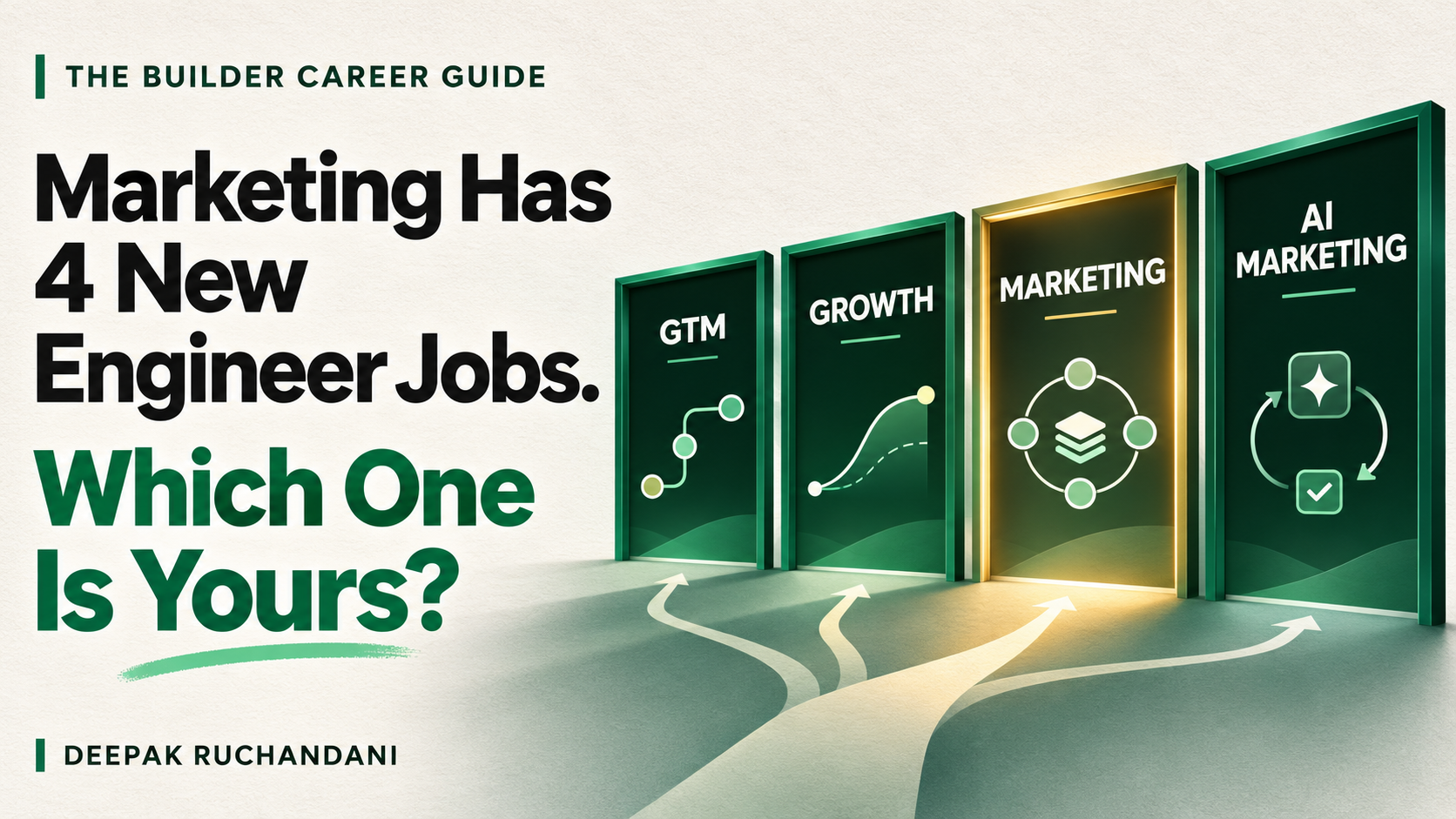
A few years ago, "engineer" was a rare word in a marketing job post. Now GTM engineer postings have tripled in a year, Figma is hiring a marketing engineer, and the Wall Street Journal has written about the role. The jobs are real. The question is which one you are built for, and the four titles are easy to confuse. This guide separates them, then gives you a three-question test to find yours.
TL;DR
All four are builder roles. They differ in what they build and where in the funnel it runs. A GTM engineer builds the outbound pipeline machine. A growth engineer builds experiments inside the product. A marketing engineer builds systems across the whole marketing surface. An AI marketing engineer builds the same systems but hands day-to-day running to supervised AI agents.
The one-line definitions
- GTM engineer: builds and maintains the systems that generate pipeline: account data, enrichment, scoring, automated outreach and routing.
- Growth engineer: a software engineer on the growth team who ships landing pages, signup flows, A/B tests and product analytics. Output is measured in lift.
- Marketing engineer: a full-stack marketer who builds AI workflows and tools that automate marketing work across channels.
- AI marketing engineer: a marketing engineer whose systems run on scheduled AI agents, with monitoring and human review, instead of someone pressing a button every morning.
Quick pick: if you love code and product funnels, aim for growth engineer. If you live in the CRM and outbound, aim for GTM engineer. If you are a product marketer, content lead or marketing ops manager who keeps automating your own work, you are already halfway to marketing engineer or AI marketing engineer.
This post builds on my earlier guide, The AI Marketing Engineer: What the Role Is, What It Does, and How to Become One.
Why did four builder titles show up at once?
Because building became cheap enough for marketers, and every company named the new builder after its own funnel. The titles arrived in this order:
| Title | Where it came from | Signal in 2026 |
|---|---|---|
| Growth engineer | Product-led growth teams at consumer and SaaS companies | The oldest of the four; common at PLG SaaS, marketplaces and consumer apps (Growth.Talent) |
| GTM engineer | Coined by Clay in 2023 for outbound and pipeline systems | Postings up 205% year over year, about 3,000 open roles in early 2026 (Onfire) |
| Marketing engineer | Introduced by Profound in early 2026; a job board followed in June 2026 | 173 people started the role in the 12 months to August 2026, up 77% (CXL) |
| AI marketing engineer | No single owner; the marketing engineer with the agent layer named | Covered by the Wall Street Journal on September 30, 2026 (JobDescription.org) |
The title is the small part of the story. In CXL's analysis of 878 US marketing job descriptions, 40% required AI skills in Q3 2026, up from 28% in Q2 and 15% in Q1. Employers want the builder skill even when the title on the posting is still "product marketing manager".
Three shifts made it happen:
- App builders and AI coding tools turned plain-language briefs into working software.
- Automation platforms such as n8n, Zapier and Make started to classify, write and decide, not just move data.
- AI agents made it possible to schedule work that used to need a person every morning.
Each team took the same capability and pointed it at its own bottleneck. Sales pointed it at pipeline. Product pointed it at activation. Marketing pointed it at everything else.
How do the four roles compare?
The cleanest way to separate them is by the system each one owns and the metric that system is judged on.
| GTM engineer | Growth engineer | Marketing engineer | AI marketing engineer | |
|---|---|---|---|---|
| Core question | How do we create more qualified pipeline? | How do we get more users to activate and pay? | How do we automate the marketing team's work? | How do we keep marketing systems running without a person in the loop every day? |
| Funnel zone | Pre-pipeline: accounts, prospects, outbound | In-product: signup, activation, retention | Whole marketing surface: content, campaigns, reporting, sales tools | Whole marketing surface, plus monitoring of the agents themselves |
| Typical builds | TAM lists, enrichment, scoring, sequences, routing | Landing pages, A/B test infrastructure, signup flows, referral loops | Context documents, brief-to-draft workflows, reporting agents, ROI calculators | Scheduled agents, voice agents for lead response, drift alerts, audit logs |
| Unit of work | A pipeline workflow | An experiment | A reusable marketing system | A supervised, always-on system |
| Success metric | Meetings, pipeline, cost per opportunity | Conversion lift, activation, retention | Hours saved, output per asset, speed to market | All of those, plus uptime and error rate |
| Common tools | Clay, HubSpot, Salesforce, Claude, n8n, Zapier, SQL | React or Next.js, Node or Python, feature flags, product analytics | n8n, Zapier, Make, Claude, Claude Code, Cursor, app builders | The marketing engineer's stack plus agent schedulers, MCP endpoints and logging |
| Coding depth | Moderate: 56% of postings ask for SQL, Python or JavaScript | High: a software engineer first | Low to moderate: no-code first, code when needed | Moderate: APIs, webhooks, debugging |
| Usually reports to | Sales, RevOps or the CRO | Head of Growth or Product | Head of Marketing | Head of Marketing, with a dotted line to tech |
| Best starting role | SDR, RevOps, sales ops | Full-stack or product engineer | Product marketer, content lead, marketing ops | Marketing engineer or marketing ops with agent experience |
| US pay signal | Median range midpoint about $160K; about $75K outside the US | $130K to $240K base, plus equity | Too new for reliable data | Too new for reliable data |
Sources for the data in this table: Onfire (GTM engineer tools, coding and pay), Growth.Talent (growth engineer builds, skills and pay), CXL (marketing engineer builds and tools), and The Keyword (AI marketing engineer scope and reporting line). Indian pay data for these titles is still thin, so treat any India number you see online with care.
What does each role actually do?
What is a GTM engineer?
A GTM engineer builds and maintains the systems that generate pipeline. The work covers account data, enrichment, account scoring, automated outreach and lead routing, with little time spent on CRM admin.
- A typical week: rebuild the ideal customer profile list, wire a new intent signal into scoring, fix a sequence whose reply rate dropped.
- What the market asks for: in Onfire's review of 209 postings, 95% mentioned AI, LLMs or agents, and the average posting named about six tools. HubSpot, Salesforce, Claude, SQL, n8n and Zapier lead the list.
- A useful warning: 91% of companies that employ GTM engineers employ only one, and about 45% of GTM engineers work in agencies or consulting. It is often a team of one.
What is a growth engineer?
A growth engineer is a software engineer embedded in a growth or product team who ships experiments. They build landing pages, A/B test infrastructure, signup flows, referral systems and the data pipelines behind experimentation. Output is measured in lift, not code shipped.
- A typical week: launch two onboarding experiments, instrument a new activation event, kill the variant that lost.
- Where the role lives: PLG SaaS, marketplaces and consumer apps.
- Who it suits: engineers who care more about user behaviour than backend performance.
What is a marketing engineer?
A marketing engineer is a marketer who builds AI workflows that take over repetitive work, so more of their time goes to strategy and decisions. Profound, which introduced the term, calls it a full-stack marketer with the skills of a builder.
- A typical week: update the shared context document that every AI tool reads, turn one campaign brief into a full first draft of assets, ship a reporting agent that writes the weekly summary.
- What employers screen for: a portfolio of working builds that real people use. Figma's Marketing Engineer, AI Deployment listing said it was open to less experience if the AI builder portfolio was strong (CXL).
What is an AI marketing engineer?
An AI marketing engineer builds the same marketing systems, but designs them to run on scheduled, supervised AI agents. The extra layer is operational: monitoring, drift detection, logs and a clear rule for when a human must step in.
- A typical week: add a voice agent that calls inbound leads within minutes and writes the summary to the CRM, review the agent's flagged conversations, tighten a prompt that started drifting off-brand.
- The defining habit: treating every build as a product with an owner, an uptime expectation and a kill switch.
I covered this role, its skills and a 90-day path in detail in The AI Marketing Engineer.
GTM engineer vs RevOps: what is the difference?
RevOps runs and optimises the revenue systems you already have. A GTM engineer builds new automated systems on top of them. The overlap is large: an analysis of over 1,000 postings found that nine out of ten GTM engineer responsibilities also appear in RevOps postings (RevOps Impact). The difference is in what each role leads with.
| RevOps | Marketing ops | GTM engineer | |
|---|---|---|---|
| Leads with | CRM ownership and forecast accuracy | Marketing automation, lead routing, attribution | Automation, integrations, outbound and prospecting systems |
| Verb | Maintain and optimise | Configure and govern | Build and ship |
| Typical output | Clean data, dashboards, forecast | Working campaigns, scoring rules, reports | New workflows, API connections, enrichment and outreach agents |
| Measured on | Forecast accuracy, data quality, process adoption | MQL quality, attribution, campaign ops speed | Pipeline created, meetings booked, cost per opportunity |
| Market size signal | 14 RevOps posts for every GTM engineering post | Part of the 5 RevTech and MarTech posts per GTM engineering post | The smallest of the three, growing fastest |
The posting ratios come from Kyle Poyar's analysis cited by Onfire. One more signal: in the US, "gtm engineer" now gets more searches than "revops", while "revops" is still the bigger term globally.
How they work together: the GTM engineer designs and ships a new workflow. RevOps folds it into existing processes, monitors it and keeps optimising it. If you are in RevOps today, the move to GTM engineer is less about new tools and more about owning new builds end to end.
A simple test: if most of your week is fixing and governing what exists, you are in RevOps or marketing ops. If most of your week is shipping systems that did not exist last month, you are doing GTM engineering, whatever your title says.
AI marketing engineer vs GTM engineer: which is wider?
The AI marketing engineer is wider; the GTM engineer is deeper. A GTM engineer goes deep on one machine: turning accounts into meetings. An AI marketing engineer covers the whole marketing surface and takes responsibility for keeping agents running safely.
| Question | GTM engineer | AI marketing engineer |
|---|---|---|
| What is the main system? | The outbound and pipeline engine | A portfolio of marketing systems run by agents |
| Who is the internal customer? | Sales and SDR teams | Marketing, sales enablement and leadership |
| What breaks if they leave? | Enrichment, scoring and sequences | Reporting, content operations, lead response, sales tools |
| What extra skill is required? | Data modelling and deliverability | Agent supervision: monitoring, drift detection, escalation rules |
Where they meet: lead response. A voice agent that calls an inbound lead within minutes, qualifies it and books a meeting could sit with either role. In sales-led teams it usually lands with the GTM engineer. In marketing-led teams it lands with the AI marketing engineer.
Marketing engineer vs AI marketing engineer: is there a real difference?
Yes, but it is about how the system runs, not what it builds. Both build the same kinds of systems. The marketing engineer's workflows usually start when a person triggers them. The AI marketing engineer's systems run on a schedule, under supervision, and alert a human when something looks wrong.
In practice, most people start as marketing engineers and grow into AI marketing engineers once their first systems are trusted enough to run unattended. Many job posts use the two titles interchangeably. Read the responsibilities, not the title.
Which role fits you? A three-question decision guide
Answer three questions in order and stop at the first yes. The questions run from the most specialised role to the broadest.
- Do you want to write production code inside a product? If yes, growth engineer.
- Do you want to own the pipeline machine that sales runs on? If yes, GTM engineer.
- Do you want your systems to run themselves, with you supervising the agents? If yes, AI marketing engineer.
If you answered no three times, you are a marketing engineer in the making. That is the most common starting point for product marketers, content leads and marketing ops managers.
The Builder Fit Score
The decision guide gives you a lane. This score tells you how ready you are for it. Rate yourself from 1 (not me) to 5 (that is my week) on each signal.
| Signal | Points to |
|---|---|
| I enjoy writing, testing and debugging code | Growth engineer |
| I think in accounts, intent signals and meetings booked | GTM engineer |
| I own positioning, content, launches or sales enablement | Marketing engineer |
| I like keeping systems running and catching failures before customers do | AI marketing engineer |
| I already automate parts of my own job without being asked | Any of the four: this is the core builder trait |
How to read it: your highest score is your starting lane. Your second highest is your next move. A score below 3 on the last row matters more than any other: build one small automation for your own work before you chase a new title.
How do you move into one of these roles from where you are?
The shortest path starts from the role you already hold. Each move below is one build you can finish in about 90 days, with proof you can show in an interview.
| You are now | Natural target | Your unfair advantage | First build to ship | Proof to capture |
|---|---|---|---|---|
| SDR or BDR | GTM engineer | You know which signals actually turn into meetings | An enrichment and scoring workflow for your own territory | Meetings booked per 100 accounts, before and after |
| RevOps or sales ops | GTM engineer | You already own the CRM and its data | A routing or re-engagement workflow that runs without manual work | Response time, pipeline recovered from dormant accounts |
| Marketing ops | Marketing engineer, then AI marketing engineer | You know the stack, the data and its gaps | A weekly reporting agent with written commentary | Reporting hours saved, decisions made faster |
| Product marketer | Marketing engineer | You own positioning, launches and sales enablement | A brief-to-assets launch workflow, or a battlecard finder for sales | Days from brief to launch-ready assets, sales usage |
| Content or demand gen lead | Marketing engineer | You know what content actually converts | A pipeline that turns one webinar into a month of assets | Output per source asset, pipeline influenced |
| Full-stack or product engineer | Growth engineer | You can ship to production | An onboarding experiment with proper instrumentation | Activation lift, test velocity |
The common thread is the advice from CXL's five-step path: pick one repeated task you own, write a context document your AI tools can read, build one workflow end to end, get a colleague to use it without you, then document the before and after (CXL). Three of these documented builds make a portfolio.
For hiring managers: which one should you hire first?
Hire for your biggest bottleneck, not for the trendiest title.
| Your biggest bottleneck | Hire first | Why |
|---|---|---|
| Not enough qualified pipeline from target accounts | GTM engineer | The returns show up directly in meetings and pipeline |
| Many signups, weak activation or retention | Growth engineer | The problem is inside the product, so it needs code and experiments |
| The marketing team is buried in repetitive work | Marketing engineer | Hours saved come back as strategy, testing and speed |
| You already have automations, but nobody owns them | AI marketing engineer | Someone has to monitor, fix and govern systems that run unattended |
Three ways to staff it (The Keyword):
- Promote from within. This is the fastest and cheapest route if someone is already automating their own work informally. The risk is changing the title without changing the scope.
- Hire externally. The talent pool is small, so judge candidates on the systems they have built, not on past titles.
- Bring in a contractor first. Use them to audit your stack and ship one visible system, then hire full-time if it pays off.
What to ask in the interview: which systems are live today, who maintains them, what broke last and how they found out. Candidates who answer with named systems and numbers have done the work. Candidates who answer with tool names have not.
Frequently asked questions
What is a marketing engineer? A marketer who builds AI workflows and tools that automate repetitive marketing work, so more time goes to strategy and decisions. The title was introduced by Profound in early 2026.
What is the difference between a GTM engineer and RevOps? RevOps maintains and optimises existing revenue systems such as the CRM, forecasting and routing. A GTM engineer builds new automated systems for enrichment, scoring and outreach. The two overlap heavily and work best together.
Is an AI marketing engineer the same as a GTM engineer? No. A GTM engineer focuses on the outbound and pipeline engine. An AI marketing engineer covers the whole marketing surface and runs those systems on supervised AI agents.
Do I need to code to become a marketing engineer? Not to start. Automation platforms and app builders handle most of the work. Basic SQL, API and debugging skills help you go further, and growth engineering does require real coding.
Which of the four roles pays the most? In the US, growth engineers and senior GTM engineers at AI and developer-tool companies sit at the top. Marketing engineer pay data is still too thin to compare reliably.
Which role is best for a product marketer? Marketing engineer. Product marketers already own positioning, launches and sales enablement, which are the inputs these systems need.
The bottom line
The four titles describe one shift: marketers and engineers are both becoming builders of systems, not just runners of campaigns. Choose by where you want to build, not by which title is trending. Pipeline points to GTM engineer. The product points to growth engineer. The whole marketing engine points to marketing engineer. Engines that run themselves point to AI marketing engineer.
Whichever you pick, the proof is the same: three live systems, each with a before-and-after number. Start with one this month.
References
- CXL, "What is a marketing engineer, and why are companies hiring them?" (2026). Source for the 77% growth in marketing engineer hires, the 40% of job descriptions that ask for AI skills, Figma's and other company listings, and the five-step path.
- The Keyword, "AI marketing engineering". Source for the definitions of all four titles, Profound's role in naming the marketing engineer, and the three ways to staff the role.
- Onfire, "GTM engineering data". Source for the 205% growth in GTM engineer postings, search demand, the tools in demand, pay data and the posting ratios against RevOps.
- RevOps Impact Newsletter, "GTM engineers: okay, so what now?". Source for the overlap between GTM engineer and RevOps responsibilities, and how the two roles divide the work.
- Growth.Talent, "Growth Engineer". Source for what growth engineers build, the skills employers want and US pay ranges.
- JobDescription.org, "AI Marketing Engineer job description". Source for the Wall Street Journal's September 30, 2026 coverage of the marketing engineer title.
- Deepak Ruchandani, "The AI Marketing Engineer: What the Role Is, What It Does, and How to Become One".
Data checked as of November 11, 2026. Job-market figures in this space change every quarter, so refresh this post each quarter.