

SEO Isn’t Dead. It Just Got Two Younger Siblings: AEO vs GEO vs SEO for B2B SaaS
SEO gets you ranked, AEO gets you quoted, GEO gets your brand named. The RAN Stack, a stage-by-stage plan for Indian B2B SaaS, a 90-day roadmap, metrics and three free templates.
TL;DR
SEO gets you ranked. AEO gets you quoted as the answer. GEO gets your brand named when ChatGPT, Perplexity, Gemini or Claude writes a recommendation. They’re not three separate jobs. They’re three layers of one job, and you have to stack them in that order.
If you run marketing at a B2B SaaS company in India, here is the short version:
- Do SEO first. Google’s AI Overviews pull almost entirely from pages that already rank. No ranking, no citation.
- Then make your pages easy to quote (AEO). Answer the question in the first two sentences. Use tables, steps and FAQs.
- Then make your brand impossible to leave out (GEO). Original data, named experts, and mentions of your brand across the web, not just on your own site.
- Ignore the shortcuts. llms.txt files, “AI-friendly” rewrites and special AI schema have no proven effect on citations as of 2026.
The rest of this guide covers the data, the ROI case, a framework (Rank, Answer, Get Named), a stage-by-stage plan for Indian startups, a 90-day roadmap, the metrics to track and three free templates you can use today.
Why this matters now: your buyer already asked ChatGPT about you
Your next customer probably formed an opinion of your product before visiting your website. Five numbers show how far this has gone:
| What changed | The number | Source |
|---|---|---|
| B2B software buyers who start research in an AI chatbot | 51% | G2, March 2026 survey of 1,076 buyers |
| US business buyers who regularly use AI to research vendors | 66% | Semrush, July 2026, 600+ professionals |
| Tech buyers who use GenAI at least as much as search for vendor research | 80% | Responsive, Oct 2025 |
| Drop in clicks to the #1 Google result when an AI Overview appears | 58% | Ahrefs, 300,000 keywords |
| Weekly ChatGPT users in India | 100 million (Feb 2026), OpenAI’s second-largest market | TechCrunch |
Here’s the twist: buyers use AI more but trust it less. Consumer trust in AI search answers fell from 82% to 54% in one year, while usage kept climbing. Forrester found the same pattern in B2B: buyers start with AI, then check what it says with peers, experts and vendors.
That changes the job. Getting a click is no longer the whole game. You have to be:
- Named in the AI answer, so you make the shortlist.
- Credible when the buyer checks you afterwards on Google, LinkedIn, G2 or Reddit.
SEO, AEO and GEO each cover a different part of that journey. That’s why the “which one should I do” question has a real answer.
What’s the ROI? The business case in numbers
AI search sends fewer visitors, but the ones it sends are much closer to buying. A buyer who clicks through from ChatGPT has usually already compared options, so they arrive ready to act. Every credible study so far points the same way:
| Study | AI-referred visitors | Traditional organic | Multiple |
|---|---|---|---|
| Ahrefs, own site data | 0.5% of traffic drove 12.1% of signups | Baseline | 23x conversion rate |
| Seer Interactive, B2B software client | 15.9% conversion (ChatGPT) | 1.76% | ~9x |
| Microsoft Clarity, 1,200+ sites | 1.66% sign-up rate | 0.15% | ~11x |
| Semrush, cross-industry | Visitor value | Baseline | 4.4x |
Keep two caveats in mind:
- The volume is still small. Demandbase found ChatGPT referrals to B2B sites grew 303% in a year but are still about 0.33% of traffic.
- Results vary by category. First Page Sage puts ChatGPT conversion for B2B SaaS at 2.4%, well below the headline numbers. Measure your own rate rather than borrowing someone else’s multiplier.
A simple ROI formula you can use
AI-influenced ARR = AI sessions × demo rate × win rate × ACV
Worked example (illustration only, plug in your own numbers). Picture an Indian B2B SaaS company with these numbers:
- 15,000 monthly organic sessions
- AI referrals at 2% of that, so 300 sessions a month
- 4% of AI visitors book a demo, so 12 demos a month
- 20% of demos close, so about 2.4 deals a month
- ₹5 lakh ACV, so roughly ₹12 lakh of new ARR every month, or ₹1.4 crore a year
At a 0.5% demo rate from ordinary organic traffic, the same 300 sessions would have produced 1 or 2 demos. This doesn’t count the bigger effect you can’t click-track: buyers who saw you named in an AI answer, then searched your brand or came in directly. That’s why branded search and “How did you hear about us?” belong in the measurement section below.
What are SEO, AEO and GEO?
What is SEO (Search Engine Optimization)?
SEO is the practice of getting your pages to rank in a search engine’s list of results, mainly Google and Bing. It covers three things: technical health (Google can crawl and index the page), relevance (the page matches what people search for), and authority (other sites trust and link to you). Success means a ranking and a click.
What is AEO (Answer Engine Optimization)?
AEO is the practice of structuring content so an answer surface quotes it as the answer. Answer surfaces include featured snippets, People Also Ask, Google AI Overviews, AI Mode, Bing Copilot and voice assistants. AEO is about how a page is shaped: a direct answer up top, question-style headings, tables, steps and FAQs. Success means your words appear inside the answer, often with a link.
What is GEO (Generative Engine Optimization)?
GEO is the practice of getting your brand mentioned and cited when an AI model writes an answer, in ChatGPT, Perplexity, Gemini, Claude or Copilot. The term comes from a 2023 research paper by Princeton, IIT Delhi, Georgia Tech and Allen Institute for AI researchers, presented at KDD 2024. GEO is about evidence and reputation: original data, named sources, and how often the rest of the internet talks about you. Success means your brand is named in the answer, ideally as a recommendation.
The one-line version
- SEO asks: Can they find my page?
- AEO asks: Will the machine quote my page?
- GEO asks: Will the machine name my brand, even when it doesn’t link to me?
AEO vs GEO vs SEO: side by side
Same goal, different finish lines. Screenshot this table for your next marketing review.
| SEO | AEO | GEO | |
|---|---|---|---|
| Goal | Rank in the results list | Be quoted as the answer | Be named or recommended by AI |
| Where it shows up | Google, Bing blue links | Featured snippets, People Also Ask, AI Overviews, AI Mode, voice | ChatGPT, Perplexity, Gemini, Claude, Copilot |
| Unit of success | A click | A quoted passage | A brand mention or citation |
| Main levers | Crawlability, keywords, links, page experience | Answer-first writing, question headings, tables, FAQs | Original data, expert quotes, web-wide brand mentions, reviews |
| Who it rewards | Strong domains | Clear, well-structured pages | Brands the internet already talks about |
| Biggest risk | Traffic lost to zero-click answers | Quoted without a click | Left out, or described wrongly |
| Key metric | Rankings, organic sessions | Snippet and AI Overview presence | AI share of voice, citation rate |
| Time to results | 3 to 6 months for a new site | Weeks, once you rank | Months; it compounds with brand |
The row that matters most is “Who it rewards”. SEO rewards your domain. AEO rewards your page. GEO rewards your reputation. A startup can win the page quickly, but has to build the reputation.
The awkward truth: Google says it’s all just SEO
Before you hire a “GEO agency”, read what Google itself says. In May 2026, Google published its first guide to optimizing for AI features. Its position: for AI Overviews and AI Mode, there are no extra requirements and no special optimizations beyond normal SEO (Google Search Central; Search Engine Journal’s summary).
The data backs Google up on its own turf. One analysis found that 99% of URLs cited in AI Overviews come from pages already in the organic top 10. AI Overviews read from Google’s own index. If you don’t rank, you don’t get cited.
Where “it’s just SEO” stops being true
Google’s guide covers Google’s surfaces. It says nothing binding about ChatGPT, Perplexity or Claude, and those engines behave differently:
- They cite different sources. Only 11% of domains are cited by both ChatGPT and Perplexity. A 2026 study of 11,500 queries found almost no overlap between the sources different AI engines cite.
- They weigh reputation over links. Ahrefs’ study of 75,000 brands found branded web mentions correlate with AI Overview visibility at 0.664, versus 0.218 for backlinks. Being talked about matters more than being linked to.
- They favour fresh content and communities. Perplexity prioritizes fresh content and pulls more from Reddit than Google does.
My take: SEO is the foundation, not the whole building. AEO is mostly good SEO writing done properly. GEO is where it truly differs, because it’s really brand-building and PR in a new channel. That’s why the framework in the next section stacks all three.
The framework: Rank, Answer, Get Named (the RAN Stack)
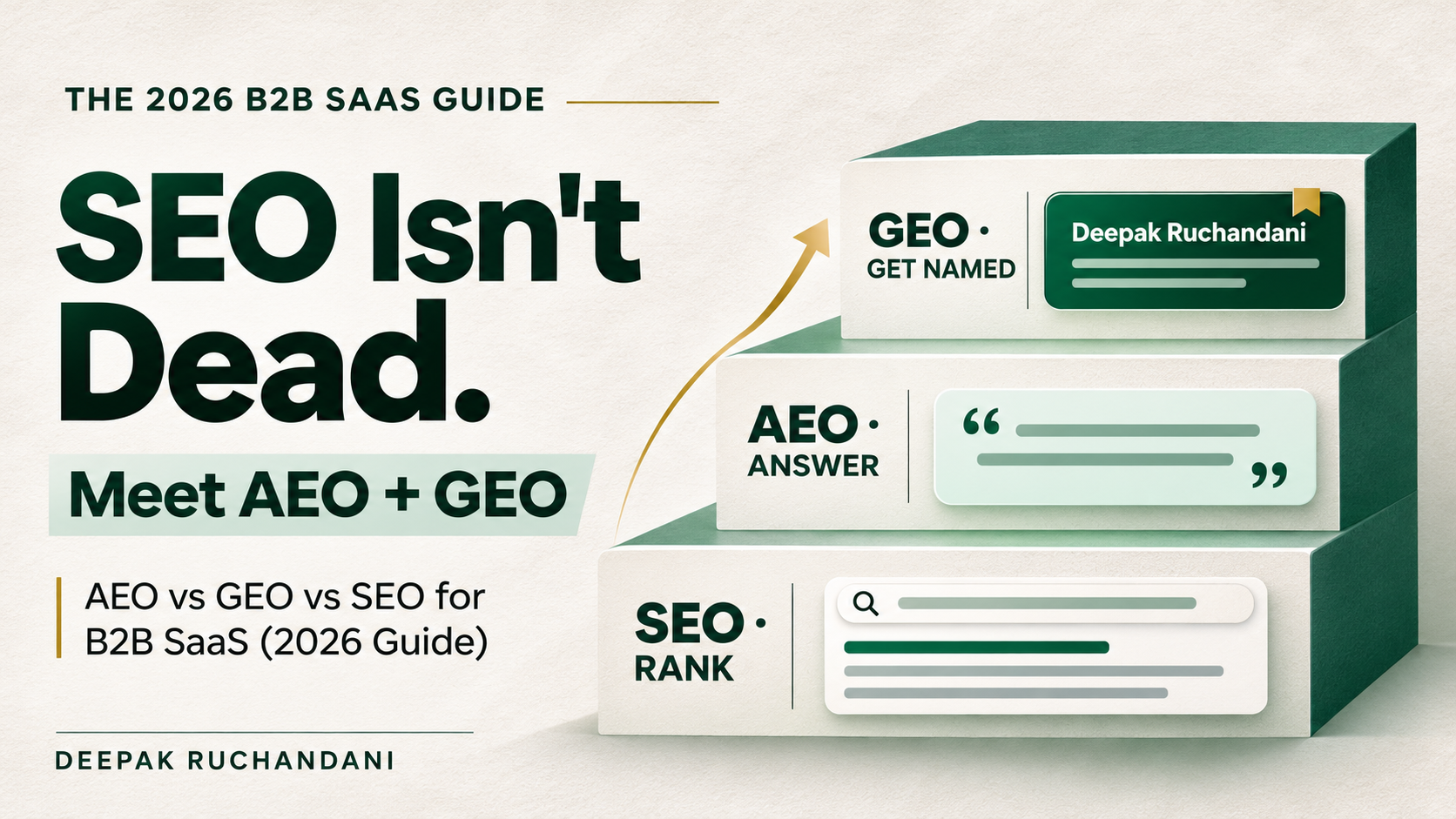
Stop treating SEO, AEO and GEO as three budgets. Treat them as three floors of one building. Each floor needs the one below it.
Read it bottom up: ranking makes a page findable, structure makes it quotable, and reputation gets the brand named.
Layer 1: Rank (SEO), so you can be found
The question this layer answers: Is my page in the index and in the top 10 for the question my buyer asks?
- Make every important page crawlable and indexable. Check robots.txt and your CDN or firewall bot settings, so you don’t block Googlebot, Bingbot, GPTBot, ClaudeBot or PerplexityBot by accident.
- Pick one buyer question per page. Long, specific questions (“best voice agent platform for NBFC collections in India”) beat broad terms (“voice AI”) for a young domain.
- Group pages into clusters: one pillar page, five to eight supporting pages, all linked to each other.
- Earn links from Indian SaaS communities, newsletters and partner sites.
Layer 2: Answer (AEO), so you can be quoted
The question this layer answers: Can a machine lift a clean, correct answer from my page in one pass?
- Answer first. Put a 40 to 60 word direct answer under the H1 and under every H2.
- Phrase headings as questions your buyer actually types (“How much does a voice agent cost per minute in India?”).
- Keep sections self-contained. Sections of 50 to 150 words earned 2.3x more citations than long, unstructured pieces.
- Use tables for comparisons and numbered lists for processes. These are the formats cited most often.
- End with an FAQ of five real questions. Add Article, FAQPage and Person schema as normal SEO hygiene, not as an AI trick.
- Write with confidence. Cited content is nearly twice as likely to use definitive language as content that gets skipped.
Layer 3: Get Named (GEO), so you’re recommended
The question this layer answers: When AI writes about my category, does it believe my brand belongs in the answer?
- Raise evidence density. In the Princeton GEO study, adding statistics, quotations and cited sources lifted visibility in AI answers by up to 40%. Replace “most companies” with “62% of the 40 Indian SaaS teams we surveyed”.
- Publish something nobody else has. AI systems prefer original research and case studies over rewritten summaries.
- Get mentioned off your own site. LinkedIn posts, podcasts, YouTube, Reddit threads, G2 and Capterra reviews, Indian trade media. Ahrefs’ December 2025 follow-up reportedly found YouTube mentions had the strongest correlation with AI brand visibility of any signal tested.
- Describe yourself the same way everywhere. Use one sentence for what your company is and who it’s for, repeated on your site, LinkedIn, Crunchbase, G2 and press releases. Consistent descriptions make it easier for AI to place you in a category.
- Keep it fresh. Update key pages every quarter and show the “last updated” date.
What the research actually proves (and how sure we can be)
Most AEO/GEO advice online is opinion dressed up as fact. Here is what holds up, rated by the strength of the evidence.
| Claim | Evidence | Strength |
|---|---|---|
| Ranking in Google’s top 10 is the gateway to AI Overviews | 99% of AI Overview citations come from top-10 pages; Google’s own guide says AI features use its normal Search index | Strong |
| Statistics, quotations and cited sources raise AI visibility | Peer-reviewed Princeton study, 10,000 queries; up to 40% lift, up to 37% on Perplexity | Strong (controlled study) |
| Off-site brand mentions beat backlinks for AI visibility | Ahrefs, 75,000 brands: 0.664 vs 0.218 correlation | Medium (correlation, not causation) |
| Short, self-contained sections get cited more | Industry analysis of 23,000+ citations: 2.3x more | Medium |
| Perplexity favours fresh content and Reddit | Multiple citation-pattern studies | Medium |
| llms.txt files improve AI citations | 97% of llms.txt files got zero requests in May 2026; no citation lift found in studies of 300,000+ domains | Disproven for now |
Two cautions. First, the Princeton figures came from a lab setup, so treat “up to 40%” as a direction, not a promise. Second, the Ahrefs data shows correlation: famous brands get mentioned more and cited more. The lesson still holds. Being part of the conversation is what gets you named.
What to ignore: five AI-search shortcuts that don’t work
Every new channel attracts hacks. Save your team’s hours by skipping these:
- Treating llms.txt as a growth lever. Ahrefs tracked 137,210 domains and found 97% of llms.txt files got zero requests in May 2026. Google says it doesn’t use the file. It costs nothing to publish, but it won’t move citations.
- Chopping pages into tiny chunks “for AI”. Google’s guide says chunking, special AI rewrites and special schema aren’t needed. Write short sections because humans scan, not because a bot wants it.
- Mass-producing AI content. Thin, summarised content is being excluded from AI Overviews. If ChatGPT could write your post, ChatGPT doesn’t need to cite it.
- Buying your way into AI answers. Branded ad traffic shows only a weak correlation (0.216) with AI Overview mentions.
- Fake mentions and review farms. AI engines cross-check sources, and so do buyers. Forrester found buyers verify AI output with peers and experts. A fake signal that gets caught costs more than it earns.
So which one first? A stage-by-stage answer for Indian B2B SaaS
The honest answer depends on how much of a reputation you already have. Use the table below to find your stage.
| Your stage | Lead with | Why | Put 70% of effort into |
|---|---|---|---|
| Pre-PMF, under ₹1 Cr ARR | SEO + AEO on long-tail questions | You have no brand for AI to name yet. Win the specific questions big players ignore. | 10 to 15 answer-first pages for your exact ICP, plus founder posts on LinkedIn |
| Early traction, ₹1 to 10 Cr ARR | AEO + early GEO | You rank for some terms. Now make those pages quotable and start earning mentions. | Comparison pages, customer stories with numbers, G2 and Capterra reviews |
| Growth, ₹10 Cr+ ARR or category leader | GEO | Buyers ask AI for “best X in India”. You need to be on that list, described correctly. | Original research, PR, analyst and podcast presence, AI visibility tracking |
The India advantage most teams miss
Global SaaS brands write for a US buyer. That leaves a gap in questions only an Indian buyer asks, and AI engines need someone to cite for them. For example:
- “Is [category] software compliant with India’s DPDP Act?”
- “[Category] pricing in INR, with GST”
- “Does it integrate with WhatsApp, Tally, Razorpay or UPI?”
- “Best [category] for BFSI, NBFCs or edtech in India”
- “How does [your product] compare with [global tool] for Indian teams?”
Each of these is a page you can rank for in weeks, get quoted for quickly, and use to get named for India-specific prompts.
Your 90-day AEO + GEO plan
Three phases of 30 days each, one per layer of the RAN Stack. Tick them off as you go.
Days 1 to 30: Rank (fix the foundation)
- Run a baseline: ask ChatGPT, Perplexity, Gemini and Google AI Mode the 20 questions your buyers ask most. Record who gets named and which pages get cited.
- Check robots.txt and CDN bot settings so search and AI crawlers can reach your pages.
- Fix indexing problems in Google Search Console and Bing Webmaster Tools.
- Pick one pillar topic and map 6 to 8 supporting questions, at least 2 of them India-specific.
- Publish the pillar page.
Days 31 to 60: Answer (make pages quotable)
- Rewrite your top 10 traffic pages to put the answer first, with question headings.
- Add one comparison table and one FAQ block to each.
- Add Article, FAQPage, Organization and Person schema, plus an author bio with real credentials.
- Publish 4 supporting pages and link them to the pillar.
- Show a “last updated” date on every page.
Days 61 to 90: Get Named (build the reputation)
- Publish one piece of original research, such as a survey of 30 to 50 buyers or an analysis of your own product data.
- Turn it into 5 LinkedIn posts, 1 short video and 1 pitch to an Indian trade publication or newsletter.
- Ask 10 happy customers for G2 or Capterra reviews that mention a specific use case.
- Answer 5 real questions on Reddit or Quora where you have real expertise. Disclose who you work for.
- Re-run the 20-question baseline and compare.
How to measure it: the metrics that replace CTR
If AI answers the question, your click-through rate will fall even when you’re winning. Track these instead.
| Layer | Metric | How to track it |
|---|---|---|
| Rank | Top-10 rankings for your target questions | Google Search Console, Ahrefs or Semrush |
| Rank | Organic sessions to cluster pages | GA4 |
| Answer | AI Overview and AI Mode appearances | Search Console’s AI performance report (now available) |
| Answer | Featured snippets and People Also Ask wins | Ahrefs or Semrush SERP features |
| Get Named | AI share of voice: % of your target prompts where your brand is named | A monthly manual prompt test, or tools like Ahrefs Brand Radar, Profound or Otterly |
| Get Named | Citation rate: % of answers that link to your domain | The same prompt test |
| Get Named | Accuracy: is the AI describing you correctly? | The same prompt test. 27% of marketers say AI has misrepresented their brand |
| Business | AI referral sessions and demo requests | GA4 referrals from chatgpt.com, perplexity.ai, gemini.google.com |
| Business | Branded search volume | Google Search Console, Keyword Planner |
| Business | “How did you hear about us?” answers that mention ChatGPT or AI | Add it as an option on your demo form |
The last row is the cheapest and most honest metric here. AI-influenced pipeline often shows up as “direct” traffic or branded search, so ask buyers directly.
Free toolkit: steal these three templates
1. The 20-prompt AI visibility audit
Run these in ChatGPT, Perplexity, Gemini and Google AI Mode once a month. Use a logged-out or incognito session. Replace the brackets with your details.
Discovery prompts (are you on the shortlist?)
- What are the best [category] tools for [ICP] in India?
- Which [category] platforms do [industry] companies in India use?
- Recommend a [category] tool for a [company size] team with a budget of [₹X] per month.
- What are the alternatives to [market leader] for Indian companies?
- Which [category] tools integrate with [WhatsApp / Tally / Razorpay / Salesforce]?
Comparison prompts (how do you stack up?)
- [Your brand] vs [competitor 1]: which is better for [use case]?
- Compare [your brand], [competitor 1] and [competitor 2] on pricing and features.
- What are the pros and cons of [your brand]?
- Is [your brand] good for [specific use case]?
- Why do companies switch from [competitor] to [your brand]?
Problem prompts (do you own the category’s questions?)
- How do I [core job your product does] in India?
- What does [category] cost in India?
- What should I look for when buying [category] software?
- Is [category] compliant with India’s DPDP Act?
- How do I measure ROI on [category]?
Brand accuracy prompts (is AI describing you correctly?)
- What is [your brand] and who is it for?
- Who founded [your brand] and where is it based?
- What does [your brand] cost?
- What do customers say about [your brand]?
- What are [your brand]’s main features?
Log each answer in a sheet with four columns: engine, prompt, brands named, URLs cited. Your AI share of voice = prompts where you’re named ÷ 20.
2. The answer-first page template
Use this skeleton for every page you want quoted:
# [The exact question your buyer types]

[40-60 word direct answer. Name the thing, give the number, state the conclusion.]

## [Follow-up question 1]?
[1-2 sentence answer first.] [Then 50-150 words of detail, one stat with a named source.]

## [Comparison question]?
| Option | Best for | Price (INR) | Key limit |

## How to [do the thing], step by step
1. ...
2. ...

## [A real example from your work, with a number]

## FAQ
### [Question]?
[40-60 word answer]

Last updated: [date] | Author: [name, role, credentials]
3. The RAN Scorecard: score your site in 10 minutes
Give yourself 1 point for each “yes”. 13 to 15 means you’re ahead of most Indian SaaS sites. Under 8 means start with Layer 1.
| Layer | Check | Yes = 1 |
|---|---|---|
| Rank | Search and AI crawlers can reach all key pages (robots.txt, CDN, no login wall) | |
| Rank | Pages render their text without needing JavaScript | |
| Rank | Each key page targets one specific buyer question | |
| Rank | You rank top 10 for at least 5 of your 20 audit questions | |
| Rank | Your pillar and supporting pages link to each other | |
| Answer | Every key page opens with a 40-60 word direct answer | |
| Answer | Headings are phrased as real buyer questions | |
| Answer | Each comparison page has a table | |
| Answer | Key pages end with an FAQ and FAQPage schema | |
| Answer | Every page shows an author and a “last updated” date | |
| Get Named | You’ve published at least one piece of original data this year | |
| Get Named | Your one-line company description is identical across site, LinkedIn, G2 and Crunchbase | |
| Get Named | You have 20+ recent reviews on G2 or Capterra | |
| Get Named | Your brand was mentioned on 5+ external sites, podcasts or videos in the last quarter | |
| Get Named | You’re named in at least 5 of the 20 audit prompts |
FAQ
Is SEO dead because of AI search?
No. SEO is the entry ticket to AI search. Google’s AI Overviews pull from pages that already rank, and Google says no special optimization is needed beyond SEO. What has changed is the payoff: a ranking now earns fewer clicks, so you also need to be quoted and named.
What is the difference between AEO and GEO?
AEO makes a page easy to quote as the answer, mostly in Google’s surfaces and voice assistants. GEO makes a brand likely to be named and cited by AI models such as ChatGPT, Perplexity and Claude. AEO is mostly about page structure. GEO is mostly about evidence and reputation.
Do I need a separate GEO agency?
Usually not. Most of GEO is good SEO, original content and PR done consistently. Be wary of anyone selling llms.txt files, AI-only schema or content chunking as the fix. Google has said those aren’t needed, and studies show no citation lift.
How long does it take to show up in ChatGPT answers?
There’s no fixed timeline. Perplexity can pick up fresh pages within days. Being named consistently across engines takes months, because it depends on how often your brand is mentioned across the web.
What is the first thing a B2B SaaS startup in India should do?
Ask ChatGPT, Perplexity and Google AI Mode the 20 questions your buyers ask most, and note who gets named. Then write one answer-first page for each India-specific question where nobody credible is cited yet.
The bottom line
SEO isn’t dead. It’s the ground floor. AEO decides whether your page gets quoted, and GEO decides whether your brand gets named. The teams that win in 2026 won’t be the ones with a separate GEO budget. They’ll be the ones that rank for the right questions, answer them better than anyone, and give the internet a reason to talk about them.
Start this week: run the 20-prompt audit, score yourself on the RAN Scorecard, and fix your lowest layer first.
About the author. Deepak Ruchandani is a B2B SaaS product marketing leader with 6+ years in IT and product marketing. He led demand generation for the mid-market segment at Exotel, across BFSI, retail, e-commerce, healthcare and edtech, after starting his career at WebEngage. He writes about product marketing, GTM and AI in marketing for Indian SaaS teams. Follow him on LinkedIn for more breakdowns like this one.
Sources and further research
Primary research and official guidance
- GEO: Generative Engine Optimization, Aggarwal et al., Princeton University, IIT Delhi and others, KDD 2024
- AI features and your website, Google Search Central
- An Analysis of AI Overview Brand Visibility Factors (75K Brands Studied), Ahrefs, May 2025
Buyer behaviour
- Half of B2B Software Buyers Now Start Their Research with AI Chatbots, G2 via Demand Gen Report, May 2026
- How AI tools shape the B2B buying process, Semrush, July 2026
- Forrester: State of Business Buying 2026, via Digital Commerce 360
- GenAI overtakes search for a quarter of B2B buyers, Responsive, October 2025
- India has 100M weekly active ChatGPT users, TechCrunch, February 2026
Search and AI citation data
- 8 AI Marketing Trends in 2026 and 5 AI Search Trends in 2026, Ahrefs
- Google’s New AI Search Guide Calls AEO and GEO ‘Still SEO’, Search Engine Journal
- Does llms.txt work?, Optimizely, October 2026
- Consumer Trust in AI Search Fell 28 Points, AuthorityTech, citing Fractl and Yext
- Answer Engine Optimization: The Complete Guide, Big Eye Agency
- AEO/GEO Optimization Guide, Starmorph
- Optimizing for AI Search in 2026, Clearscope
- AEO Content Marketing, The Digital Elevator
- Brand mentions beat backlinks 3-to-1 for AI visibility, summary of Ahrefs research