

AI-Native Mid-Market Demand Generation: What to Fix Before You Spend on Ads
Fix five foundations before spending on ads: ICP, messaging, landing pages, speed to lead and measurement, with practical AI workflows for mid-market B2B teams.
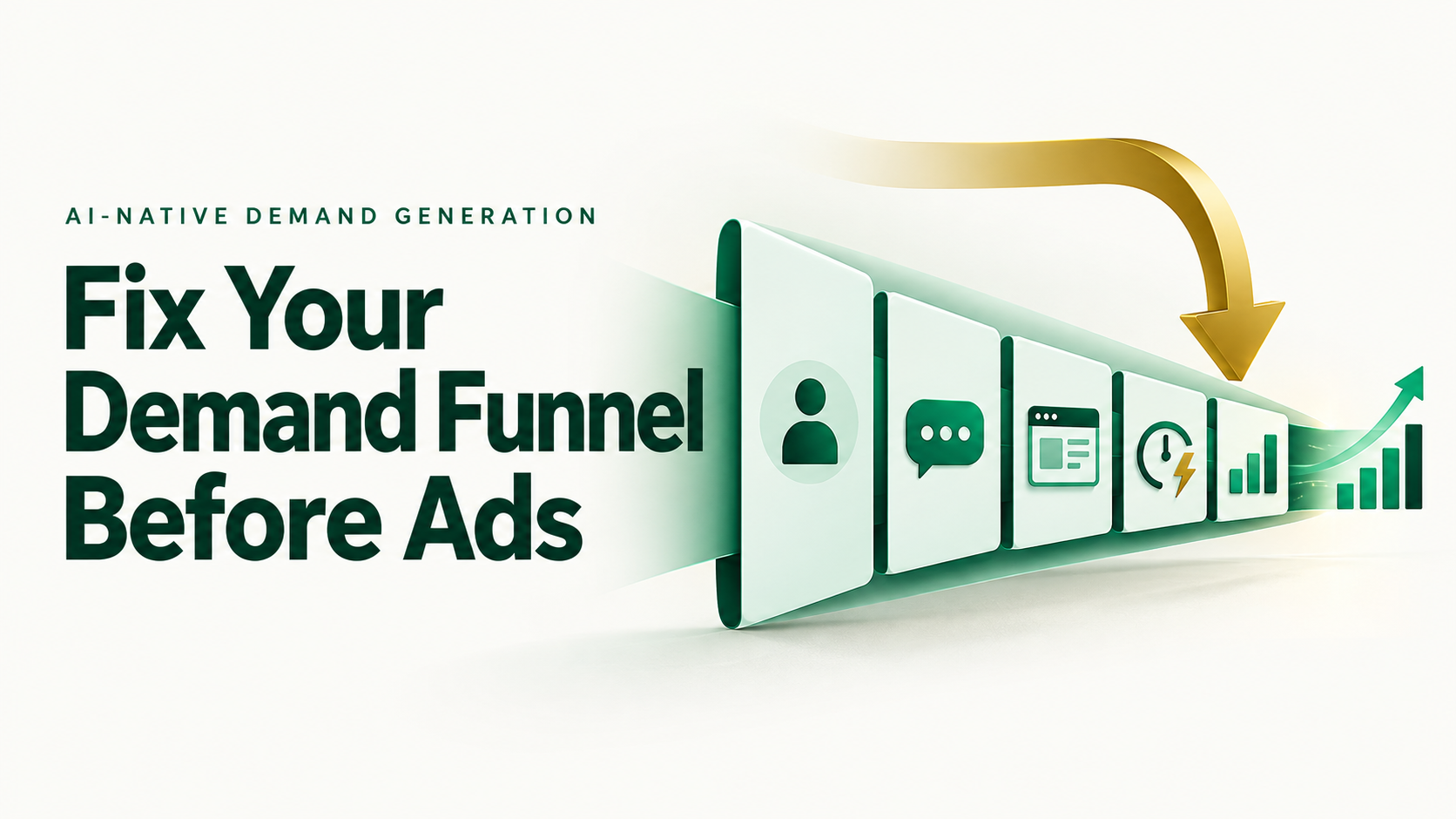
The short answer: Before spending on ads, fix five things in this order: your ICP, your message, your landing page, your speed to follow up, and your measurement. In an AI-native team, each fix is a workflow you can build in days with tools like Claude, n8n and Apollo, not a quarterly project. Ads amplify whatever funnel you have, so a leaky one just leaks faster.
Ads rarely fail because the ads are bad. They fail because the funnel behind them was never ready. In mid-market B2B, deals take weeks and hinge on a few dozen right accounts. You cannot afford to learn that after the budget is gone. The good news: AI now makes the fixing fast and cheap.
The AI-Native 5-Fix Framework
| # | Fix | Question to ask | AI workflow | Tools |
|---|---|---|---|---|
| 1 | ICP | Can you name the industries and roles that actually close? | CRM export to AI pattern analysis | HubSpot or Salesforce, Claude, Apollo |
| 2 | Message | Can a stranger tell in five seconds who this is for? | Call and review mining into message drafts | Claude, Fireflies or Gong, G2 |
| 3 | Landing page | One page, one audience, one action? | Segment pages generated and tracked | Lovable or v0, Vercel, PostHog |
| 4 | Speed to lead | How fast does someone reach a new lead? | Auto enrich, score, route, first touch | n8n, Apollo, Resend, voice agent |
| 5 | Measurement | Can you trace a lead to pipeline? | Weekly AI performance brief | n8n, Looker Studio, Claude |
Fix 1: Narrow your ICP
Workflow: Export 12 months of closed-won and closed-lost deals from your CRM as a CSV. Give it to Claude and ask for patterns in industry, company size, trigger event and buyer role, plus what the lost deals share. Then use Apollo to build an account list that matches the winning profile. Add call transcripts from Fireflies or Gong and Claude can extract triggers and objections by segment too.
Example: A communication software company finds wins cluster in BFSI collections and e-commerce support, while healthcare deals drag on for months. Ads now target only those two segments.
Fix 2: Sharpen your message
Workflow: Feed Claude your call transcripts, win-loss notes and G2 reviews. Ask it to pull the exact words buyers use for their pain, then draft one message per segment: “For [role] at [segment] who [pain], we deliver [outcome] without [biggest objection].” AI gives you raw material. You supply the judgement.
Example: A BFSI buyer cares about compliance and audit trails. A retail buyer cares about surviving peak season. One generic message serves neither.
Fix 3: Build pages that convert
Workflow: Brief Lovable or v0 with each segment's message and generate one page per segment. Deploy on Vercel and add PostHog to watch form drop-offs and session replays. Use Claude to draft headline variants, but test one change at a time. Keep the form short and put proof near the top.
Example: An edtech company sells to institutions and parents. Two audiences need two pages, because the pain, language and buyer are different.
Fix 4: Win on speed to lead
This is where AI pays back fastest. Build one n8n workflow:
- A form submission triggers n8n.
- Apollo enriches company size, industry and role.
- Claude scores fit against your ICP and drafts a personalised first email.
- The CRM record is created, routed by segment, and the rep gets a Slack alert.
- High-fit leads get a first call within minutes from a voice agent, which confirms intent and books a meeting through Cal.com or Calendly. Others enter an email and WhatsApp sequence sent through Resend.
Check consent and DND rules before automated calls or messages, and review AI-drafted copy until you trust it.
Illustrative math (hypothetical numbers): You spend Rs 5 lakh a month and get 200 leads. With next-day follow-up, 5% become meetings: 10 meetings, or Rs 50,000 each. Respond in minutes and lift that to 8%: 16 meetings, or about Rs 31,000 each. Same spend, more pipeline.
Fix 5: Measure pipeline, not leads
Workflow: Put UTM tags on every link and make the CRM source field mandatory. Let n8n pull weekly data from your CRM and ad platforms into Looker Studio, then have Claude write a Monday brief: cost per opportunity by channel, anomalies, and one suggested action. Post it to Slack.
Example: A channel delivers cheap leads but zero opportunities. On a lead dashboard it looks like a winner. In reality it is your most expensive channel.
Score yourself before you spend
Give each fix 0 (broken), 1 (partial) or 2 (solid).
- 8 to 10: Launch ads.
- 5 to 7: Fix your two weakest areas first, then run a small test.
- Below 5: Pause paid spend. Every rupee will leak.
Your 30-day plan
- Week 1: CRM export and ICP analysis in Claude.
- Week 2: Message drafts and segment pages in Lovable.
- Week 3: The n8n speed-to-lead workflow, live and tested.
- Week 4: Tracking, Monday brief and test design.
Then run one channel, one segment and one offer for four to six weeks. Use AI to produce ad variants, but write your scale and stop rules before launch.
FAQ
Which AI tools do I need to start?
Claude, n8n, your CRM and PostHog cover most of this. Add Apollo for enrichment and a voice agent when your follow-up workflow is stable.
Can a non-technical marketer build these workflows?
Yes. n8n is visual, and Claude can explain or debug each step. Start with one workflow, not five.
How long before ads show results?
Plan for four to six weeks of testing. Judge early success on opportunities, not closed deals.
Your next step
Export your last 12 months of closed-won deals today and ask Claude what they have in common. That one exercise improves every ad you will ever run.
PS: AI speeds up the fixing, but it cannot choose your ICP for you. Treat its output as a strong first draft and let your sales team challenge it.