

AI for Product Positioning and Messaging: A PMM's 6-Step Workflow (With the Tools to Run It)
A six-step workflow for product marketers to mine customer language, map alternatives, draft positioning, test messaging, and validate it with real buyers using AI tools.
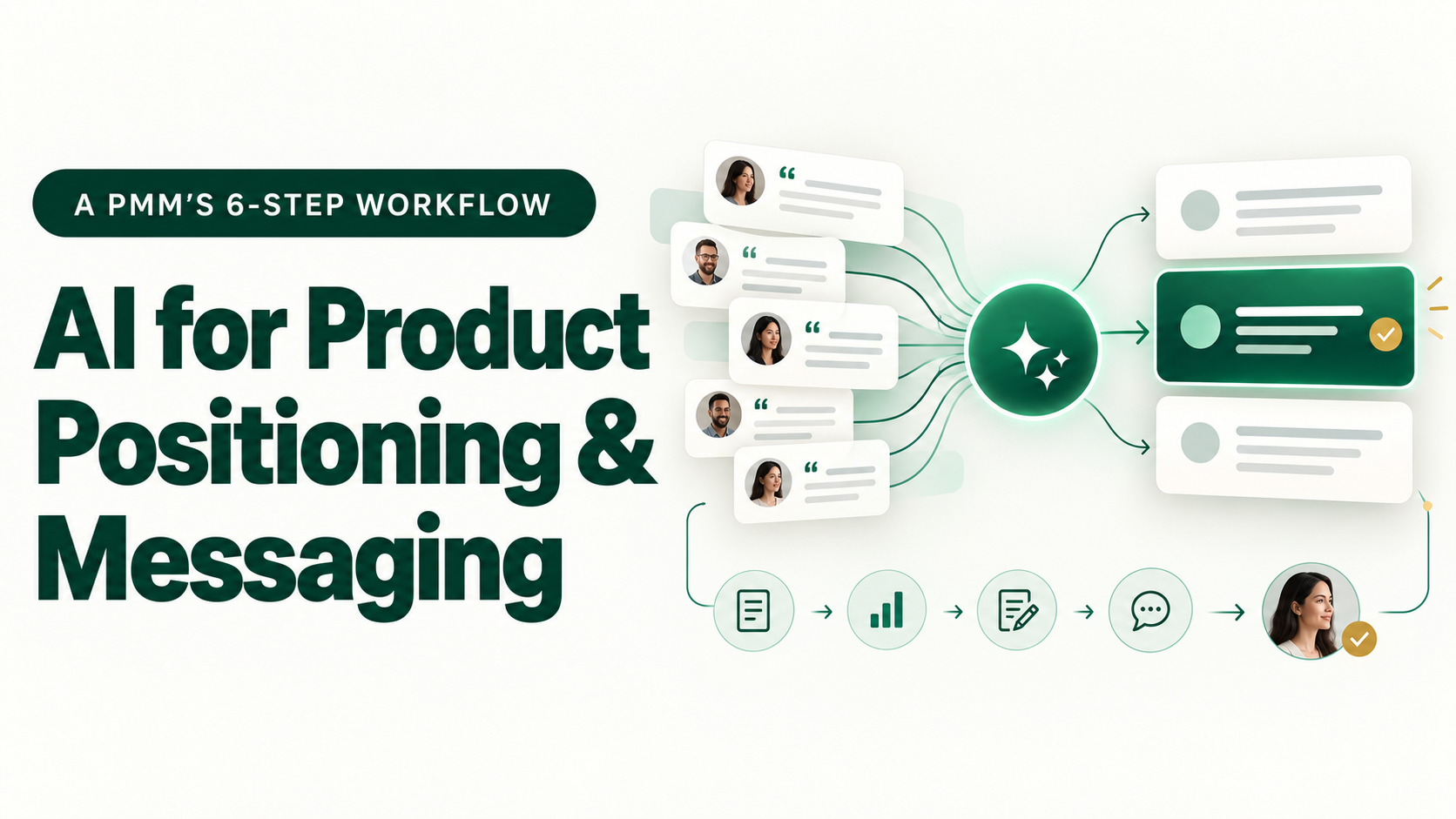
The short answer: Product marketers can use AI to mine customer language, map competitors, draft positioning options and stress-test messaging in about a week. Use a call-recording tool for raw data, an LLM for synthesis, a competitive intelligence tool for market context, and a testing tool for validation. AI drafts and critiques. You decide who you serve and what you stand for.
The PMM AI stack at a glance
| Job | Tools |
|---|---|
| Capture customer calls | Gong, Fireflies, Grain, Otter |
| Synthesize research | Claude Projects, ChatGPT, NotebookLM, Dovetail |
| Competitor tracking | Klue, Crayon, Perplexity |
| Review mining | G2, Gartner Peer Insights, TrustRadius |
| Workshop and mapping | Miro, FigJam, Notion |
| Message testing | Wynter, Lyssna, Typeform |
| AI visibility check | Profound, Peec AI, Otterly.AI, Semrush |
You don't need all of these. A call recorder, one LLM and one testing tool cover 80% of the value. Features and pricing change fast, so verify before buying.
Step 1: Mine the customer's own words
Tools: Gong or Fireflies for transcripts, NotebookLM or Claude Projects for analysis.
Export 20 to 30 won and lost calls plus G2 reviews. Upload them to a NotebookLM notebook or a Claude Project, which keeps the sources grounded and quotable. Then prompt:
"Extract: (1) the trigger event that started the search, (2) verbatim phrases describing the problem, (3) alternatives considered, (4) why they chose or rejected us. Tag each quote with role and deal outcome."
Verbatim quotes stop the model from inventing a neat story. Separating won from lost deals shows you where your message fails, which is worth more than praise from happy customers.
Step 2: Build the competitive alternatives map
Tools: Klue or Crayon for battlecards, Perplexity for fast research with sources, G2 for review gaps.
Your competitors include spreadsheets, internal builds and doing nothing. Feed the transcripts and competitor pages to your LLM:
"For each alternative, list strengths, where customers say it fails, and the buyer it suits best. Mark any claim not supported by the provided sources as UNVERIFIED."
The UNVERIFIED instruction is the guardrail against confident guesses. Cross-check it against Perplexity's cited answers.
Step 3: Draft positioning from a framework
Tools: Claude or ChatGPT, Miro for the group session.
Don't ask for "positioning." Give the model April Dunford's components: competitive alternatives, unique attributes, value, best-fit customer and market category.
"Write three positioning statements, each for a different best-fit customer and market category. For each, give the strongest evidence, the biggest risk and the competitor who would hurt us most."
Paste the three options into Miro and have sales and product vote with sticky notes. Positioning is a bet, so look at the alternative bets before choosing.
Step 4: Build the message house by persona
Tools: Notion or Google Docs for the master doc, a Custom GPT or Claude Project for reuse.
Create one core promise, three proof pillars and variants for each buyer.
"Write value propositions for a CFO, VP Operations and engineering lead. Use only the proof points below. Maximum 25 words each. Ban 'seamless,' 'powerful,' 'robust' and 'end-to-end.'"
Save your positioning, proof points and banned-word list inside a Custom GPT or Claude Project. Every future asset (landing pages, sales decks, launch emails) then starts from the same source of truth instead of a blank chat. This is the biggest time saver in the workflow.
Step 5: Stress-test with a skeptical buyer
Tools: Claude or ChatGPT.
"Act as a procurement lead who has heard ten similar pitches this quarter. List every claim you don't believe, every generic phrase, and three questions you'd ask before a meeting."
Run it again as a CFO, then as a technical evaluator. Fix whatever all three flag.
Step 6: Validate with real people
Tools: Wynter for B2B message testing with target-role panels, Lyssna for five-second tests, Typeform for quick surveys.
Synthetic feedback is a filter, not evidence. Test your top two headlines with real buyers in your ICP. The five-second test question: "What does this company do, and is it for you?" If they can't answer, rewrite. A Wynter-style panel test is worth the cost before a major launch, and a free Typeform sent to ten customers works for smaller changes.
Make your messaging citable by AI engines
Buyers now ask ChatGPT, Perplexity and Gemini for recommendations, so your positioning has to survive being summarized.
- Use the same one-sentence positioning on your homepage, LinkedIn, G2 profile and directories.
- Open every key page with a plain-language answer to a buyer's question.
- Back claims with named customers, numbers and dates.
- Run 20 category prompts monthly in Profound, Peec AI or Otterly.AI, or manually in a spreadsheet, and check how each engine describes you. If the description is off, your messaging is inconsistent somewhere.
Five mistakes that kill the ROI
- Starting without data. Generic input gives generic output.
- Using one long chat. Use a Project or Custom GPT with fixed sources.
- Letting AI invent proof. Supply facts and restrict the model to them.
- Using AI to avoid choosing. If your statement fits every competitor, it isn't positioning.
- Skipping real buyers. AI can't tell you what a prospect believes.
The one-week schedule
- Day 1: Export calls and reviews. Run the mining prompt.
- Day 2: Build the alternatives map. Choose the best-fit customer.
- Day 3: Generate three positioning options. Vote in Miro.
- Day 4: Build the message house and load it into a Custom GPT or Project.
- Day 5: Run the skeptic test. Launch a Wynter or Lyssna test.
FAQ
Can AI write product positioning on its own? No. It drafts and critiques, but choosing a segment and category requires business context only you have.
Which AI tool is best for PMMs? Pick whichever lets you upload sources and save reusable instructions, such as Claude Projects, Custom GPTs or NotebookLM. Grounding in your own data matters more than the model.
How do I avoid generic messaging? Ban filler adjectives, require verbatim customer phrases and demand evidence for every claim.
The bottom line
AI won't fix fuzzy strategy, but it will expose it faster. Compress research and drafting into days, then spend the saved time on what only you can do: making the call and testing it with real buyers.
PS: Paste your current homepage headline into Claude with the skeptic prompt today. If it returns more than three "I don't believe this" flags, you know where Day 1 starts.