

AEO for Product Marketers: The New Distribution Skill PMMs Need to Learn
A practical guide to making positioning, buyer questions, comparisons and customer proof easier to find and represent accurately in AI-generated answers.
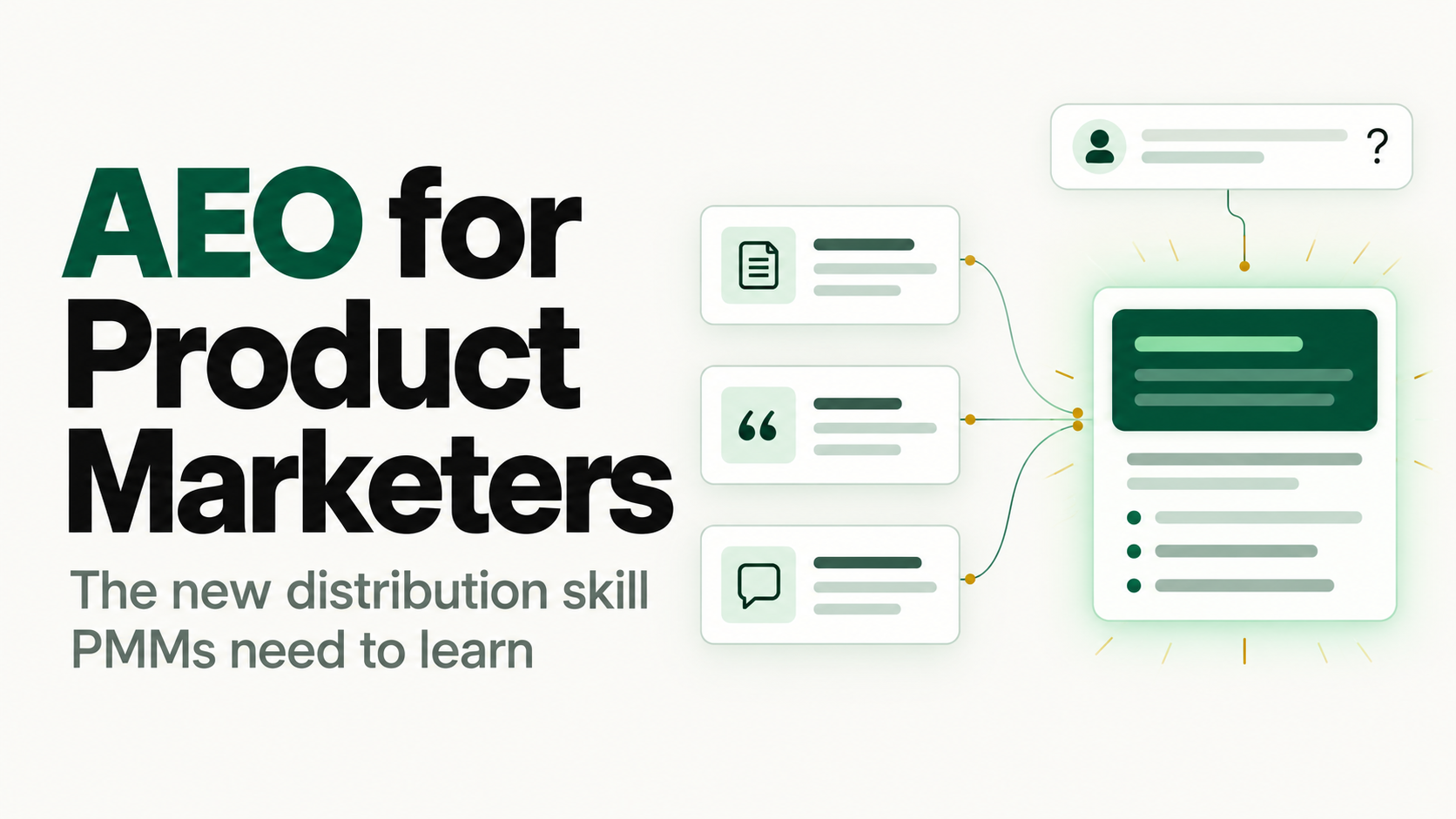
Product marketers have always been responsible for one critical job:
Help the market understand why a product matters.
That has traditionally meant defining the category, sharpening positioning, building messaging, enabling sales, launching products, creating customer proof, and helping buyers make sense of alternatives.
Now there is a new distribution layer between brands and buyers:
AI-generated answers.
Buyers increasingly ask tools such as ChatGPT, Gemini, Perplexity, Claude, and AI-powered search experiences questions like:
- What is the best CRM for a Series B SaaS company?
- Which customer engagement platform is best for fintech?
- What are the top alternatives to HubSpot?
- Which voice AI platforms support Indian languages?
- Which product is better for an enterprise team: Product A or Product B?
In many cases, the first explanation of your market may no longer come from your website, an analyst report, or a sales call.
It may come from an AI-generated answer.
For Product Marketing, this introduces a new responsibility.
It is not enough to create clear positioning.
You increasingly need to make your positioning, proof, and differentiation easy to understand, retrieve, and represent correctly across AI-powered discovery experiences.
That is where AEO — Answer Engine Optimization — becomes relevant to Product Marketing.
But AEO should not be treated as simply another SEO tactic.
It is better understood as a new distribution layer for positioning, proof, and category understanding.
AEO Is Not Just “SEO for AI”
SEO and AEO are related, but they solve different problems.
SEO primarily focuses on improving visibility within search-engine results.
AEO focuses on making information clear, structured, and useful enough that answer engines can understand and potentially surface it when responding to questions.
And then there is AI Visibility.
AI Visibility is the measurable outcome.
It asks:
- Does the brand appear?
- Is it recommended?
- Is it cited?
- Is it described accurately?
- Is it associated with the right category?
- Does it appear in high-intent buyer questions?
A useful way to think about the relationship is:
SEO improves discoverability.
AEO improves answer-readiness.
AI Visibility measures the outcome.
That distinction matters because AEO should not be treated as a replacement for SEO.
It adds another layer to digital distribution.
Why Product Marketers Are Central to AEO
It may be tempting to treat AEO as purely an SEO responsibility.
But much of the information answer engines need is created or influenced by Product Marketing.
PMMs typically own or shape:
- Category definition
- ICP clarity
- Positioning
- Messaging
- Use cases
- Competitive differentiation
- Buyer objections
- Product proof
- Customer stories
- Comparison narratives
- Sales FAQs
- Launch messaging
These are exactly the inputs required to help both buyers and machines understand what a product does and where it belongs.
Consider these two positioning statements.
The first:
“The intelligent platform powering next-generation customer relationships.”
It sounds polished.
But it tells a buyer — or an answer engine — very little.
Compare it with:
“AcmeCX is a customer engagement platform for ecommerce and fintech companies that helps teams automate personalized communication across WhatsApp, email, SMS, and push notifications.”
The second statement explains:
- What the product is
- Who it is for
- What it helps them do
- Which channels it supports
- Which category it belongs to
This is not about making copy robotic.
It is about reducing ambiguity.
AEO rewards clarity — and clarity has always been one of Product Marketing’s core responsibilities.
The PMM Role Is Expanding From Messaging to Retrievability
Product Marketing has always been involved in distribution.
What is changing is the importance of message retrievability.
A PMM can create an excellent positioning document internally.
But if the same positioning is inconsistent across:
- Product pages
- Documentation
- Comparison pages
- Reviews
- Customer stories
- Analyst coverage
- FAQs
- Partner content
- Industry publications
then AI systems may form a fragmented or outdated understanding of the brand.
That creates a new PMM question:
Is our positioning distributed consistently enough that an external system can reconstruct it correctly?
This is where AEO becomes much more than content optimization.
It becomes an information architecture problem.
Start With the AEO Question Map
Keyword research has traditionally been central to SEO.
AEO requires another layer:
buyer-question mapping.
A PMM should identify the questions buyers ask across the journey and decide where the brand needs to participate in those answers.
A simple AEO Question Map can include four major categories.
1. Problem Questions
These appear before the buyer understands the category.
Examples:
- How can I automate outbound prospecting?
- How do I reduce customer churn?
- How can I automate customer-support calls?
These questions tell PMMs how buyers describe the problem in their own language.
2. Category Questions
The buyer now understands that a category exists.
Examples:
- What are the best AI SDR platforms?
- What are the top customer engagement platforms?
- Which voice AI tools are available for enterprises?
This is where category association matters.
3. Comparison Questions
The buyer is evaluating options.
Examples:
- HubSpot vs Salesforce
- Braze vs CleverTap vs WebEngage
- Product A vs Product B
These questions make competitive positioning visible.
4. Purchase-Intent Questions
These are often the most commercially important.
Examples:
- Which CRM is best for a 100-person SaaS company?
- Which voice AI platform is best for BFSI in India?
- Which customer engagement product is easiest to deploy?
This is where being mentioned is no longer enough.
You want the brand to be relevant to the buying context.
Think in “Answer Ownership”
A useful operating model for PMMs is to identify:
What are the 20–50 questions in our category where we want our brand, proof, or point of view to be part of the answer?
Call this your Answer Ownership Map.
The objective is not to manipulate AI systems.
The objective is to make sure important buyer questions have strong, accurate, public information available.
For example:
| Buyer question | Useful PMM asset |
|---|---|
| What is the best platform for X? | Category or use-case page |
| Product A vs Product B? | Comparison page |
| Does Product A support Y? | Product page or FAQ |
| Who uses Product A? | Customer case study |
| Why choose Product A? | Positioning and proof page |
| Is Product A suitable for enterprise? | Enterprise use-case page |
This makes AEO practical.
You are no longer asking:
“How do we optimize for AI?”
You are asking:
“What questions matter to buyers, and have we created the best possible answer?”
That is a much more useful Product Marketing problem.
Comparison Pages Are Becoming Distribution Assets
Comparison pages have historically been treated as bottom-of-funnel SEO content.
That undersells their value.
Suppose a buyer asks:
“What is the difference between HubSpot and Salesforce for a 50-person SaaS company?”
An AI system has to assemble that answer from available information.
Clear comparison content can make that job easier.
A useful comparison page should explain:
- Ideal customer profile
- Company size
- Product capabilities
- Deployment complexity
- Pricing model
- Integrations
- Key use cases
- Strengths
- Trade-offs
Importantly, good comparison content should not pretend your product is superior in every situation.
A credible page can say:
Choose us when X matters.
Consider the competitor when Y is your priority.
That makes the content far more useful to buyers.
And useful buyer education is ultimately the foundation of strong AEO.
Customer Proof Is Structured Evidence
Consider the difference between these two statements:
“Our platform improves customer-service efficiency.”
and:
“A 500-agent support organization reduced average handling time by 22% after deploying the platform.”
The second is more useful because it gives context and evidence.
PMMs should increasingly think of case studies as structured evidence assets.
A strong case study should make it easy to understand:
- Who the customer was
- Their industry
- Their problem
- What product they used
- How they deployed it
- What changed
- What measurable result was achieved
Instead of saying:
“Acme transformed its customer experience.”
say:
“Acme automated 60% of tier-one customer queries within six months.”
Specificity benefits human buyers first.
It can also improve the likelihood that answer engines can correctly understand and summarize the proof.
Turn Sales Questions Into Public Knowledge
One of the best sources of AEO ideas already exists inside most companies.
Sales calls.
Ask your sales team:
What questions come up repeatedly in deals?
The list may include:
- Does this integrate with Salesforce?
- Do you support enterprises?
- What languages do you support?
- Is your product available in India?
- How long does implementation take?
- What does migration look like?
- How does pricing work?
- Can we switch from Competitor X?
- What happens when usage increases?
These are not merely sales objections.
They are buyer questions.
If the same question repeatedly appears in sales conversations, there is a good chance buyers are also asking it in search engines and AI tools.
Where appropriate, that knowledge should become publicly accessible through:
- FAQ pages
- Integration pages
- Documentation
- Comparison pages
- Implementation guides
- Pricing explanations
- Migration guides
AEO can turn institutional sales knowledge into scalable distribution.
A Practical Example
Imagine a fictional SaaS company called PipelineAI.
It sells an AI prospecting platform for B2B sales teams.
Its positioning says:
“AI-powered pipeline generation for modern revenue teams.”
The company ranks reasonably well for several SEO keywords.
But the PMM tests 100 AI prompts and finds something surprising.
PipelineAI appears frequently for:
“What are AI prospecting tools?”
But it rarely appears for:
“Best AI prospecting tool for a 20-person sales team”
or:
“AI prospecting tools that integrate with Salesforce”
or:
“Apollo alternatives for SaaS companies”
The issue is not general brand awareness.
The issue is retrievability around specific buying contexts.
The PMM builds an AEO Question Map.
They identify four gaps:
Category: The website never clearly defines PipelineAI as an AI prospecting platform.
ICP: The website does not clearly explain that its core customer is a 10–100-person B2B sales organization.
Integrations: Salesforce compatibility exists, but the information is buried in documentation.
Competitive context: There is no clear explanation of when someone should choose PipelineAI instead of Apollo or another alternative.
The PMM then works with Content, SEO, Product, and Sales to build:
- A category page
- Three industry use-case pages
- A Salesforce integration page
- Apollo comparison content
- A structured FAQ
- Two quantified customer stories
- An implementation guide
A few months later, the team measures AI Visibility again.
The goal is not simply:
“Did our mention rate increase?”
The more useful questions are:
- Did visibility improve for high-intent prompts?
- Are AI systems describing the ICP correctly?
- Are the right use cases appearing?
- Are customer outcomes being represented accurately?
- Has competitive positioning improved?
That is what makes AEO strategically useful to PMMs.
Measure AI Visibility, Not Just Content Output
Publishing more AEO content is not success.
Teams need to understand whether the information is actually changing how the brand is represented.
A PMM dashboard might track:
- Brand Mention Rate
- Recommendation Rate
- AI Share of Voice
- Citation Rate
- Message Accuracy
- Average Position
- Competitor Co-occurrence
- Visibility by buyer-journey stage
- High-intent Prompt Visibility
For example:
If your brand appears in 65% of category prompts but only 18% of purchase-intent prompts, you probably do not have a category-awareness problem.
You may have a consideration problem.
Similarly, if the brand is mentioned frequently but AI systems describe it as an SMB product while the company now sells primarily to enterprises, you have a positioning consistency problem.
AI Visibility gives PMMs another lens into how the market may be interpreting the company.
AEO Is Cross-Functional
AEO should not sit entirely inside Product Marketing.
Nor should it sit entirely inside SEO.
It requires collaboration.
Product Marketing provides positioning, ICP, differentiation, proof, and buyer context.
SEO improves technical discoverability and search performance.
Content turns those insights into useful assets.
Product ensures technical claims are accurate.
Sales contributes objections and buying questions.
Customer Success contributes real customer language and outcomes.
A strong AEO program connects these functions around a shared objective:
Make the company easier to understand wherever buyers ask questions.
Do Not Optimize for Machines at the Expense of Buyers
There is one important risk.
AEO could easily become the next version of keyword stuffing.
Teams may start producing repetitive pages designed primarily to influence answer engines.
That would be a mistake.
The strongest principle is simple:
Excellent buyer education first. Machine-readable clarity second.
A useful page should still help someone make a better decision even if no AI system ever sees it.
That means:
- Clear writing
- Honest comparison
- Specific evidence
- Useful context
- Minimal jargon
- No artificial repetition
AEO should improve information quality, not degrade it.
The New PMM Operating Model
The traditional Product Marketing workflow often looks like:
Research → Positioning → Messaging → Launch → Enablement
The AI-era workflow adds another layer:
Research → Positioning → Messaging → Distribution → Retrievability → Measurement
That small addition changes how PMMs should think about almost every asset.
A positioning page is not merely website copy.
A comparison page is not merely SEO content.
A case study is not merely sales collateral.
A FAQ is not merely support content.
A product page is not merely a conversion asset.
Together, these assets form a public information system explaining:
Who you are.
Who you serve.
What you solve.
Why you are different.
What proof exists.
When someone should choose you.
That information increasingly needs to work for both humans and AI systems.
Final Thought
The underlying job of Product Marketing has not changed.
PMMs still need to help buyers understand why a product matters.
What is changing is where that understanding happens.
A buyer may learn about your product from Google.
They may hear about it from a salesperson.
They may read an analyst report.
Or increasingly, they may ask an AI system:
“What should I buy?”
That means the next PMM advantage will not come simply from writing more messaging.
It will come from making the company’s positioning, proof, differentiation, and buyer context easy to retrieve wherever buyers ask questions — including AI.
That is why AEO should not be viewed merely as another search tactic.
It is becoming a new distribution skill for Product Marketing.