

BookBite
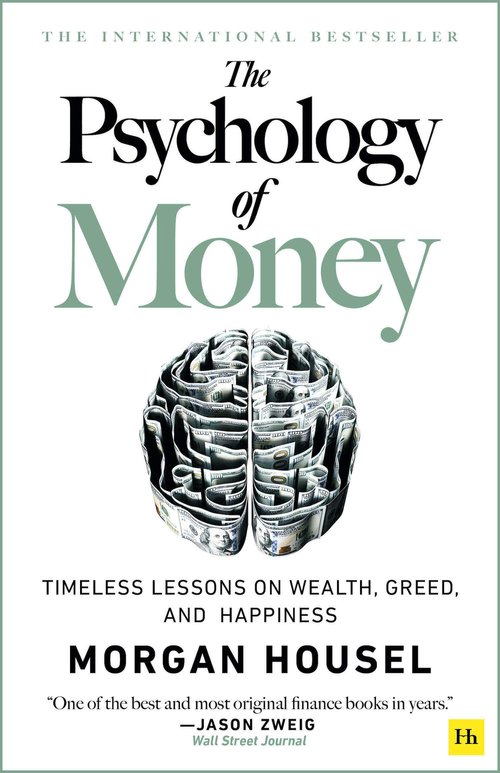
The Psychology of Money by Morgan Housel book cover
Book summary & key learnings

The Psychology of Money

Morgan Housel · 16 min read

Timeless lessons on wealth, greed, and happiness.

The core idea

The Psychology of Money is less about how to calculate returns and more about how people behave with money.

Morgan Housel's central argument is that financial success has much more to do with behavior, patience, expectations, and how you respond to uncertainty than with intelligence or technical knowledge.

Two people can have the same income, the same investment opportunities, and the same information, yet end up with completely different financial outcomes because they think about money differently.

Doing well with money isn't necessarily about knowing more. It is about behaving well.

1

No One Is Crazy

People make financial decisions based on their own experiences.

Someone who grew up during a recession may think very differently about investing from someone who grew up during a period of strong economic growth.

Someone who experienced poverty may value money differently from someone who grew up wealthy.

Their decisions may look irrational from the outside, but they make sense within their personal experience.

The lesson: Don't assume other people's financial decisions are irrational simply because they don't match your own experience.

2

Luck and Risk Matter More Than We Think

Financial outcomes are influenced by things that are outside our control.

Success can involve: skill + effort + timing + luck.

Failure can involve: bad decisions + circumstances + bad luck.

The problem is that we often attribute success entirely to skill and failure entirely to mistakes.

Housel encourages looking at outcomes with more humility.

The lesson: Don't become overconfident because things worked out, and don't become overly self-critical when they didn't.

3

Never Enough

One of the most important ideas in the book is knowing when you have enough.

There is always another level: more money, more status, more success, more possessions.

The danger is continuing to take unnecessary risks because what you already have doesn't feel sufficient.

The book uses the story of people who had enormous wealth but still took risks that eventually destroyed it.

The lesson: Knowing when you have enough is a financial skill.

4

Compounding Is Powerful

You don't need extraordinary returns if you can allow reasonable returns to compound for a very long time.

The book uses Warren Buffett as a major example.

A significant part of his wealth came from the fact that he started investing young and had an unusually long period for compounding to work.

The key isn't only: How much return can I generate? It is: How long can I allow the return to compound?

The lesson: Time is one of the most powerful forces in investing.

5

Getting Wealthy and Staying Wealthy Are Different

Making money requires taking risks, being optimistic and putting yourself out there.

Keeping money requires something different: humility, frugality, caution, risk management.

The book emphasizes that survival is extremely important.

You don't need to win every year. You need to avoid getting wiped out.

The lesson: Building wealth and preserving wealth require different behaviors.

6

The Importance of Survival

This is one of the book's most important investing principles.

Financial success is not simply about maximizing returns. It is also about staying in the game long enough for compounding to work.

A strategy that produces fantastic returns but has a meaningful chance of destroying your wealth may not be sustainable.

The lesson: Avoiding ruin is more important than maximizing every possible opportunity.

7

The Power of Reasonable

Housel repeatedly argues against the obsession with maximizing everything.

You don't need the highest possible investment return. You don't need to find the perfect stock. You don't need the most optimized financial strategy.

A reasonable strategy that you can stick with for decades can be far more effective.

The lesson: A good financial plan is one you can actually stick with.

8

The Role of Freedom

One of the strongest ideas in the book is that the greatest value of money is not what it can buy. It is control over your time.

Having enough money can give you the ability to: choose what you do, choose when you do it, choose who you spend time with, and walk away from situations you don't want.

Housel considers this one of the highest returns money can provide.

The lesson: The greatest value of wealth is the ability to control your time.

9

Wealth Is What You Don't See

There is an important difference between rich and wealthy.

Rich is visible. It is the expensive car, house, watch or holiday.

Wealth is often invisible. It is: savings, investments, assets, financial flexibility.

You can't see someone's wealth simply by looking at what they own.

The lesson: Spending money can make you look rich. Not spending it can make you wealthy.

10

Save Without a Specific Goal

Housel makes an important argument for saving even when you don't have a specific purchase or objective in mind.

Why? Because you cannot predict the future.

Savings give you flexibility when opportunities or unexpected situations arise.

Money saved today can provide options tomorrow.

The lesson: Saving isn't only about buying something later. It is about creating flexibility for an uncertain future.

11

Reasonable Beats Rational

Traditional financial thinking often assumes people should make perfectly rational decisions. Real people don't work that way.

A strategy that looks mathematically optimal may be difficult to follow emotionally.

If a slightly less optimal strategy helps you sleep at night and stay invested, it may produce a better real-world outcome.

The lesson: The best financial strategy is not always the mathematically perfect one. It is the one you can live with.

12

Expect Uncertainty

The future is unpredictable.

You don't know: when markets will crash, when the economy will change, when an opportunity will appear, or when your personal circumstances will change.

Because of this, financial planning should leave room for things you cannot predict.

The lesson: Don't build a financial plan that only works if everything goes according to plan.

13

The Importance of Room for Error

This is one of the book's most practical concepts.

Leave yourself a margin for things going wrong.

If your plan requires everything to go perfectly, it is fragile.

Having extra savings, manageable expenses and conservative assumptions gives you room to absorb surprises.

The lesson: Build financial plans that can survive being wrong.

14

You Will Change

A financial plan created today may not fit the person you become ten or twenty years from now.

Your goals, career, family, interests, and priorities can all change.

Housel calls attention to the difficulty of making long-term decisions while assuming your future self will want exactly what your current self wants.

The lesson: Leave room for your future self to change.

15

Nothing Is Free

Every investment strategy has a price.

Sometimes the price is: volatility, uncertainty, fear, or temporary losses.

The mistake is expecting high returns without paying the emotional or financial price that comes with them.

Instead of thinking of volatility as a fine, Housel suggests thinking of it as the price of admission for participating in investing.

The lesson: Don't expect returns without accepting the discomfort that comes with them.

16

The Seduction of Pessimism

Negative financial stories often sound more intelligent than positive ones.

A market crash is dramatic. A financial crisis is dramatic. A slow improvement in wealth over twenty years isn't.

The problem is that pessimism can make temporary problems feel permanent.

The lesson: Don't confuse a frightening story with a prediction of the future.

17

When You'll Believe Anything

People tend to believe stories that make sense to them. This can be dangerous with money.

A convincing story can make an investment seem obvious even when the underlying evidence is weak.

The world is complicated, and simple explanations can be attractive because they reduce uncertainty.

The lesson: A compelling financial story isn't necessarily a reliable financial conclusion.

18

All Together Now

The book's individual ideas work together.

Good financial behavior involves: saving, compounding, patience, humility, room for error, long-term thinking, accepting uncertainty, and avoiding unnecessary risks.

None of these ideas work in isolation.

The goal is to create a financial system that can survive different environments.

The lesson: Financial success comes from combining several reasonable behaviors consistently.

19

Confessions of a Money Manager

Housel shares his own approach to money and investing.

One of the important ideas is that personal finance is personal.

You don't need to copy another person's exact financial strategy.

What matters is having a strategy that fits: your goals, your risk tolerance, your circumstances, your personality, and your need for security.

The lesson: There is no single financial strategy that works perfectly for everyone.

20

The Psychology of Money

The final message brings everything together.

Money decisions are deeply personal. They involve: fear, greed, ego, status, experience, family, identity, and uncertainty.

That is why knowing financial theory isn't enough. You also need to understand yourself.

The lesson: Managing money well requires managing your behavior.

The Core Frameworks and Mental Models

The book's ideas connect into a few practical mental models:

  1. 1Wealth vs. Riches: Riches = what you spend. Wealth = what you don't spend. Wealth is the assets and savings you have that give you future options.
  2. 2Getting Wealthy vs. Staying Wealthy: Getting wealthy requires optimism + risk-taking + action. Staying wealthy requires humility + frugality + caution + survival. The behaviors are different.
  3. 3The Compounding Framework: Reasonable Returns × Long Time × Consistency = Compounding. The key insight is that time can matter more than trying to achieve extraordinary returns.
  4. 4Room for Error: Expected outcome + Unexpected problems = Real life. Your plan should still work when things don't go exactly as expected. That means keeping enough flexibility to survive bad markets, unexpected expenses, career changes, poor decisions, and bad luck.
  5. 5The Freedom Framework: The value of money isn't only consumption. It can buy control over your time. That can mean being able to leave a bad job, take time off, pursue something meaningful, spend time with people you care about, and make decisions without immediate financial pressure.
  6. 6The Survival Framework: Don't aim to maximize every opportunity. Aim to stay in the game. Because if you survive long enough: Time → Compounding → Wealth.

The Most Important Lessons

The ideas worth returning to again and again:

  1. 1Your behavior matters more than your financial knowledge.
  2. 2Everyone has a different money story.
  3. 3Know when you have enough.
  4. 4Compounding needs time.
  5. 5Survival comes first.
  6. 6Save for flexibility.
  7. 7Wealth is invisible.
  8. 8Money's greatest value is freedom.
  9. 9Leave room for error.
  10. 10Don't chase perfection.
  11. 11Volatility is part of investing.
  12. 12Don't let your current self control your entire future.
  13. 13Be careful with financial stories.
  14. 14Be humble about luck.
  15. 15Don't underestimate the power of consistency.

The Money Mindset From the Book

The book's philosophy can be reduced to a simple flow:

  1. 1Spend less than you earn
  2. 2Save consistently
  3. 3Invest for the long term
  4. 4Give compounding time
  5. 5Accept uncertainty
  6. 6Leave room for error
  7. 7Avoid financial ruin
  8. 8Keep enough flexibility
  9. 9Use wealth to control your time

What I Think Is the Most Important Part of the Book

The book isn't really telling you which stock to buy or how to build the perfect portfolio. It is asking a more fundamental question:

  1. 1Can you behave well enough with money to let a reasonable financial strategy work for a very long time?
  2. 2That means resisting the urge to: chase what is already working, take unnecessary risks, compare yourself with others, spend to signal status, react emotionally to market movements, and assume the future will behave like the past.
  3. 3Instead, the book keeps bringing you back to: patience, saving, humility, long-term thinking, room for error, enough, and freedom.

The One Idea to Take Away

  • Financial success is less about being brilliant with money and more about being reasonable, patient, and disciplined for a very long time.
  • Make enough. Save enough. Take risks you can survive. Leave room for things to go wrong. Give compounding time to work.
  • And most importantly: Use money to buy freedom, not just things.