

BookBite
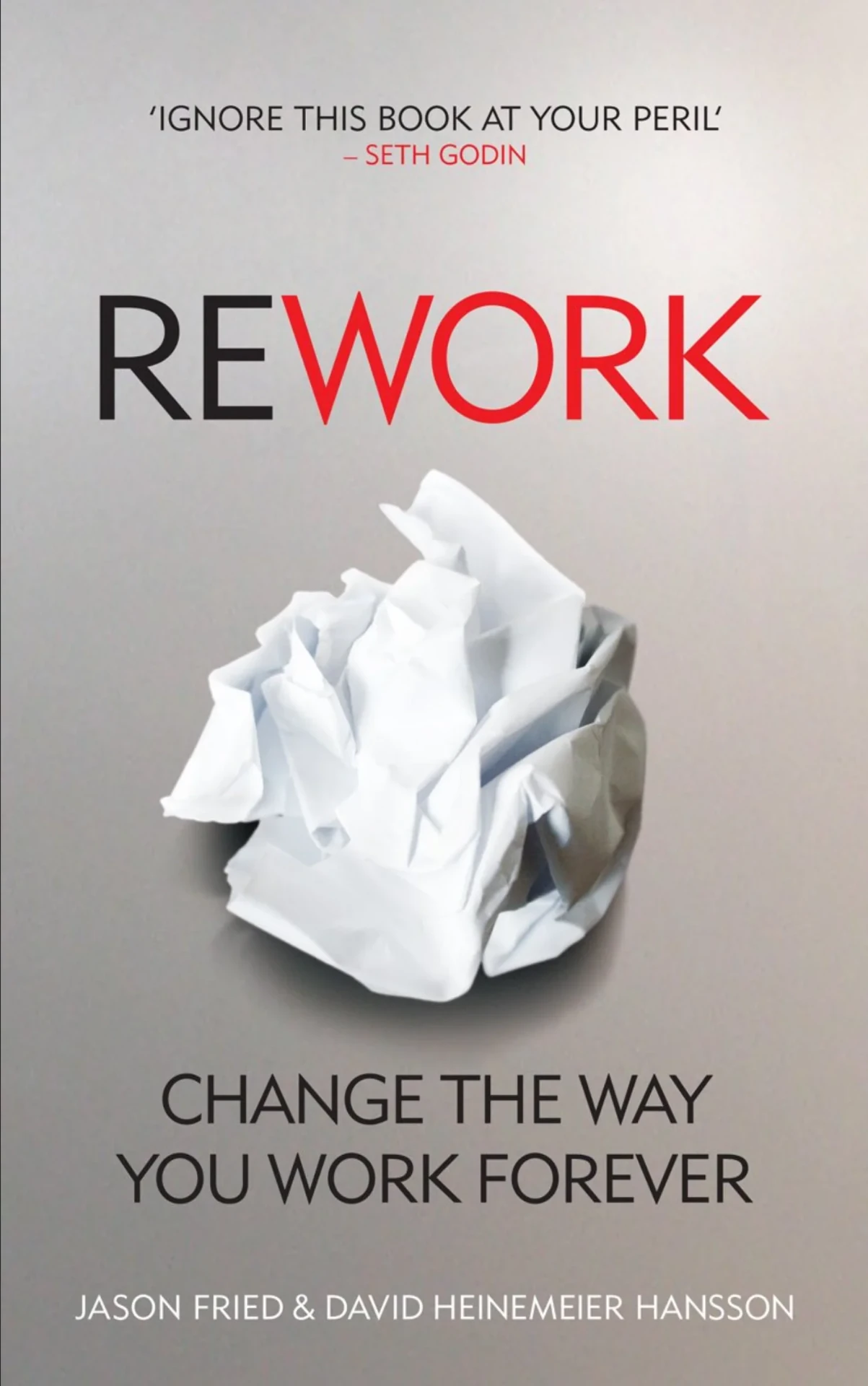
Rework by Jason Fried and David Heinemeier Hansson book cover
Book summary & key learnings

Rework

Jason Fried and David Heinemeier Hansson · 14 min read

Change the way you work forever by building a simpler, calmer, more focused business.

The core idea

Rework challenges many of the conventional ideas about building a business. You don't necessarily need a detailed business plan, outside funding, a large team, long working hours, or a complicated strategy to build something successful.

The book argues for a much simpler approach: start something useful, keep it simple, build for yourself, focus on what matters, ship the work, and learn from reality.

The underlying philosophy is: less planning, less complexity, less bureaucracy, more focus, more action, more control.

1

Start Something

You don't need to wait for the perfect opportunity. You don't need permission. You don't need to have everything figured out before starting.

Ideas are easy. What matters is doing something with them.

The lesson: Stop waiting for perfect conditions. Start building.

2

Don't Build a Business Plan

Traditional thinking says you need a detailed business plan before starting. Rework challenges this idea.

A plan is based on assumptions about the future. The further into the future you plan, the more assumptions you make.

Instead, start with what you know and adjust as you go.

The lesson: You don't need to predict the future. Start with what you know and respond to what actually happens.

3

Scratch Your Own Itch

One of the strongest ideas in the book is to build something you personally need. When you are the customer, you understand the problem, you know what is frustrating, you can judge whether the solution is useful, and you don't have to guess what customers want.

This was an important principle behind Basecamp.

The lesson: Solve a problem you understand deeply, preferably one you experience yourself.

4

Make a Dent in the Universe

The book encourages businesses to have something meaningful to contribute. You don't need to change the entire world, but you should create something that matters.

The question isn't only "How do we make money?" It is also "What are we trying to change?"

The lesson: Have a reason for existing beyond simply making money.

5

Keep Your Business Small

The book strongly challenges the assumption that growth always means hiring more people. A larger company brings more communication, more meetings, more management, more complexity, and more overhead.

Growth for the sake of growth can create problems. The authors prefer staying small when being small allows the company to remain focused and efficient.

The lesson: Don't grow your company simply because you can. Grow when growth actually creates value.

6

Build Less

The instinct in business is often to add more: more features, more products, more people, more processes, more meetings. Rework argues for the opposite.

Do less, but do it better. Every additional feature creates more complexity to maintain. Every additional process creates more overhead.

The lesson: The best way to make something simpler is often to remove things.

7

Focus on What Won't Change

Instead of constantly chasing trends, focus on things customers will continue to value: speed, simplicity, good customer service, useful products. These needs are unlikely to disappear.

The lesson: Build around enduring customer needs instead of constantly reacting to what is fashionable.

8

Decisions Are Progress

Decisions shouldn't take forever. You rarely have complete information. Waiting for certainty slows the company down.

Make the decision, move forward, and adjust if necessary.

The lesson: A good decision made quickly can be more useful than a perfect decision made too late.

9

Workaholism Is Not a Virtue

The book challenges the idea that working longer automatically means accomplishing more. Working all the time can lead to bad judgment, poor decisions, burnout, and lower-quality work.

The goal isn't to work more hours. The goal is to do meaningful work efficiently.

The lesson: Don't confuse hours worked with productivity.

10

Build a Calm Company

The authors argue against creating a workplace where everything feels urgent. Constant urgency can lead to stress, interruptions, poor decisions, and burnout.

The goal is to build a company where people can do focused work without everything becoming a crisis.

The lesson: A calm environment can produce better work than constant pressure.

11

Meetings Are Expensive

Meetings interrupt focused work. They also involve people who may not need to be there. The book takes a skeptical view of meetings and encourages simpler forms of communication where possible.

The lesson: Don't schedule meetings simply because that's how businesses traditionally operate. Use them when they are genuinely necessary.

12

Interruptions Are the Enemy of Productivity

Focused work requires uninterrupted time. Every interruption creates a cost because you have to shift your attention and get back into the problem.

The book favors an environment where people can work without constant interruptions.

The lesson: Protect focused work instead of filling every hour with communication.

13

Embrace Constraints

Having unlimited resources isn't always an advantage. Constraints force you to make choices. If you have less money, less time, or fewer people, you have to determine what actually matters.

Those limitations can lead to simpler and more creative solutions.

The lesson: Constraints can force better decisions and prevent unnecessary complexity.

14

Start With No

When someone asks for a new feature, don't automatically say yes. Ask: Does this solve an important problem? Is it consistent with what we're building? Is it worth the cost and complexity?

Saying no protects the product from becoming bloated.

The lesson: Every yes has a cost. Saying no is an important part of staying focused.

15

Don't Copy

The book strongly discourages blindly copying competitors. Copying means you're reacting to someone else's decisions instead of making your own.

Study competitors, but don't automatically imitate them.

The lesson: Build your own way of doing things instead of becoming a slightly different version of someone else.

16

Underdo Your Competition

Instead of trying to match every feature competitors have, consider doing less. A simpler product can be easier to understand, easier to use, easier to maintain, easier to explain, and easier to sell.

The lesson: You don't have to win by having more. Sometimes you win by needing less.

17

Pick a Fight

The book argues that businesses can benefit from having a clear point of view. Stand for something. Be willing to say: "We believe this is the better way."

This creates a clearer identity and gives customers something to believe in.

The lesson: A strong point of view is more memorable than trying to please everyone.

18

Build an Audience

The authors emphasize creating an audience instead of depending entirely on traditional advertising. Teach people, share what you know, create useful material, and build trust.

An audience can become a long-term asset for the business.

The lesson: Don't only look for customers. Build people who are interested in what you have to say and what you create.

19

Teach Instead of Selling

The book encourages businesses to share their knowledge. If you know something useful because of the work you do, teach it. Share your experience and explain how things work.

This creates credibility and attracts people who value your expertise.

The lesson: Teaching can be a powerful way to build trust and attract customers.

20

Hire When It Hurts

Don't hire simply because you think a company is supposed to have more employees. Hire when there is a real problem that requires another person. Hiring too early creates unnecessary costs and management overhead.

The lesson: Don't hire for growth optics. Hire when the workload genuinely requires it.

21

Hire the Right Person, Not the Resume

A strong resume doesn't guarantee someone will do great work. The authors value people who can actually do the work. They also prefer giving people responsibility rather than creating unnecessary layers of management.

The lesson: Look at what someone can actually accomplish, not just what their resume says.

22

Do It Yourself First

Before hiring someone to handle something, understand the work yourself. This helps you understand what actually needs to be done, how much work it requires, what good work looks like, and whether you actually need another person.

The lesson: Don't outsource or hire for work you haven't understood yourself.

23

Don't Create Problems Before They Exist

Businesses often prepare for hypothetical problems. They create policies, processes, and systems for situations that may never happen. The book argues that this creates unnecessary complexity.

Deal with problems when they actually appear.

The lesson: Don't solve imaginary problems. Solve real ones.

24

Inspiration Is Perishable

When you have an idea or feel motivated to do something, act on it. Waiting can cause the energy behind the idea to disappear.

The lesson: When inspiration strikes, use it instead of assuming it will still be there later.

25

Be a Starter

The book values people who can take an idea and turn it into something real. Starting is often harder than discussing. You can spend months planning, researching, discussing, and analyzing without actually producing anything.

The lesson: Execution starts with taking the first real step.

26

Make a Stand

The authors don't believe businesses should try to make everyone happy. Having strong opinions can make the company clearer. It tells customers who you are, what you believe, and what you won't do.

This can attract people who share your perspective.

The lesson: A strong point of view can create a stronger relationship with the right customers.

27

Let Your Customers Outgrow You

Not every customer request should automatically become a product feature. Sometimes a customer wants something that doesn't fit the product's direction. You have to be comfortable saying no.

The lesson: You don't have to become everything every customer wants.

28

Pick a Fight You Can Win

Competition doesn't always mean beating the biggest company at its own game. Find an area where your approach is different and valuable. Build around your strengths.

The lesson: Don't fight competitors on their terms. Create your own terms.

The Core Philosophy of Rework

The book's ideas connect into a simple way of working:

  1. 1Start small
  2. 2Solve a real problem
  3. 3Build something useful
  4. 4Keep it simple
  5. 5Do less
  6. 6Avoid unnecessary complexity
  7. 7Make decisions
  8. 8Ship the work
  9. 9Listen to customers
  10. 10Adjust
  11. 11Stay focused

The Most Important Lessons

The ideas worth returning to again and again:

  1. 1Start now. You don't need everything figured out before beginning.
  2. 2Solve your own problem. Build something you understand and genuinely need.
  3. 3Keep things simple. Complexity is expensive.
  4. 4Build less. Every feature and process has a cost.
  5. 5Don't grow for the sake of growing. A bigger company isn't automatically a better company.
  6. 6Say no. Focus requires rejecting things that don't matter.
  7. 7Don't copy competitors. Build your own approach.
  8. 8Embrace constraints. Limited resources force you to prioritize.
  9. 9Protect focused work. Constant interruptions and meetings reduce the quality of work.
  10. 10Make decisions. Waiting for perfect information slows progress.
  11. 11Hire when necessary. Don't build a large team before you need one.
  12. 12Do the work yourself first. Understand the problem before handing it to someone else.
  13. 13Build an audience. Share what you know and create useful material.
  14. 14Have a point of view. Trying to please everyone can make you forgettable.
  15. 15Don't solve imaginary problems. Deal with problems when they actually appear.
  16. 16Ship. Ideas don't create value until they become something real.

The One Idea to Take Away

  • Build less. Do better work. Stay small enough to stay focused.
  • You don't need a complicated business to build something valuable.
  • Start with a real problem. Build the simplest useful solution. Say no to things that distract you.
  • Make decisions. Ship your work. Listen to what happens. Then improve it.
  • That's the essence of Rework.