

BookBite
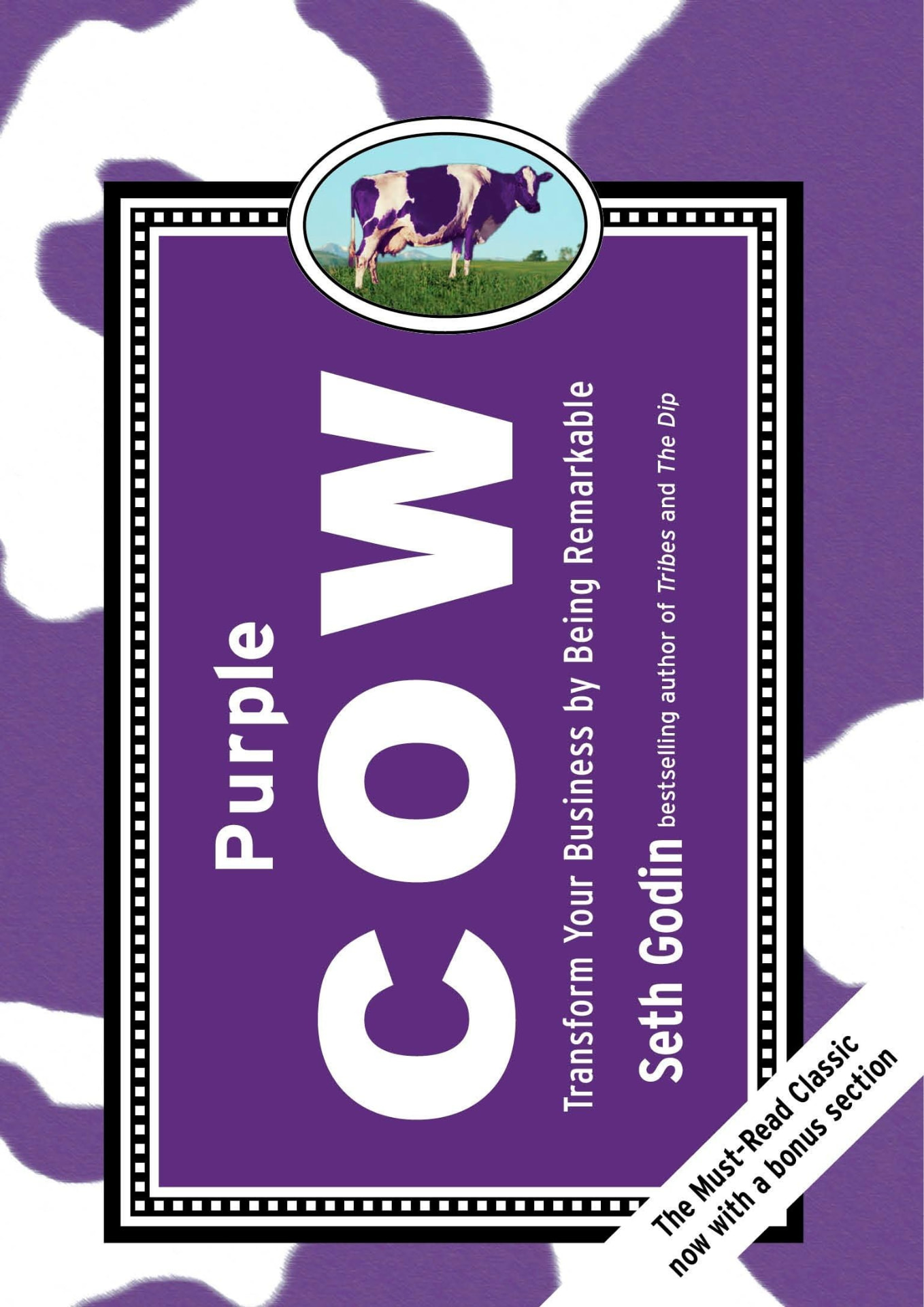
Purple Cow by Seth Godin book cover
Book summary & key learnings

Purple Cow

Seth Godin · 10 min read

In a crowded market, being good is no longer enough. The only way to grow is to be remarkable.

The core idea

In a crowded market, being good is no longer enough. There are too many products, too many brands, too much advertising and too many choices. Even a well-made product can easily get ignored.

Seth Godin's central argument is simple: If you want people to notice, remember and talk about your product, make it remarkable. The Purple Cow is the metaphor for something that stands out in a field of ordinary cows. It is something people notice because it is different enough to be worth noticing. And that's what 'remarkable' really means in the book: worth making a remark about.

1

Being Good Is Not Enough

For a long time, marketing followed a simple formula: Make a good product → Advertise it → Reach more people → Sell more.

Godin argues that this model is becoming less effective. People are overwhelmed with advertising and have learned to ignore most of it. Being slightly better than competitors doesn't necessarily make you visible.

The lesson: In a crowded market, being competent is not enough. You need a reason to be noticed.

2

Build the Purple Cow Into the Product

One of the strongest ideas in the book is that you can't make an ordinary product and then expect advertising to make it remarkable. The product itself needs to have something worth talking about.

Marketing shouldn't simply begin after the product is built. It should influence what you build in the first place. Ask: What is there about this product that someone would actually tell another person about?

The lesson: Don't separate product development from marketing. Build something that naturally creates conversation.

3

Remarkable Means Worth Talking About

Godin uses the word 'remarkable' very literally. It means: worth making a remark about.

A remarkable product gives someone a reason to say: 'You have to try this.' It creates a story. It gives customers something interesting to share.

The lesson: Don't only ask, 'Is this a good product?' Ask: 'Would anyone talk about this?'

4

The Old Marketing Model Is Losing Its Power

Godin describes the traditional mass marketing system as the TV Industrial Complex. The basic model was: Mass production → Mass advertising → Mass distribution → More sales.

Companies could make products for the mass market, advertise them on television, distribute them widely and grow. But consumers now have far more choices and far more ways to ignore advertising.

The lesson: You cannot assume that more advertising will make an ordinary product successful.

5

Find the People Who Care

You don't need everyone to love your product. In fact, trying to appeal to everyone can make the product less interesting to anyone. Instead, find the people who are most likely to care.

These are the people who are curious, interested and willing to try something new. Godin calls people who spread ideas Sneezers. They notice something interesting and tell others about it.

The lesson: Start with people who are most likely to care, not people who are least likely to notice.

6

The Sneezers Matter

A Sneezer is someone who helps spread an idea. They might recommend a product, tell a friend about it, write about it, share it or simply create conversation around it.

But there is an important point: You can't make someone spread something that isn't worth spreading. The product has to give them a reason to talk.

The lesson: Don't just find people with influence. Give them something worth sharing.

7

Understand the Adoption Curve

The book discusses the Diffusion of Innovations model. People adopt new products at different speeds: Innovators → Early Adopters → Early Majority → Late Majority → Laggards.

The early part of the curve is particularly important because these people are more willing to try something new. They can help an idea move toward the larger market.

The lesson: Understand who is most likely to try something first and how the idea can move from them to a larger audience.

8

Don't Try to Appeal to Everyone

A product designed for everyone can easily become generic. A product designed for a specific group can become extremely meaningful to that group. That is often where remarkability comes from.

Instead of asking: 'How do we appeal to everyone?' Ask: 'Who would absolutely love this?'

The lesson: Specificity can make a product more remarkable.

9

Find Your Edge

Remarkability can come from many different places. It could be faster, simpler, more convenient, more specialized, more luxurious, more affordable, more unusual or more extreme.

The important thing is not simply being different. The difference needs to matter to someone.

The lesson: Don't copy the middle of the market. Find an edge that gives people a reason to choose you.

10

Safe Can Be Risky

Companies often try to avoid failure. They create something predictable because predictable feels safer. But predictable products are also easy to ignore.

This creates an interesting paradox: Trying too hard to avoid risk can create the risk of becoming invisible.

The lesson: In a crowded market, being ignored can be more dangerous than being different.

11

Don't Confuse Weird With Remarkable

Being unusual doesn't automatically make something remarkable. Something can be strange and still be irrelevant. The difference has to matter to the customer.

A Purple Cow isn't simply: 'Look how different we are.' It is: 'This is different, and it matters to me.'

The lesson: Novelty alone isn't enough. Remarkability needs relevance.

12

Marketing Starts Before Advertising

If you build an ordinary product and then ask: 'How do we market this?' you may already have a problem. The better question is: 'How can we build something people will want to talk about?'

Marketing becomes part of product development. The product itself becomes part of the marketing.

The lesson: The best marketing can be built into the product.

13

Build for the People Who Care

You don't need to convince everyone. Find the people who already have an interest in your category. Then give them something that excites them.

They can become the starting point for word of mouth. This is where the ideas of Sneezers, early adopters and Otaku become important.

Otaku refers to people with an unusually strong interest in a particular product or category. These people can be especially valuable because they care deeply enough to pay attention, try new things and talk about them.

The lesson: Find the people who care deeply and build something they will genuinely appreciate.

14

Design for Word of Mouth

Word of mouth doesn't happen simply because a product is good. People need a reason to talk about it.

Ask: What is the story? What would someone tell a friend? What would make someone recommend this? What makes this experience memorable?

The product should contain something that gives people a reason to make that remark.

The lesson: Don't just hope for word of mouth. Design for something worth talking about.

15

The Average Product Is in Trouble

Godin argues that the middle of the market can be a difficult place to compete. There are products for people who want cheap and products for people who want premium. But products that are simply average can struggle to create strong preference.

If your product is similar to everything else, there is little reason to notice it.

The lesson: Give people a compelling reason to choose you instead of being another option in the middle.

16

Remarkability Can Be Designed

A Purple Cow doesn't have to happen by accident. You can deliberately look for ways to make something more remarkable.

Ask: What could we change that competitors wouldn't? What would make someone tell a friend about this? What part of the experience could become the story? What would make this worth noticing?

This turns remarkability into a product design objective.

The lesson: Don't wait for a brilliant idea to appear. Actively look for opportunities to make the product remarkable.

The Core Concepts

The key terms that form the vocabulary of the book:

  1. 1Purple Cow: A product or experience that is remarkable enough to be noticed and talked about.
  2. 2Sneezers: People who spread ideas and products to others.
  3. 3Otaku: People with a strong interest in a particular product or category.
  4. 4Diffusion of Innovations: Innovators → Early Adopters → Early Majority → Late Majority → Laggards.
  5. 5TV Industrial Complex: Mass production → Mass advertising → Mass distribution → More sales.

The Most Important Lessons

The ideas worth returning to again and again:

  1. 1Being good isn't enough. If everyone is good, being good doesn't make you stand out.
  2. 2Build something worth talking about. Don't depend on advertising to make an ordinary product interesting.
  3. 3Put marketing into the product. The product itself should create attention and conversation.
  4. 4You don't need everyone. Find the people who are most likely to care.
  5. 5Find the Sneezers. Give people who spread ideas something worth spreading.
  6. 6Don't be afraid to be different. Different gets noticed.
  7. 7Safe can be dangerous. A product nobody dislikes can also be a product nobody remembers.
  8. 8Don't confuse weird with remarkable. Being unusual isn't enough. The difference needs to matter.
  9. 9Stop chasing the average customer. Create something specific enough to excite a particular group.
  10. 10Make the story part of the product. If customers have something interesting to say, marketing becomes easier.
  11. 11Design for word of mouth. Give people a reason to talk, share and recommend.
  12. 12Take calculated risks. A Purple Cow requires moving away from the safe middle.

The Purple Cow Mental Model

How remarkability moves through a market:

  1. 1Create something ordinary
  2. 2Get lost in the noise
  3. 3Make the product remarkable
  4. 4Get the right people to notice
  5. 5Give them a reason to talk
  6. 6Sneezers spread the idea
  7. 7More people discover it
  8. 8The idea moves through the market
  9. 9Growth

The One Idea to Take Away

  • In a crowded market, the biggest risk isn't always being different. It can be being invisible.
  • Don't create something ordinary and then spend more money trying to get people to notice it.
  • Build something worth noticing. Then find the people who care enough to talk about it.