

BookBite
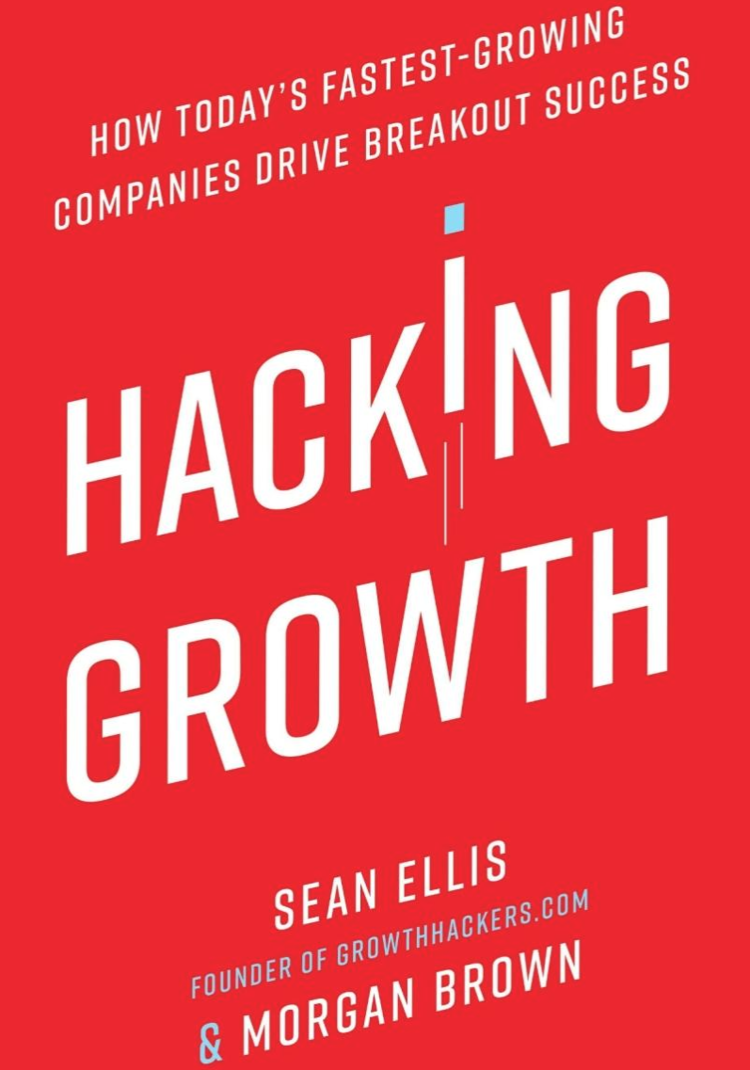
Hacking Growth by Sean Ellis and Morgan Brown book cover
Book summary & key learnings

Hacking Growth

Sean Ellis and Morgan Brown · 15 min read

How today's fastest-growing companies drive breakout success through systematic, data-informed experimentation.

The core idea

This is probably my all-time favourite book on growth. I have read it multiple times, and I keep coming back to it whenever I am working through a growth problem. What I love about the book is that it makes growth feel less like a collection of marketing tricks and more like a discipline and a way of thinking.

The biggest takeaway is simple: Don't search for a growth hack. Build a system that consistently discovers growth. Growth is not about finding one clever marketing tactic. It is about building a repeatable system for understanding customers, identifying growth opportunities, testing ideas quickly, learning from the results, and scaling what works. The core process is: Analyze → Ideate → Prioritize → Test → Learn → Repeat.

1

Growth Is Not a Hack

The word "hacking" can make growth sound like finding shortcuts. That is not what the book is really about.

Growth hacking is a systematic, data-informed and cross-functional approach to experimentation.

It is not one clever marketing tactic, a shortcut to growth, the responsibility of one marketer, or a collection of random experiments. It is a process for continuously finding and scaling growth opportunities.

The lesson: Sustainable growth comes from a system, not a single breakthrough.

2

Growth Is a Team Sport

Growth should not sit entirely with marketing. A strong growth team brings together different capabilities: Product, Engineering, Marketing, Design, and Data and analytics.

Each function sees a different part of the problem. Marketing may identify an acquisition opportunity. Product may identify an activation problem. Engineering makes the experiment possible. Design improves the experience. Analytics tells the team whether it actually worked.

The lesson: Growth happens when different functions work together around the same growth objective.

3

Start With a Product People Actually Want

One of the most important ideas in the book is that you should not aggressively scale a product that people don't value. Before investing heavily in acquisition, understand whether customers actually care about the product.

The book discusses the Must-Have Survey, which asks customers: "How would you feel if you could no longer use this product?"

The book uses the percentage of users who would be "very disappointed" as an important indicator, with 40% used as a benchmark. The number itself is not the point. The real question is: Do enough people genuinely care about this product?

The lesson: Don't use growth tactics to compensate for a product that people don't find valuable.

4

Find the Aha Moment

The Aha Moment is the point where a customer experiences the core value of the product. The growth team tries to identify the behavior that separates users who become engaged and retained from those who don't.

Ask: What do our best users do that other users don't? This analysis can reveal the action or sequence of actions associated with long-term product value.

The lesson: Growth isn't simply about getting more people into the product. It is about getting more people to experience why the product matters.

5

Engineer the Aha Moment

Finding the Aha Moment is only the beginning. The next question is: How can we help more users reach it?

This can mean improving onboarding, activation, product experience, feature discovery, messaging, and user flows. The goal is to reduce the distance between signing up and experiencing meaningful value.

The lesson: Don't leave product value to chance. Design the experience so users can discover it quickly.

6

Build a Growth Equation

"Growth" is too broad to optimize directly. The book encourages teams to break growth down into the variables that actually create it.

For example: Acquisition × Activation × Retention × Revenue × Referral.

The exact equation depends on the business. The important thing is to understand the relationship between the different variables. Once the equation is clear, the team can ask: Which variable represents the biggest opportunity?

The lesson: Turn a vague growth goal into measurable variables you can actually influence.

7

Find the Bottleneck

Not every part of the funnel deserves equal attention. Maybe acquisition is working well but activation is weak. Maybe activation is strong but users don't stay. Maybe retention is healthy but monetization is poor.

The growth team's job is to identify where the biggest constraint or opportunity exists.

The lesson: Don't try to improve everything at once. Find the part of the system where improvement can have the greatest effect.

8

The Growth Hacking Cycle

This is the central framework of the book. The cycle is: Analyze → Ideate → Prioritize → Test.

Analyze: Understand what is happening. Look at customer behavior, product data, conversion, retention, cohorts, surveys, and customer interviews. Ask who your best customers are, what they do differently, where users drop off, and what behaviors correlate with retention.

Ideate: Generate potential solutions. The book emphasizes building a continuous pipeline of ideas. An idea should ideally have the idea, the hypothesis, why you think it could work, and the metric it should influence.

Prioritize: You cannot test everything. Resources are limited, so ideas need to be ranked. This is where the ICE Framework comes in.

Test: Turn the highest-priority ideas into experiments. Run them, measure them, learn from them, then feed those learnings back into the next cycle.

The lesson: When something can be tested quickly, testing is often more useful than debating endlessly.

9

Other Prioritization Frameworks

The book also discusses alternatives to ICE.

Value vs. Complexity compares potential value against implementation complexity. High-value, lower-complexity opportunities become attractive candidates.

The Kano Model evaluates ideas based on customer value or delight against cost of implementation.

Buy-a-Feature gives people a limited amount of fictional money and asks them to spend it on the features or ideas they consider most valuable. The ideas that attract the strongest investment become candidates for further consideration.

The lesson: Prioritization doesn't have to be based purely on internal opinion. Structured methods can reveal what the team or customers value most.

10

Experiment Instead of Debate

Traditional organizations can spend weeks discussing whether an idea will work. Growth teams ask: Can we test it?

Instead of debating whether a new onboarding flow will improve activation, run an experiment. Instead of arguing about whether a particular message will improve conversion, test it.

The customer and the data become part of the decision-making process.

The lesson: Replace unnecessary debate with evidence whenever the question can be tested.

11

Test at High Tempo

Speed matters because every experiment creates information. Some experiments will work. Many won't. Some will produce small improvements. A few may create significant gains.

But each experiment can improve the team's understanding of the customer. Over time: More experiments → More learning → Better ideas → Better experiments.

This creates a compounding advantage.

The lesson: The ability to learn quickly can become a competitive advantage.

12

Most Experiments Will Not Be Huge Wins

A growth team should not expect every experiment to produce dramatic results. Many ideas will fail. Some will create small improvements. A few will become significant growth levers. That is normal.

The objective isn't to make every experiment successful. The objective is to increase the probability of finding meaningful wins by running a large number of thoughtful experiments.

The lesson: Don't wait for the one big breakthrough. Build a system capable of producing many smaller wins.

13

Use Data to Find Opportunities

Data should not only be used to report what happened. It should be used to discover where to investigate next.

Look for unexpected user behavior, drop-off points, differences between customer groups, retention patterns, high-performing features, and low-performing experiences.

For example, if highly retained users consistently perform a particular action, that behavior may reveal something important about product value.

The lesson: Good data analysis doesn't just answer questions. It creates better questions.

14

Data Tells You What, Customers Tell You Why

Analytics can tell you what happened. It does not always tell you why it happened. That is where qualitative research becomes important.

Talk to customers. Survey users. Interview people who churned. Understand their motivations, expectations and frustrations.

The strongest growth insights often come from combining quantitative data and qualitative understanding.

The lesson: Numbers can show you where the problem is. Customers can help you understand why it exists.

15

Retention Is a Core Growth Lever

Acquisition gets people into the product. Retention determines whether they stay. If users leave quickly, increasing acquisition simply means replacing users who have already disappeared.

The growth team therefore needs to understand: Who stays? Who leaves? When do they leave? What do retained users do differently? What experiences make people come back?

The lesson: Sustainable growth requires creating enough value for customers to keep coming back.

16

Use Cohort Analysis

Looking only at total user numbers can hide what is really happening. Cohort analysis allows the team to compare groups of users based on when they joined or what they did.

For example: Users who joined in January versus users who joined in February. You can then observe how their behavior and retention change over time.

You can also compare users who performed a particular action versus users who didn't. This can reveal behaviors associated with retention.

The lesson: Don't just ask how many users you have. Understand how different groups behave over time.

17

Build Engagement and Habits

Retention isn't only about fixing leaks. Products can become part of a user's regular behavior.

The book discusses engagement loops involving: Trigger → Action → Reward → Investment. Repeated interaction can strengthen the relationship between the customer and the product.

The team can explore triggers that bring the user back, the action the user takes, the reward or value the user receives, and the investment the user puts into the product that makes future use more valuable.

The lesson: Strong retention comes when the product becomes useful enough to become part of the customer's behavior.

18

Growth Is More Than Acquisition

A common misconception is: Growth = More users. The book takes a broader view.

Growth can come from improving acquisition (getting more people to discover the product), activation (getting new users to experience value), retention (getting users to stay), revenue (creating more economic value from users), and referral (getting existing users to bring in others).

The growth team can work across the entire customer journey.

The lesson: Don't automatically assume acquisition is the biggest growth opportunity.

19

Scale What Works

Running an experiment isn't the finish line. When something works, ask: Why did it work? Then: Can we make the impact bigger?

A successful experiment can become a new growth lever. The team can continue experimenting around that insight and find additional improvements.

The lesson: A winning experiment should create the next set of questions, not end the growth process.

20

Growth Is a Continuous Learning System

There is no permanent point where a company can say: "We've figured out growth." Customers change. Markets change. Products change. Competitors change. New opportunities appear.

So the process continues: Analyze → Ideate → Prioritize → Test → Learn → Scale → Repeat.

The real advantage comes from making this cycle part of how the company operates.

The lesson: Growth is not a project with an end date. It is an organizational capability.

The Core Frameworks

The frameworks that form the backbone of the book:

  1. 1The Growth Hacking Cycle: Analyze → Ideate → Prioritize → Test
  2. 2ICE Framework: Impact + Confidence + Ease
  3. 3Growth Equation: Acquisition × Activation × Retention × Revenue × Referral
  4. 4Aha Moment: Identify the behavior that represents a customer's meaningful experience of product value
  5. 5Must-Have Survey: Ask customers how they would feel if they could no longer use the product
  6. 6Cohort Analysis: Group users based on when they joined or what they did
  7. 7Engagement Loop: Trigger → Action → Reward → Investment
  8. 8Alternative Prioritization: Value vs. Complexity, Kano Model, Buy-a-Feature

How Everything Fits Together

The real strength of the book is that these frameworks form one connected system:

  1. 1Validate Product Value: Do customers actually care about the product?
  2. 2Find the Aha Moment: What behavior indicates that users have experienced the core value?
  3. 3Build the Growth Equation: What variables actually drive growth?
  4. 4Find the Biggest Opportunity: Where is the biggest constraint or opportunity?
  5. 5Analyze: What does the data and customer research tell us?
  6. 6Ideate: What could we change?
  7. 7Prioritize: Which ideas deserve to be tested first? Use ICE or another method.
  8. 8Test: Run the experiment.
  9. 9Learn: What happened? Why?
  10. 10Scale: If it works, how can we make the impact bigger?
  11. 11Repeat: Find the next opportunity.

The 12 Lessons I Keep Coming Back To

The ideas worth returning to again and again:

  1. 1Don't confuse growth with marketing. Growth also happens through product, engineering, design, analytics, retention, engagement, revenue and referral.
  2. 2Don't scale before understanding product value. More acquisition cannot fix a product that customers don't value.
  3. 3Find what your best customers do differently. Your strongest customers can reveal the behaviors that drive activation and retention.
  4. 4Turn growth into a measurable system. Don't say 'We need more growth.' Ask 'Which variable in our growth equation is limiting us?'
  5. 5Don't fall in love with ideas. An idea is only a hypothesis until customers and data validate it.
  6. 6Build an idea pipeline. You shouldn't have to come up with a new experiment from scratch every time.
  7. 7Prioritize ruthlessly. There will always be more ideas than resources. Use frameworks such as ICE to focus attention.
  8. 8Test instead of debating. When something can be tested quickly, let the experiment answer the question.
  9. 9Increase the speed of learning. The advantage isn't simply executing faster. It is learning faster.
  10. 10Failed experiments are useful. A failed experiment can eliminate a bad assumption and make future experiments better.
  11. 11Retention is proof of value. Acquisition can create a spike. Retention tells you whether customers found enough value to stay.
  12. 12Keep pushing after a win. A successful experiment isn't the end. Ask why it worked, can we make it bigger, and where else can this insight apply.
21

What This Book Changed For Me

The biggest shift is in how you think about growth. Traditional thinking often looks like: Set a plan → Execute → Measure → Report. The growth approach is: Find a problem → Form a hypothesis → Test → Learn → Improve → Test again.

One is primarily an execution model. The other is a learning model. That distinction is what makes the book so powerful.

Growth becomes less about having the right answer upfront and more about building a process that helps you discover the right answer faster.

The Simple Version

If you remember only one framework from the book:

  1. 1Understand the customer
  2. 2Find the behavior that creates value
  3. 3Identify the biggest growth opportunity
  4. 4Generate ideas
  5. 5Prioritize
  6. 6Experiment
  7. 7Learn
  8. 8Scale what works
  9. 9Repeat

The One Idea to Take Away

  • Don't search for a growth hack. Build a growth machine.
  • A growth machine is a team and process that continuously understands customers, finds opportunities, generates ideas, prioritizes experiments, tests quickly, learns, scales winners, and repeats.
  • The real advantage isn't having the smartest growth idea. It is building a system that consistently produces, tests, learns from, and improves ideas faster than everyone else.