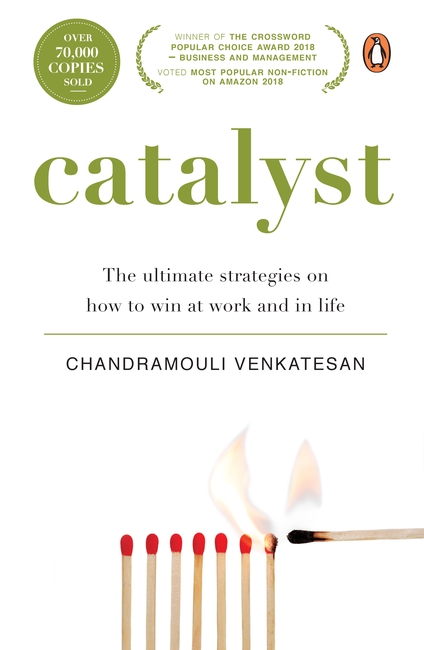
The core idea
Catalyst asks a simple question: Why do some people grow much faster in their careers than others, even when they have similar intelligence, education, hard work and opportunities?
Chandramouli Venkatesan argues that intelligence, education and effort matter, but they are not enough. What makes the difference are the catalysts that accelerate individual growth.
His central idea is that career growth equals real individual growth plus environmental factors. Over a long career, environmental factors tend to balance out. What you can control is your real individual growth: your knowledge, skills, judgment, influence, communication and ability to deliver results.
1
Career Growth Starts With Individual Growth
People often focus on getting promoted, getting a better job, getting a bigger title or getting a higher salary.
The book asks you to reverse that thinking. Instead of focusing primarily on getting, focus on deserving more.
Build knowledge, skills, judgment, decision-making ability, influence, communication and leadership. Career growth follows real individual growth.
The lesson: Don't spend all your energy chasing the next opportunity. Spend it becoming the person who is ready for the next opportunity.
2
Time at Work Is Not the Same as Experience
Someone can spend ten years working and still have only a few years of real experience repeated several times.
Simply spending time on something doesn't automatically turn that time into experience. Time leads to activity, but activity does not automatically become experience.
Something needs to happen in between. That catalyst is TMRR.
3. The TMRR Framework
The book's most important framework for turning activity into experience:
- 1Target: Before doing something, know what you're trying to achieve.
- 2Measure: Track what actually happened.
- 3Review: Compare the result with what you intended to achieve.
- 4Reflect: Ask what you could have done better and what you would do differently next time.
That final reflection step is what turns an activity into learning. Don't just complete projects. Extract experience from them.
4
Reflection Is What Converts Time Into Experience
You can spend three months working on a project. If you finish it and immediately move to the next thing, you may gain very little transferable learning.
Ask what worked, what didn't, what you could have anticipated, what you would do differently next time, and what this taught you that you didn't know before.
That reflection becomes part of your personal experience algorithm. The project ends when the work is done. The learning cycle ends when you understand what the experience taught you.
5
Maximize Learning Cycles
A learning cycle is a significant project, initiative or transformation that gives you an opportunity to learn by being involved in the process from beginning to end.
A complete learning cycle can involve identifying the opportunity, building the proposal, developing the product, testing, launching, stabilizing and correcting problems. That complete journey teaches much more than participating in one small part of the process.
The lesson: Look for opportunities where you can experience the full cycle, not just one small piece of it.
6
Major Learning Cycles Matter Most
You will experience many projects during a career, but not all of them are equally important. Only a handful become major learning cycles.
These are the projects or experiences that fundamentally change your capabilities and build your experience algorithm. They might involve a major transformation, a turnaround, a new business, a difficult leadership assignment, a cross-functional move or a completely new area of responsibility.
The lesson: Don't judge an opportunity only by title or salary. Ask whether it could become a major learning cycle.
7
Don't Leave Major Learning Cycles Incomplete
People often leave because another opportunity appears. But leaving halfway through a major transformation or project can mean losing the most valuable part of the experience.
Long stints can become increasingly valuable because your experience can move from a relatively linear curve to a more powerful one as you stay long enough to learn the deeper layers of the business.
The lesson: Don't leave a meaningful learning cycle just because something shinier appears.
8
Depth Over Width
Early in your career, there can be a temptation to collect experiences across different companies, roles, industries and titles.
But the book argues for depth over width during the foundation-building phase. Depth allows you to understand something deeply enough to develop real capability. It also helps you learn how to solve increasingly difficult problems.
The lesson: Don't confuse variety with experience. Deep exposure to important problems can build stronger capabilities than constantly changing roles.
9
Get Out There Early
The book encourages people earlier in their careers to get close to the actual business. That means experiencing the operational side of work and understanding the nuts and bolts of how a business really functions.
Don't spend your entire early career looking at business from a distance. Get involved, see customers, understand operations, experience the front line and learn how things actually work.
The lesson: Practical exposure builds a foundation that becomes increasingly valuable as you move into senior roles.
10
Your First Half Builds Your Second Half
The author divides a career broadly into two phases. The first half is primarily about building the foundation. The second half is about using that foundation to create significant impact.
Many people optimize the first half for immediate rewards: promotion, salary, title and status, instead of building the capabilities they will need later.
The lesson: Don't optimize your early career only for immediate advancement. Build capabilities that will matter later.
11
The Second Half Is a Different Game
As you move higher, the organizational pyramid becomes narrower, there are fewer positions, you receive less supervision, and you are expected to solve more complex problems independently.
The skills that got you promoted earlier may not be enough anymore. That is why many people do well early in their careers but struggle later.
The lesson: The skills that make you successful in the first half of your career may not be the skills that make you successful in the second half.
12
Productivity Becomes More Important as You Rise
As responsibility increases, the amount of work and complexity you deal with increases. But you still have the same 24 hours.
Simply working harder stops being a solution. The book focuses on personal productivity as a catalyst for career growth.
The goal is to make better use of your time and energy as your responsibilities increase.
13. Circle of Influence vs. Circle of Concern
The book uses the distinction between two circles:
- 1Circle of Influence: things you can affect - your work, decisions, behavior, relationships and priorities.
- 2Circle of Concern: things you care about but cannot directly control - politics, other people's decisions, market conditions and organizational events outside your influence.
Time spent in the Circle of Concern is not only unproductive. It also drains your energy and can create negativity that affects the work you actually can influence. Put your energy where you can create an outcome.
14
The Rocks First Method
Think of your time as limited space. The important things are the rocks. Everything else is sand.
If you fill your time with sand first, there may be no room left for the things that matter. Identify the most important priorities and protect time for them.
The lesson: Important work should get priority, not leftover time.
15
Good Bosses Are Career Catalysts
A good boss can accelerate your development by giving you challenging assignments, teaching you, giving you responsibility, providing feedback, creating learning opportunities and helping you build your foundation.
A poor boss can have the opposite effect. The book suggests three ways to improve your chances of having good bosses: be a good subordinate, work in organizations that tend to have good bosses, and stay with good bosses when you find them.
The lesson: Don't underestimate the impact a good manager can have on the trajectory of your career.
16
Find the Right Mentor
A good mentor should be senior to you, someone who knows you well, and outside your direct reporting line.
A senior mentor can see your career from a different point on the road. They have already experienced parts of the journey you haven't, which gives them a perspective you cannot get from someone at exactly the same stage as you.
The lesson: Don't look for a mentor simply because they are successful. Look for someone who understands you and can see further along the career path than you can.
17
Don't Confuse Quitting With Joining
People often make one decision: 'I'm leaving.' Then they use the next job opportunity to justify that decision.
The book argues that quitting and joining should be treated as two separate decisions. First ask why you are leaving. Then independently ask why you should join this company.
The lesson: Don't let the desire to leave make you fall in love with the first alternative that appears.
18. The Four-Quadrant Career Decision Framework
When considering a move, evaluate four things:
- 1Current Company - Good: What is good here?
- 2Current Company - Bad: What is bad here?
- 3New Company - Good: What could be good there?
- 4New Company - Bad: What could be bad there?
The common mistake is looking only at what's bad in your current company and what's good in the new one. That creates a biased comparison. Look at all four quadrants before deciding.
19
Quit for Learning and Fit
The decision to quit should primarily come down to two things: learning and fit.
Learning means your experience algorithm is still growing and you are still getting meaningful challenges. Fit means the organization's values and culture work for you and you can perform well in that environment.
Other factors such as pay, designation and temporary frustration should have lower weight in the decision.
The lesson: Don't quit simply because you're having a bad month. Look at whether learning and fit have fundamentally deteriorated.
20
Evaluate the New Job Through Learning and Fit
When considering a new company, don't start with 'How much more will I earn?' Ask whether you will learn more, get major learning cycles, have good bosses, find a culture that fits you, and accelerate your real individual growth.
The book puts these factors ahead of compensation and designation when evaluating the quality of a career move.
The lesson: A job change should improve your long-term experience algorithm, not just your short-term package.
21
Life Impacts Work
The book challenges the common assumption that work primarily determines your life. Chandramouli argues that life also has a major impact on work.
Your life shapes your personality, values, integrity, behavior, relationships and attitude. These qualities inevitably show up at work.
The lesson: Professional success cannot be completely separated from the person you become outside work.
22. Achievement, Mastery and Purpose
The book presents a model for understanding motivation at work:
- 1Achievement: wanting to win, progress and achieve visible results.
- 2Mastery: wanting to become genuinely good at something.
- 3Purpose: wanting your work to create meaning beyond personal achievement.
The challenge is that achievement can become a hungry beast. You achieve one thing and immediately need another. Mastery and purpose become increasingly important as you progress. Achievement can get you moving, but mastery and purpose can give your career greater depth.
23
Build a Passionate Striving Hobby
A hobby shouldn't necessarily be something you do only to relax. Chandramouli advocates having a passionate striving hobby: something that involves effort, practice, persistence, improvement and a genuine interest in becoming better.
Examples include running, cycling, golf, mountaineering, gardening with goals or social causes. The point is not the hobby itself. The point is having another area of life where you can experience achievement and mastery without making your career responsible for satisfying every need for achievement.
The lesson: Don't make your career carry the entire burden of achievement.
24. Values Are a Career Catalyst
The central leadership equation is:
- 1Leadership = (Position + Content) x Values
- 2Position gives you authority.
- 3Content represents the quality of your ideas, decisions and what you bring to the table.
- 4Values multiply the impact.
Leadership is ultimately about followership and influence. Values have a major effect on whether people trust and follow you. Position can give you authority. Values determine how much influence you can actually create.
25. The Twin Hs
The author highlights two personal values as important lodestar values:
- 1Pristine Honesty: Doing what you believe is right even when others are doing the wrong thing. The standard comes from your own moral compass rather than the behavior of the majority.
- 2Humility: Stay grounded through success and failure, recognize your limitations, recognize the contribution of others, and continue improving.
The lesson: Values aren't just something you claim. They need to show up in your decisions, especially when nobody is forcing you to behave well.
26
Values Need Practice Too
Values don't automatically improve simply because you get older. Just as you practice a technical skill, you need to consciously practice values.
The book describes a progression: Sensitivity → Practice → Habits. First, become aware of where you stand. Then deliberately practice the behavior. Eventually, it becomes part of who you are.
The lesson: Character development requires deliberate effort too.
The Core Frameworks From Catalyst
Eight frameworks carry most of the book's practical weight:
- 1Career Growth Equation: Career Growth = Real Individual Growth + Environmental Factors. Over a long career, environmental factors tend to balance out, so focus on what you can control.
- 2TMRR: Target → Measure → Review → Reflect. The framework for turning time and activity into real experience.
- 3Learning Cycle: Opportunity → Execution → Completion → Reflection → Experience. The bigger and more complete the learning cycle, the greater the potential for individual growth.
- 4Circle of Influence: Focus your time and energy on things you can affect, not things you care about but cannot control.
- 5Rocks First: Important priorities are rocks. Everything else is sand. Put the rocks in first.
- 6First Half vs. Second Half: The first half builds the foundation. The second half uses that foundation to create greater impact.
- 7Four-Quadrant Career Decision Framework: Evaluate the good and bad of both your current and new company before deciding.
- 8Leadership Equation: Leadership = (Position + Content) x Values. Values multiply the impact of position and content.
The Most Important Lessons
Twenty ideas worth returning to:
- 1Stop focusing only on getting. Focus on becoming someone who deserves more.
- 2Time doesn't automatically become experience. You have to extract the learning.
- 3Use TMRR: Target, Measure, Review, Reflect.
- 4Reflect after important work. Ask what you could have done better and what you would do differently next time.
- 5Seek major learning cycles. The biggest projects can become the biggest catalysts for your career.
- 6Complete important learning cycles. Don't leave a transformational experience halfway through.
- 7Choose depth over width early in your career. Deep capability becomes more valuable over time.
- 8Build your first half for your second half. Don't optimize your entire career for immediate promotions.
- 9Focus on your Circle of Influence. Don't waste your best energy on things you cannot control.
- 10Put the rocks first. Protect time for the work that actually matters.
- 11Find good bosses. A great manager can accelerate years of development.
- 12Find a real mentor. Choose someone senior, who knows you well and has no direct authority over you.
- 13Separate quitting from joining. Decide why you want to leave before evaluating where you want to go.
- 14Evaluate career moves through learning and fit. Pay and designation matter, but they shouldn't be the primary criteria.
- 15Don't let achievement become the entire point. Move from achievement toward mastery and purpose.
- 16Have a passionate striving hobby. Build another source of achievement and mastery outside your career.
- 17Life shapes your professional success. Your character, values and behavior don't stay outside the office.
- 18Values multiply leadership. Position gives you authority. Values determine how much trust, followership and influence you create.
- 19Practice your values. Honesty and humility become strengths when they are deliberately practiced.
- 20Build a career that compounds. The goal is to build an experience algorithm that becomes more powerful with every major learning cycle.
The Career Philosophy of Catalyst
The book's ideas connect into a clear career model:
- 1Build yourself
- 2Convert time into experience
- 3Use TMRR
- 4Seek major learning cycles
- 5Develop depth
- 6Build your first-half foundation
- 7Learn from good bosses and mentors
- 8Improve productivity
- 9Make thoughtful career decisions
- 10Develop mastery and purpose
- 11Build strong values
- 12Create greater leadership impact