

On this page
A founder in Hamburg asks ChatGPT how to cut churn in her small SaaS business. She gets a good, long answer. Right underneath it sits a small, clearly labelled card from a company she has never heard of. She clicks.
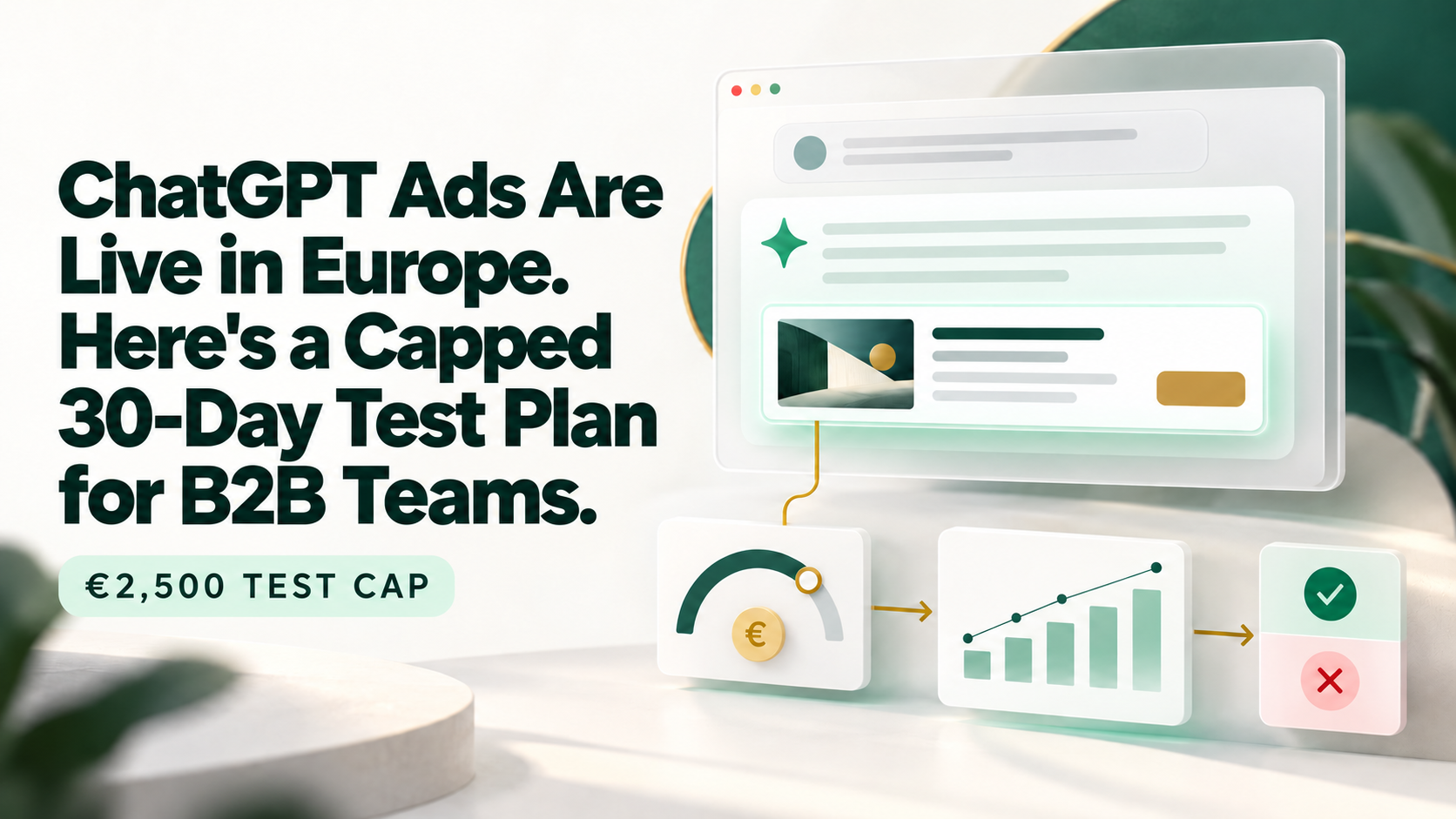
That click is what B2B marketers are now being asked to buy. On August 24, 2026, ChatGPT started showing ads across 31 European markets, and on August 31 self-service buying through Ads Manager opened up. The pitch is attractive: reach people while they are actively exploring and comparing. The evidence is another matter, because nobody has publicly proven it for B2B pipeline yet.
If you only read this box
- The ask: €2,500 over 30 days, hard cap, no top-ups without a written decision.
- The question: do buyers on free AI plans click, convert and get accepted by sales at a cost that pays back?
- The bar: with a €5,000 deal and a 15% close rate, you need only about 3 to 4 sales-accepted leads to break even.
- The safety net: stop rules are written before launch, so nobody argues about them mid-flight.
- The upside of a "no": you keep clean attribution, a tested landing page and a list of the questions your buyers really ask.
Reality check: three things that decide whether this works for you
1. Your buyer has to be on a plan that shows ads
Ads appear only to logged-in Free and Go users. People on Plus, Pro, Business, Enterprise and Edu see none, and some Free users opt out in exchange for lower message limits. If your buyers work at companies that pay for enterprise AI seats, your ad may never reach them. The best fits are founders, small business owners, freelancers, solo practitioners and individual researchers.
2. In Europe, you are buying context, not a person
At launch, ads in the European Economic Area are selected without personalization, using the current conversation, rough location and language. Personalized targeting needs separate opt-in consent. So your message must match the question being asked. Ads also don't run in sensitive conversations such as health or politics.
3. Early numbers are modest and mixed
One B2B agency spent about $2,300 and got 739 clicks (1.1% CTR, $3.14 CPC) with no qualified lead. Another got roughly 40,000 impressions in a month and no tracked website conversion. A B2B SaaS advertiser on Reddit reported about 1% CTR. Similarweb panel data suggests CTR topped 1% in four markets but not in the US. Some of the early spend reportedly came from test budgets driven partly by fear of missing out. Treat all of it as directional.
Should you test at all? A 60-second go/no-go
Rule of thumb, not a published benchmark: 5 to 6 ticks is a go, 3 to 4 means fix the gaps first, and 2 or fewer means wait.
The €2,500 plan, week by week
Build the measurement first
- Install the OpenAI Pixel and, if you can, the Conversions API before any money goes out.
- Use UTMs on every ad group. Advertisers on Reddit say their top complaint is measurement: clicks in the dashboard that analytics can't see, and traffic landing as Direct.
- Build one dedicated landing page that continues the answer the user was reading. Not your homepage.
- Add a required "How did you hear about us?" field with ChatGPT as an option.
- Write the success metric and stop rules down, and get sign-off from whoever owns the budget.
Question: which kind of conversation is worth buying?
- One campaign on CPC bidding with three ad groups at about €400 each. Same offer, same landing page, three context themes (templates below).
- Do not use conversion-optimized bidding yet. A test this small won't feed it enough conversions.
- Brand-first headlines got a slightly lower CPC in one agency test ($3.07 against $3.30). That is one small sample, so test it yourself.
Question: which offer turns a click into a lead?
- Take the winning theme and change one variable: the offer.
- Low friction: a checklist, benchmark, template or calculator.
- High friction: a demo or consultation request.
- Someone mid-conversation with an assistant is often researching, not buying. The soft offer may win on volume and the demo on quality. Let the data decide.
For the things that always happen
- Agency or managed fees, if any (some charge a few percent on top of media).
- Overspend. Daily budgets are reported to work as a seven-day average, so a single day can spend well above the daily figure.
- One round of creative fixes if a stop rule fires.
Verify the numbers in your own Ads Manager. Published minimums, CPMs and CPCs have changed several times this year, and sources disagree. One late-September guide lists a daily minimum of €15 for a euro-billed account, and the commonly reported CPC range of $3 to $5 is quoted in dollars. Treat every figure here as a planning assumption.
Copy-ready templates for the three themes
Fill in the brackets, then check the current character limits and ad policies in Ads Manager, including any rules on naming competitors.
Theme A: the problem question
- Headline
- [Fix pain point] [x days] earlier
- Description
- Free [asset] for [role] at [company type]. Takes [x] minutes.
- Landing page opener
- One paragraph answering the same question the user just asked, then the asset.
Theme B: the category question
- Headline
- How to compare [category] tools in 10 minutes
- Description
- A one-page scorecard built from [real buying criterion]. No signup wall for the summary.
- Landing page opener
- The scorecard first, your product's fit second.
Theme C: the switching question
- Headline
- Moving off [current approach]? Check these 5 things first
- Description
- A migration checklist from teams that have done it. Free for [role].
- Landing page opener
- The checklist, an honest "when not to switch" note, then your offer.
Naming convention for tracking
- utm_source / utm_medium
- chatgpt / paid-ai
- utm_campaign
- eu-test-oct26
- utm_content
- theme-a-offer-checklist (theme, then offer)
Budget caps and stop rules
This is the part that makes the plan easy to approve. Write it down before launch.
| Guardrail | Rule |
|---|---|
| Total cap | €2,500 across 30 days. No top-ups without a written decision. |
| Daily budget | Set it so that even a 2x day stays inside the weekly plan. |
| Weekly check | Every Monday: spend, clicks, CTR, CPC, form starts. Compare Ads Manager clicks with analytics sessions. |
| Weak creative | If CTR is below 0.5% after a couple of thousand impressions, rewrite the headline or context theme. Early reported ranges treat under 0.5% as low and around 1% as strong. |
| Weak landing page | With 100 or more clicks and almost no form starts, fix the page before blaming the channel. |
| Weak fit | If sales rejects most leads in the first two weeks, pause and revisit whether your buyers are on free plans. |
The maths that should calm your CFO
Take illustrative numbers: a €5,000 first-year deal and a 15% close rate on sales-accepted leads. One accepted lead is then worth about €750 in expected revenue. To earn back €2,500 you need roughly 3 to 4 accepted leads from the whole test. That is the bar, not hundreds of leads. If your own deal value is higher, the bar drops further.
Now try your own numbers. The defaults are placeholders chosen to be on the cautious side, so replace them with your landing-page rates, deal size and the CPC you see in your account.
Small tests are noisy: one or two wins can swing the picture either way. Use this to set expectations and the break-even bar, not to forecast.
The scorecard on day 30
You can't judge closed revenue in 30 days, so judge leading indicators and write the decision down.
- Interest: CTR and CPC by ad group. Reported averages range from about 0.7% to 1.3%.
- Engagement: engaged sessions and form starts on the landing page.
- Quality: cost per sales-accepted lead within seven days. This matters most.
- Attribution: self-reported "ChatGPT" answers and any lift in branded search.
My suggested decision rule: graduate to a larger second round if your cost per sales-accepted lead is within about 1.5 times your current paid-search number. A premium is reasonable because you are buying learning, and some reports say traffic from AI platforms converts better than other referrals. Higher than that, hold, change the audience fit and re-test. Zero accepted leads with a sound landing page means stop. Three to five accepted leads at a sensible cost is a reason for a second round, not proof of anything.
What you keep even if the test fails
- A map of real buyer questions. The context themes that got clicks are the questions your buyers ask AI assistants. Feed them into your content and your organic AI visibility work.
- Clean attribution. The tracking and the "how did you hear about us" field help every other channel.
- A tested landing page. You will know what an answer-first page does to conversion.
- A defensible answer. The next time your CEO asks "should we be on ChatGPT ads?", you have data instead of an opinion.
Mistakes that burn the budget
- Broad targeting. One home-services advertiser reported spending $5,000 over three weeks with poor lead quality.
- Judging on last-click only. Advertisers who are happy with the channel tend to look at blended results.
- Pasting in your Google ads. Write for someone who just read a helpful answer, with one clear next step.
- Testing out of fear of missing out. Go in with a question, not a feeling.
The one-paragraph pitch for your boss
Ask: €2,500 over 30 days with a hard cap, to test whether ChatGPT Ads can generate sales-accepted leads in Europe.
Why now: ads went live in 31 European markets on August 24 and self-serve opened on August 31, so early learning is cheap and our competitors are already looking.
Break-even: at [deal value] and [close rate], we need about [n] sales-accepted leads to earn back the spend.
Controls: written stop rules, weekly reviews, no top-ups without sign-off.
Outcome: a scale, hold or stop decision on day 30, and reusable tracking and buyer-question insights either way.
The bottom line
ChatGPT Ads are real, self-serve in Europe and cheap to test. Whether they work for B2B is still open, which is exactly why a capped experiment beats both hype and dismissal. If it works, you will have found a channel before your competitors worked out how to measure it. If it doesn't, you spent €2,500 and bought a clear answer.
PS: The free half of this strategy is making sure the answers above those ads actually mention you. Paid and organic visibility inside AI assistants will end up on the same dashboard, so start tracking both now.